
Livraison le jour même ou le lendemain

Qualité garantie

Débloquez vos offres de bienvenue: Livraison GRATUITE | Jusqu'à -80 % | 30 jours d'essai gratuits à JoyPlus
Téléchargez l'application
Whether you're a weekend DIYer, a mechanics enthusiast, or simply someone who wants to be prepared for small daily repairs, choosing a tool kit can quickly become a headache. Faced with an overwhelming number of options, it's easy to fall into the classic traps that turn a good investment into a source of frustration. To make sure you get it right, let's break down the mistakes you should never make.
The 3 pitfalls to avoid when buying a tool case:
To avoid buyer's remorse, here are the technical points that truly make a difference in the long run.
The cornerstone of a good mechanic's tool set? The quality of its material. Chrome-Vanadium (Cr-V) steel is an excellent foundation, offering a good balance between strength and resistance to fatigue. But the heat treatment is just as crucial: it's what gives the tool its final hardness. Also, prioritize finishes that protect against corrosion, like a polished chrome or a black phosphate coating. This is a real bonus, especially if you work in damp environments or on an automotive tool kit.
The ratchet wrench is often the centerpiece of a socket set. Its effectiveness is measured by the number of teeth in its mechanism.
For auto or motorcycle mechanics, where precision is king, a ratchet with at least 72 teeth isn't a luxury, it's a necessity.
A tool case, even one labeled "complete," must above all be suited to your needs. For use in North America and Europe, verify that the set includes both metric and SAE (imperial) systems, or the one most relevant to your work. A good set of combination wrenches (one open end, one box end) and a socket set covering the most common sizes (e.g., 8 to 19 mm) form the ideal foundation for most jobs, at home and in the garage. For more specialized applications, like torque-specific tightening on a carbon fiber bike or an engine cylinder head, adding a torque wrench becomes essential.
To help you see things more clearly, here is our selection of tool cases suited for every profile.
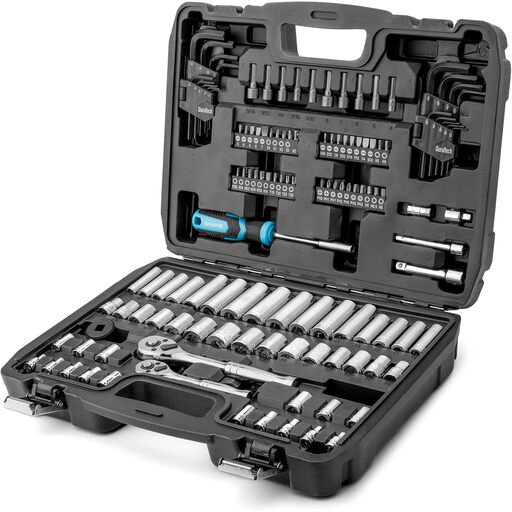
Why we chose it: Ideal for home repairs and basic vehicle maintenance. It offers a balanced selection of tools without being bogged down by superfluous parts, all in a compact form factor that's easy to store.
This set focuses on the essentials: metric and SAE sockets, hex keys, and a magnetic bit holder with 40 genuinely useful bits. It avoids the "filler" trap by offering only functional tools.
Tools made from heat-treated Cr-V steel for excellent durability. The sturdy case ensures organized storage and quick size identification.
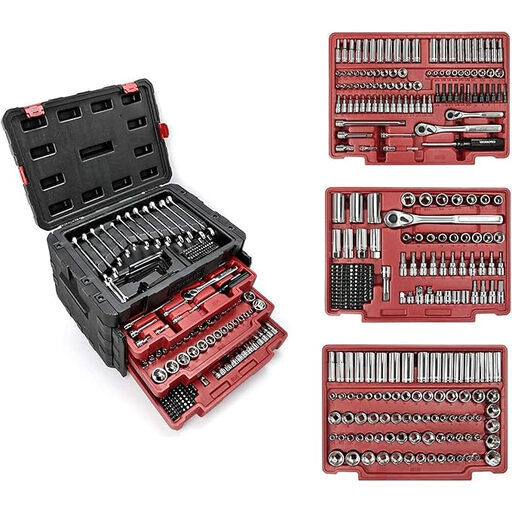
Why we chose it: For those who regularly tackle automotive repairs or restoration projects. This complete tool kit covers a very wide spectrum of needs with its three ratchet sizes (1/4", 3/8", 1/2").
Unlike entry-level XXL kits, the quality is definitely there. The tools feature a triple chrome finish for superior corrosion resistance, and the molded case is designed for heavy use in a workshop.
The comprehensive set of tools (sockets, combination wrenches, hex keys, bits). The four-tray case allows for crystal-clear organization and immediate access to every tool.
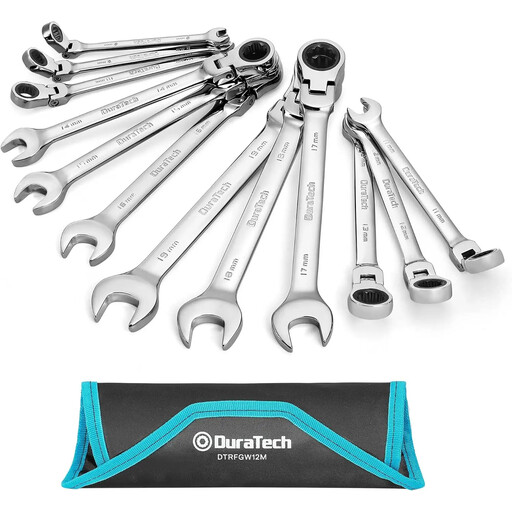
Why we chose it: The indispensable addition for any mechanic, amateur or pro, who faces inaccessible bolts. These wrenches are designed to get into places where a standard tool gives up.
This set doesn't claim to do it all. It solves one specific problem: access. It avoids the gadget trap by offering a feature (flex-head and precise ratchet) that provides real-world value.
180° flex-head and 72-tooth mechanism (5° swing arc). The Cr-V steel with a mirror-polish finish ensures both strength and excellent corrosion resistance.
For cycling enthusiasts, we have selected the best tool kits that meet demanding criteria for the maintenance and repair of all types of bicycles.
The lifespan depends less on the "Cr-V" label than on the quality of the heat treatment and your maintenance. A well-made and cared-for tool set (cleaned after use, stored in a dry place) can last you for years, even with regular use. Conversely, low-end tools can show signs of wear (rounded-off edges, corrosion) after just a few intensive uses.
For a beginner, such a large kit is often counterproductive. It's better to start with a well-chosen 100- to 150-piece kit that will cover 90% of common needs. This allows you to become familiar with the essential tools without being overwhelmed. Nothing stops you from expanding your collection later with more specific tools (like a torque wrench or Torx keys) as your projects require.
For general DIY around the house, no. However, it becomes crucial as soon as you start working on auto, motorcycle, or bicycle mechanics. It is the only tool that ensures you apply the correct tightening torque, an essential point for your safety and for preventing damage to delicate parts (aluminum, carbon). For an automotive tool kit or bike kit, it's a more than wise investment.