Shoppers avoiding added sugars
Look for an explicit claim on the sauce you choose, then compare the sugars and salt per 100 g. A sauce labelled ‘no added sugars’ can still contain naturally occurring sugars.


To choose a pasta sauce for a barbecue, first distinguish ‘no added sugars’ from ‘reduced sugar’, then compare the ‘sugars’ and salt values per 100 g: no added sugars does not mean there are no naturally occurring sugars. Next, choose a recipe to suit your menu and the number of guests, without trying to guess its sugar content from the brand, taste or Nutri-Score.
Look for an explicit claim on the sauce you choose, then compare the sugars and salt per 100 g. A sauce labelled ‘no added sugars’ can still contain naturally occurring sugars.
Choose the texture and seasonings to suit the pasta or sides you’re serving, then pick a pack size that works for the number of guests.
Check that the jar contains the amount you need and that the product is available at your chosen retailer. Don’t assume that every recipe from a brand carries the same sugar claim.
For a barbecue, start with the sugar claim that meets your needs, then compare the values per 100 g before choosing a recipe and pack size.
| Criteria | What to check | Who it’s for |
|---|---|---|
| Sugar claim | Read the exact claim, then compare ‘of which sugars’ and ‘salt’ per 100 g. Don’t confuse ‘no added sugars’ with ‘reduced sugar’. | If my main priority is avoiding added sugars, the claim on the jar matters, but I also want to know its total sugar content. This is the top priority for around 39% of shoppers concerned about sugar. |
| Recipe and texture | Choose between a simple tomato base and a recipe with vegetables or herbs to suit the dishes you’re serving; check the sugar claim separately. | For pasta at my barbecue, I first look for a texture and seasonings that work with the menu. Around 23% of shoppers put finding a recipe to suit their dishes first. |
| Ingredients and storage | Read the ingredients and allergen information for the specific product, along with its storage instructions after opening. | When several guests are sharing the meal, I want to check what’s in the sauce and plan how to use any leftovers. This is the priority for around 23% of shoppers. |
| Pack size and availability | Check the net weight, how much you need and whether the product is available at your chosen retailer. | I prefer to choose a pack size I can use for this meal and the next, without buying more sauce than I need. Pack size and availability come first for around 15% of shoppers. |
Naturally occurring sugars are still included in the nutrition information. Auchan’s Pomodoro Italians Do It Better sauce carries a ‘no added sugars’ claim and contains 2.9 g of sugars per 100 g.
Compare the ‘of which sugars’ values on the same per-100 g basis. For a ‘reduced sugar’ claim, check the stated reduction and what it is compared with, rather than assuming it follows from the absence of added sugars.
A sugar claim tells you nothing about the salt content. Auchan states that its Pomodoro Italians Do It Better sauce contains 0.98 g of salt per 100 g.
Compare both the ‘sugars’ and ‘salt’ values per 100 g for the sauces you’re actually considering.
The amount you need for a barbecue won’t always match the contents of the jar. Storage instructions after opening vary by recipe: Auchan’s product information says to refrigerate its Pomodoro Italians Do It Better sauce for four days and its Mutti Provençale sauce for five days.
Choose a pack size with your next meals in mind, and follow the instructions on the product you buy.
The range includes a Tomates Cuisinées sauce, available in several sizes, including 210 g, 400 g and 650 g.
Barilla describes its 400 g Tomates Cuisinées sauce as a sauce base or an accompaniment for pasta.
Auchan describes its Mutti Provençale sauce with IGP Provence thyme as having ‘no added sugars’.
Auchan’s 290 g Pomodoro tomato and basil sauce carries a ‘no added sugars’ claim.
These MUTTI tomato purées can be used as a base for a pasta sauce prepared for a barbecue. They are not ready-to-serve cooked sauces, and their name alone does not establish a sugar claim.
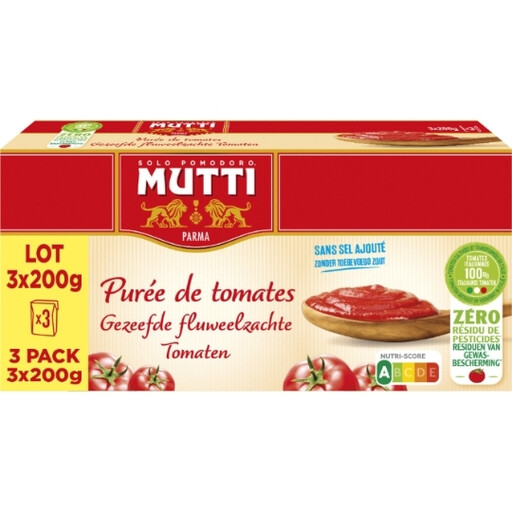 Image unavailable
For making a pasta sauce rather than serving a sauce that’s already cooked. The pack contains three 200 g containers; after opening, the instructions say to refrigerate the purée and use it within three days.
If a sugar claim is important to you, check the label on the exact product sold in France.
 Image unavailable
For making a pasta sauce from tomato purée, rather than serving a ready-made cooked sauce. This pack contains 500 g; after opening, the instructions say to refrigerate it and use it within five days.
Before choosing it to meet a requirement for no added sugars or reduced sugar, read the claim on the label of the exact product sold in France.
No. Naturally occurring sugars can still appear in the ‘sugars’ line of the nutrition information. To compare sauces, check this value per 100 g. For example, Auchan states that its Pomodoro Italians Do It Better sauce, which carries a ‘no added sugars’ claim, contains 2.9 g per 100 g.
First compare the sugars and salt per 100 g, then choose a recipe to suit the dishes you have planned. A tomato and basil base and a cooked vegetable sauce have different recipe profiles, so check the sugar claim on each jar rather than trying to infer it from the main ingredients.
Follow the instructions for the product you’ve bought. Auchan’s product information says to refrigerate its Pomodoro Italians Do It Better sauce for four days and its Mutti Provençale sauce for five days. These time limits do not apply to all tomato sauces.
Yes. Check the ingredients and allergens for the exact recipe, even if the name sounds simple. Carrefour’s product information for Heinz tomato, garlic and onion sauce mentions, among other things, a flavouring that contains milk.