
当日/次日达

品质保障

开启新人专享福利: 全场免邮 | 低至 2 折 | 免费试用 30 天 JoyPlus 会员
下载 Joybuy
Buying toilet paper seems simple. Yet the format, number of plies and pack size can all affect comfort, consumption and your budget. A very thick roll is not necessarily the most economical, while a large multipack can quickly become awkward to store in a small home. To avoid unpleasant surprises, it is better to rely on concrete information rather than the promises printed on the packaging.
A pack of 12 rolls does not necessarily contain twice as much paper as a pack of 6. The length, number of sheets per roll and basis weight can vary from one product to another. To compare two products properly, check:
For example, Lotus Extra Comfort XXL rolls advertise 50% more sheets than a standard Lotus Comfort roll, according to the product listing. Information like this is far more useful than simply describing a product as ‘large format’.
2-ply toilet paper is often chosen for its good balance of softness, strength and price. A 3-ply, 4-ply or 5-ply product may seem thicker and more comfortable, but each sheet does not necessarily have the same weight or surface area. Thickness should therefore suit your household’s habits, rather than automatically leading you to choose the product with the highest number of plies.
Compatibility with your plumbing and a septic tank depends on the paper used, the amount flushed and the installation. Even when a roll or its core is described as flushable, avoid flushing a large quantity at once. Extra-thick products require particular care in older homes or properties with narrow waste pipes.
The number of plies provides a useful starting point:
Strength does not depend solely on the number of plies. The material, basis weight, way the layers are bonded and perforation also play a part. Strong toilet paper should tear cleanly without becoming difficult to flush.
When choosing soft toilet paper, look at the texture, embossing and composition listed by the manufacturer. Fragrance-free products may suit people who prefer to limit scented ingredients. However, this feature is not a medical guarantee: if irritation or discomfort occurs, stop using the product and seek advice from a healthcare professional.
Some of the products featured below are made from virgin wood pulp or cellulose. If you are looking for biodegradable toilet paper, do not rely on this wording alone. Check the manufacturer’s information, recycling instructions and compatibility with your sewage or septic system.
A large-quantity toilet paper pack means you can shop less often, but it requires dry, well-ventilated storage space. Keep the rolls in their packaging until needed, away from moisture, heat and direct sunlight. For a large family, a pack of 24 or 27 rolls may be a practical choice. In a flat with limited storage, a pack of 6 or 12 rolls will be easier to store.
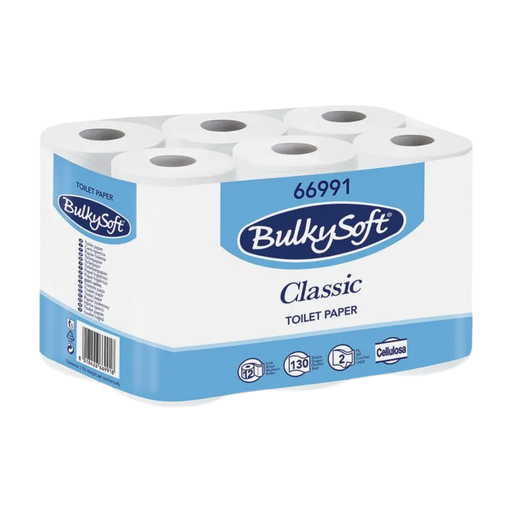
Why this product suits this profile : This pack of 12 rolls is suitable for everyday use and contains approximately 130 sheets per roll, with a composition of 100% cellulose.
The number of sheets and rolls is clearly stated, making it easier to compare this product with other formats.
2-ply construction, 12 rolls and approximately 14.3 m per roll according to the product listing.
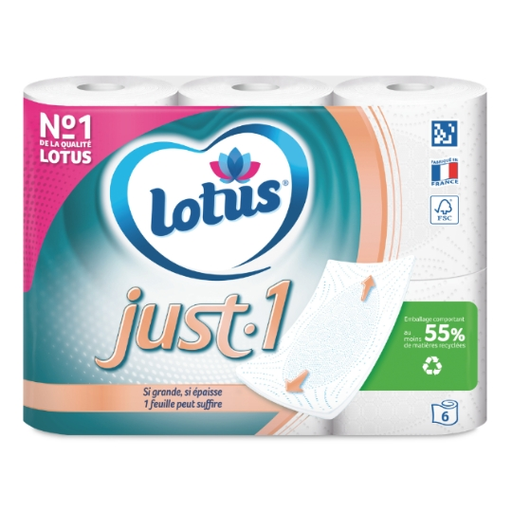
Why this product suits this profile : Its 5-ply construction is designed for people who prioritise a very thick sheet and a luxuriously soft feel, in a pack of 6 rolls.
The thickness is clearly stated, so you can compare it with 2-ply or 3-ply toilet paper without relying solely on marketing claims.
5-ply, virgin cellulose and an Aqua-Tube core described as flushable according to the product information.
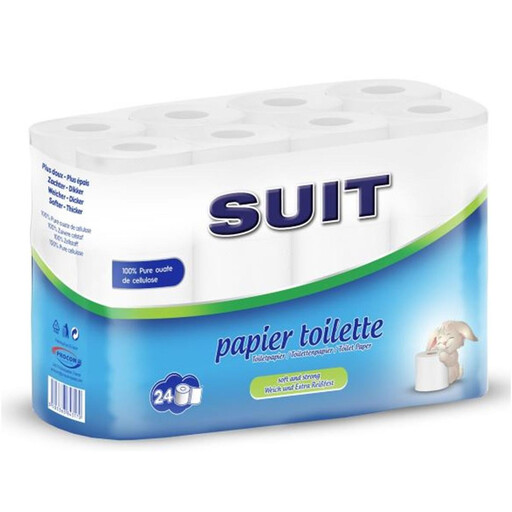
Why this product suits this profile : With 24 rolls of 150 sheets, this pack is suitable for families and places where you want to reduce the need for frequent restocking.
The stock is broken down by rolls and sheets, making it easier to estimate how long it will last.
Pack of 24 rolls, 2-ply, manufactured in France and described as compatible with septic tanks when used according to the stated conditions.
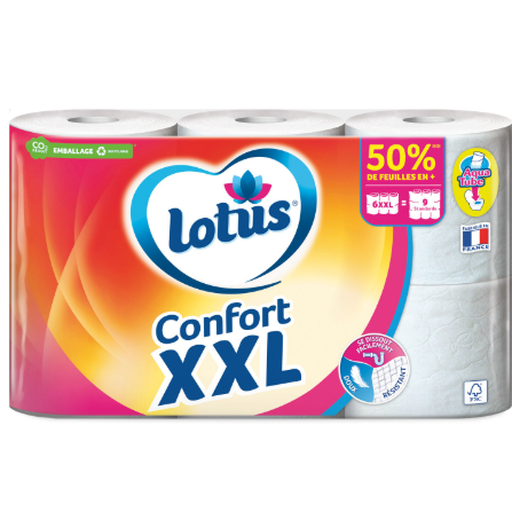
Why this product suits this profile : This product is described as being made in France. It combines 6 XXL rolls with a 2-ply construction, helping you shop less often without choosing an extra-thick sheet.
The XXL format includes a comparison of the number of sheets with a standard roll, making the claim easier to assess.
2-ply, virgin cellulose, XXL rolls and an Aqua-Tube core described as flushable or recyclable.
We have brought together a comprehensive, real-time updated selection of products that meet these strict criteria and European safety requirements.
To compare the price of family toilet paper, calculate the cost per roll where possible, followed by the cost per 100 sheets. This method helps you avoid choosing a large pack whose rolls ultimately contain very little paper. Bulk packs are mainly worthwhile if you have enough storage space and your household’s usage remains consistent.
Store your stock in a dry place, preferably outside the bathroom if it is very humid. A cupboard, pantry or enclosed shelf will be more suitable. In a professional setting, also remember to check the roll dimensions, dispenser capacity and restocking frequency.
Choose a product whose listing clearly states that it is compatible with septic tanks, then follow the usage instructions. Even paper described as flushable can cause a blockage if too much is flushed at once. If in doubt, consult the instructions for your system or the company responsible for maintaining it.
Not necessarily. It may reduce the number of sheets needed each time, but its weight and price per roll are often higher. Compare the price per 100 sheets, the total number of sheets and the amount actually used by the members of your household.
Dry toilet paper generally does not have a shelf life comparable to that of a food product. Nevertheless, it should be kept away from moisture, dust and heat. If the product has an expiry date or batch number, refer to the information shown directly on the packaging.