Parents keeping an eye on their budget
You buy rusks regularly and want a pack size your household can get through without leaving an opened packet unused for too long.


For a toddler’s breakfast, first check that your child can manage the dry, crunchy texture of a rusk. Sit them down and stay with them while they eat. If they’re comfortable with this texture, choose a pack size that suits how much your household will use, then compare the ingredients, allergens and nutritional information. A wholemeal recipe or one with no added sugar won’t necessarily meet all these criteria.
You buy rusks regularly and want a pack size your household can get through without leaving an opened packet unused for too long.
You compare recipes, particularly their sugar, salt and allergen content. If you have a known allergy, the Ministry of the Economy reminds shoppers that allergenic ingredients must be identified on the label.
You want to know whether your child can already chew and swallow dry, crunchy foods comfortably. Ameli describes how children progress through different textures, while Manger Bouger recommends that they eat sitting down, with an adult watching over them.
Start with the textures your child can manage, then check the pack size and the label on the exact product.
| Criteria | What to check | Who it matters to |
|---|---|---|
| Budget and pack size | Check the net weight and choose an amount your household can use and store properly. | If I buy rusks often, I want to avoid choosing a pack that’s too big for our needs. Around 42% of consumers put managing their budget at the top of their list. |
| Recipe and label | Read the ingredients and allergen information, then compare the sugar, salt and fibre per 100 g. | If an allergen or a particular feature matters, I need to look beyond the name on the pack to choose a recipe. The ingredients are the main priority for around 33% of consumers. |
| Texture at mealtimes | Take account of your child’s individual progress with solid foods; sit them down and keep an eye on them while they eat. | Before offering a dry, crunchy food, I want to know whether my child can chew and swallow it comfortably. Texture comes before other criteria for around 25% of consumers. |
Auchan’s wholemeal rusk, labelled as having no added sugar, contains 3.4 g of sugars per 100 g. The claim doesn’t mean there are no naturally occurring sugars.
Also check the ‘sugars’ line in the nutritional information and the ingredients list.
Auchan’s wholemeal rusk lists wheat, gluten and barley, as well as several possible traces. A simple product name isn’t enough to establish what’s in the pack you choose.
If you have a known allergy, check the ingredients and any traces listed on the exact pack.
According to Ameli, children move on to small pieces gradually. A dry, crunchy rusk won’t necessarily be suitable for every child of the same age.
Watch how your child manages textures they already know. At mealtimes, keep them seated and supervise them, as recommended by Manger Bouger.
Carrefour’s range includes plain rusks and other recipes, so you can compare pack sizes and labels within the same aisle.
The range includes 300 g wholemeal rusks with no added sugar and a 900 g wheat rusk.
Heudebert products listed in Auchan’s range include recipes with cereals and an option described as having no added salt.
ALDI offers a 300 g pack of rusks made with wheat germ.
This Heudebert product with no added salt is worth considering if you’re looking for breakfast rusks and your child can already manage this texture. It comes in a 300 g pack.
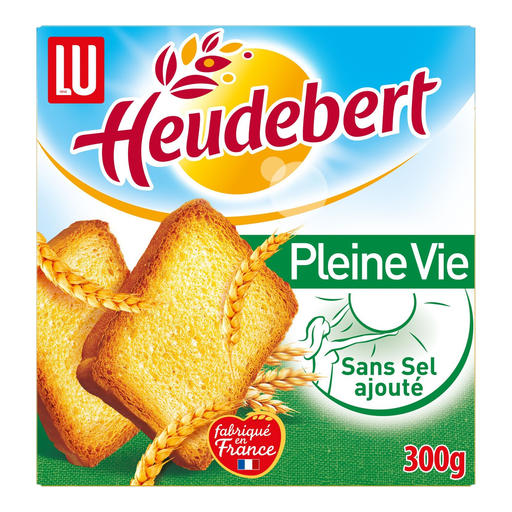 Image unavailable
A recipe to consider if you’re looking for breakfast rusks with no added salt. The product listing says it isn’t suitable for children under one; it lists gluten and possible traces of sesame. Check the pack if you have an allergy, and only offer this texture if your child can already manage it, while seated and supervised.
No, it can only be part of the meal. Manger Bouger reminds parents that milk continues to have a place in a child’s diet after their first birthday.
Go by how they’re progressing with different textures, not their age alone. Ameli describes how small pieces are introduced gradually, while Manger Bouger recommends that children sit properly and be watched by an adult while eating. If your child has difficulty swallowing, ask a healthcare professional for advice.
Check the net weight, ingredients and allergens, then compare the nutritional values per 100 g. France’s Directorate-General for Competition, Consumer Affairs and Fraud Control explains that displaying this information per 100 g makes it easier to compare pre-packed foods.
No. Auchan’s product listing for its wholemeal rusks with no added sugar gives a sugar content of 3.4 g per 100 g and states that they contain naturally occurring sugars. Check the ‘sugars’ line and the ingredients list on the exact product.