
Livraison le jour même ou le lendemain

Qualité garantie

Débloquez vos offres de bienvenue: Livraison GRATUITE | Jusqu'à -80 % | 30 jours d'essai gratuits à JoyPlus
Téléchargez l'application
Creating a play space for your little one that is fun, stimulating, and safe is the holy grail for every parent. A toddler climbing set is an ideal solution for developing their coordination, balance, and confidence right at home. But be careful: with an overwhelming number of options, it's easy to be tempted by the wrong product and turn a great investment into instant buyer's remorse.
Before you make your choice, here are the 3 most common pitfalls to avoid:
To sort through the options and invest in a toddler activity structure that will last as your child grows, let's scrutinize the technical features that truly make a difference.
The quality of a climbing set depends above all on what's inside: its foam. The number one thing to watch for? Its composition. Insist on climbing blocks made of high-density polyurethane foam. Unlike low-end foams, it offers two decisive advantages:
The blocks' outer layer is just as crucial as their foam core. A good cover must check three boxes:
The true genius of a great indoor activity set is its ability to evolve. A set of modular blocks isn't just a toy: it's a true Swiss Army knife for development. For a crawling baby, a ramp and a step will suffice. As they get older, they will assemble them to build tunnels, forts, or ever more daring obstacle courses. This versatility, reminiscent of a modular play couch, is a fantastic engine for creativity and imagination, all while adapting to the child's motor skill progression.
Now that you have all the information you need, here is a selection of products that check all the boxes: safety, durability, and practicality.
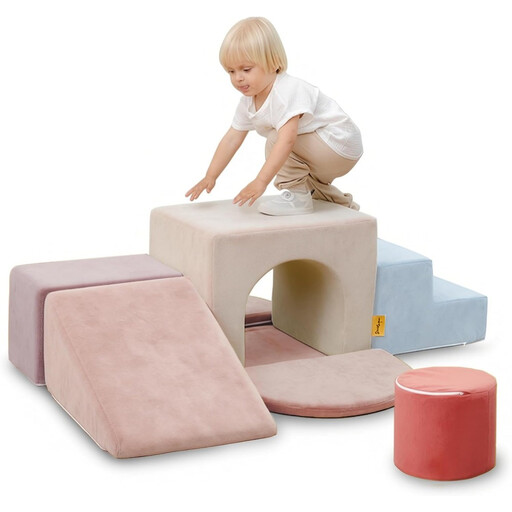
Why we love it: With seven pieces in various shapes, this set offers nearly endless play potential. It's the perfect choice for families who want an evolving play space that can keep up with a child's growth, from their first crawls to building sophisticated forts.
Its high-density polyurethane foam prevents any sagging. Its removable, machine-washable covers ensure perfect hygiene. Finally, its non-slip base and sturdy Velcro fasteners provide rock-solid stability.
Compliance with the European safety standard EN71. High modularity thanks to its 7 elements, perfect for stimulating long-term creativity.
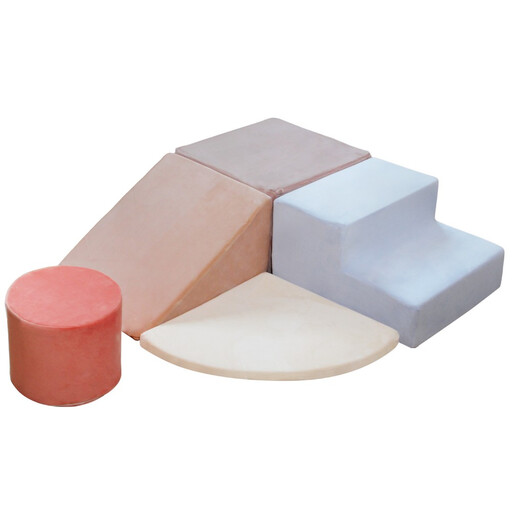
Why we love it: This 5-piece set is an excellent entry point into the world of motor skills. More compact, it's perfect for smaller spaces or as a first Montessori toy for a 1-year-old to introduce your baby to climbing and sliding in complete safety.
It features the same certified high-resilience foam and washable covers as larger models. Safety isn't sacrificed for a smaller footprint: it also has a non-slip base and connectors for optimal stability.
A compact and accessible format that makes no compromises on material quality or safety (EN71 compliant).
We have curated a complete list of products that meet our strict selection criteria and European safety standards.
A motor skills course can be introduced as soon as a baby starts to move around confidently, usually between 6 and 9 months. At first, they will explore by crawling. Around 1 year old, they will use it to pull themselves up and start climbing. Thanks to their modularity, these sets remain relevant and stimulating up to age 4 or 5, when children will repurpose them for more elaborate imaginative play.
It couldn't be simpler, provided you choose a model with removable covers. Just unzip each cover and put it in the washing machine, following the manufacturer's instructions (usually a cold wash or at 30°C / 86°F). For everyday minor spills, a quick wipe with a damp sponge will do the trick. Let the covers air-dry completely before putting them back on.
Although their worlds overlap, their primary purpose differs. A motor skills course is designed first and foremost for motor development: its shapes (ramps, stairs, waves) are made to encourage climbing, sliding, and crawling. A modular play couch, on the other hand, focuses more on comfort and symbolic play (building forts, reading nooks), although it also contributes to motor skills. The choice therefore depends on your priority: pure physical development or a more hybrid play and relaxation space.