If you’re serving lots of portions
For a table of sharing dishes, the number of rusks or slices stated on the pack is more useful for planning than the words ‘family size’ alone.


For a table of sharing dishes, choose according to what you plan to serve: rusks with a stated piece count if you need plenty of bases, sliced toast for making open sandwiches, or crackers designed for toppings to make small bites. Pack weight alone won’t tell you how many portions you’ll get. Check the ingredients and allergens too, then add moist toppings shortly before serving.
For a table of sharing dishes, the number of rusks or slices stated on the pack is more useful for planning than the words ‘family size’ alone.
If you’re planning to serve spreads, vegetables, fish or cold toppings, start by choosing the size and shape of the base to suit the bites you want to make.
Before serving guests with dietary restrictions, check the ingredients and allergens on the pack you’ve actually bought. Several products mentioned here contain wheat or list other possible allergens.
First decide whether you’re preparing lots of pieces to put on the table, open sandwiches or small topped bites. Then compare the piece count, ingredients and label of the product you choose.
Choose this if: you want slices to add toppings to and to compare ingredients or nutritional values per 100 g.
Bear in mind: a 500 g pack doesn’t guarantee a specific number of slices or individually wrapped portions.
Choose this if: the number of ready-to-serve pieces matters more than the size of the open sandwiches; Auchan states that the 500 g Heudebert La Braisor box contains 3 × 20 rusks.
Bear in mind: their shape and thickness may not suit every topping.
Choose this if: you’re making small bites; Auchan describes Heudebert plain crackers as a product to spread with toppings for an aperitif.
Bear in mind: this product weighs 250 g, compared with 500 g for the larger packs mentioned here.
| Criteria | What to check | Who is it for? |
|---|---|---|
| Number of portions | The stated number of slices or rusks, and the net weight. | When bites need to go round lots of guests, I want to count the pieces before deciding how much to buy; around 31% of consumers make the number of portions their top priority. |
| Base for toppings | The size of the base and when to add moist toppings. | When serving topped bites rather than plain slices, I look for a shape that suits what I’m going to put on it; around 25% of consumers prioritise this fit. |
| Recipe and nutritional values | The proportion of wholemeal flour, if stated, and the fibre, sugars, fat and salt per 100 g. | When comparing wholemeal recipes, I want to read the ingredients and nutritional information on the same basis; around 19% of consumers prioritise this comparison. |
| Ingredients and allergens | The ingredients list and allergens highlighted on the pack you buy. | If a guest needs to avoid an ingredient, I check the label before putting the product on the table; around 25% of consumers put this suitability ahead of other criteria. |
Even at the same weight, pack sizes differ: Auchan states that Heudebert La Braisor contains 3 × 20 rusks, while its 500 g wholemeal toast contains 2 × 12 slices; Carrefour states that its 500 g Pelletier wholemeal toast contains 24 slices.
Start with the number of pieces stated on each pack, then take into account the other bites you’re planning for your evening.
The products featured contain wheat; some also list other ingredients or possible traces, which vary by product.
Keep the packaging handy so you can check the label on the batch you’ve bought. If a guest has a dietary restriction, choose a product whose labelling meets their needs.
Moist sauces and toppings can take away the crunch you want when it’s time to serve.
Store the products in a dry place as directed on the pack, and add moist toppings shortly before bringing them to the table.
Auchan describes one wheat rusk product as a 500 g family-size pack.
The products mentioned include both large packs of rusks and crackers designed for toppings, and they aren’t interchangeable.
Carrefour describes its wholemeal wheat toast as a 500 g box containing 24 slices.
Carrefour lists a 500 g wholemeal wheat toast.
Its 500 g wholemeal wheat toast is listed as 2 × 12 slices.
These 250 g crackers and 300 g rusks can be used as bases for toppings at your evening get-together. To plan portions, check the number of pieces on the pack: their weight doesn’t match the 500 g packs mentioned above.
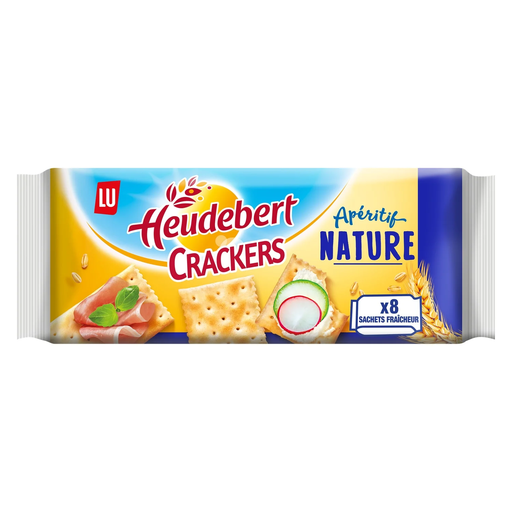 Image unavailable
Table crackers to consider for small topped bites. The product description states that they contain 98% wheat flour; it also mentions that they may contain egg and milk. Check the number of crackers and the pack label before working out portions for your guests.
 Image unavailable
Rusk slices to consider if you’re making open sandwiches to share. The product listing states that they contain 96% wheat flour and mentions soya lecithin. Check the number of slices and the ingredients on the packaging for the batch you’ve bought before serving.
The weight alone isn’t enough to tell. For example, Auchan states that the 500 g Heudebert La Braisor pack contains 3 × 20 rusks, while its wholemeal toast of the same weight contains 2 × 12 slices. Count the pieces according to the other bites you’ll be serving too.
For small bites, Auchan describes Heudebert plain crackers as suitable for spreading with toppings; for larger open sandwiches, opt for sliced toast instead. Add moist toppings shortly before serving if you want to keep everything crisp.
The products described here contain wheat, so don’t choose them as a gluten-free option. Always check the label on the pack you buy and look for a product whose information meets the needs of the guest concerned.
Read the label on the product you’ve bought: the DGCCRF states that allergenic ingredients must be highlighted. To compare the nutritional information for pre-packed products, check the values per 100 g, including fibre, sugars, fat and salt.