Students preparing several lunches
You want to split a tin or multipack between several meals. The drained weight and number of tins can help you choose an amount you’ll use up.


For an individual lunch at uni, choose a tin you can use up without having to store leftovers. If you’re preparing several meals, a larger size may suit you, as long as you follow the storage instructions after opening. Check the drained weight and ingredients for the specific product you’re considering: composition claims don’t apply to an entire brand.
You want to split a tin or multipack between several meals. The drained weight and number of tins can help you choose an amount you’ll use up.
You’re looking for an amount that’s easy to add to a salad or lunchbox, without leaving a large tin open after lunch.
You choose based on the ingredients or a specific claim, such as ‘no added salt’ or ‘organic’. Check these details on the product you’re buying rather than relying on the brand name alone.
Start with how many lunches you’re planning and whether you can store any leftovers. Then check the ingredients of the tin that suits your needs.
| What to consider | What to check | Who it’s for |
|---|---|---|
| Amount for several meals | Compare the drained weight and number of tins in the pack with the meals you’re planning. | If I’m splitting sweetcorn between several lunches, I want an amount I can use up; around 30% of consumers prioritise using it across several meals. |
| Individual portion | Check the amount in each tin and the storage instructions in case you don’t use it all. | Between lectures, I’d rather open a small tin for my salad than have to store leftovers; around 40% of consumers share this priority. |
| Ingredients | Read the ingredients and nutritional information, and check any specific claims on the product you’re considering. | When I’m looking for a recipe with no added salt or another specific claim, I want to be able to check it on the packaging; around 30% of consumers prioritise ingredients. |
A Bonduelle sweetcorn product labelled ‘no added sugar’ also lists naturally occurring sugars.
For the tin you’re considering, check the ingredients list and the ‘of which sugars’ line in the nutritional information.
One Auchan product advises transferring any leftover sweetcorn to an airtight container, refrigerating it and eating it within two days.
Choose an amount close to what you’ll use, or plan another meal within the time stated on the tin.
Any leftovers you can’t store and eat according to these instructions may go to waste.
Ingredients and claims vary between products. Auchan also notes that the composition of some products may vary depending on the store’s online shopping service and the date of purchase.
Check the ingredients and any claim you’re looking for on the packaging of the variety you’re buying.
The brand offers several varieties of tinned sweetcorn, including options with no added sugar and products labelled ‘no pesticide residue’.
This supermarket own brand includes sweetcorn with no added salt and no GMOs, sold in two tins, each with a drained weight of 140 g.
E.Leclerc offers, among other products, tender sweetcorn with a drained weight of 285 g and crunchy sweetcorn with no added sugar.
Auchan’s crunchy sweetcorn products carry different claims depending on the variety, including ‘no GMOs’ and ‘no pesticide residue’.
Aldi offers Fleur des Champs crunchy sweetcorn with no added sugar, as well as a Bon et Bio product.
This selection of sweetcorn includes small portions, larger tins and varieties with specific ingredient claims. Start by choosing an amount that suits your meals, then check the details of the tin you’ve picked.
 Image unavailable
The two 140 g tins mean you can open one for an individual lunch. This product is described as organic; check the drained weight and storage instructions on the packaging.
 Image unavailable
This 285 g tin could be used to make a salad. Its product name includes the ‘no pesticide residue’ claim. Check this on the packaging of the variety you buy, along with the drained weight.
 Image unavailable
Consider this 570 g tin if you’re planning to use sweetcorn in several meals. If you have leftovers after opening, the product description advises storing them in an airtight container in the fridge and eating them within two days. Check the drained weight too.
 Image unavailable
This 400 g tin of sweetcorn kernels is described as suitable for salads or side dishes. If you don’t use the whole tin, follow the instruction to eat the product within a day of opening.
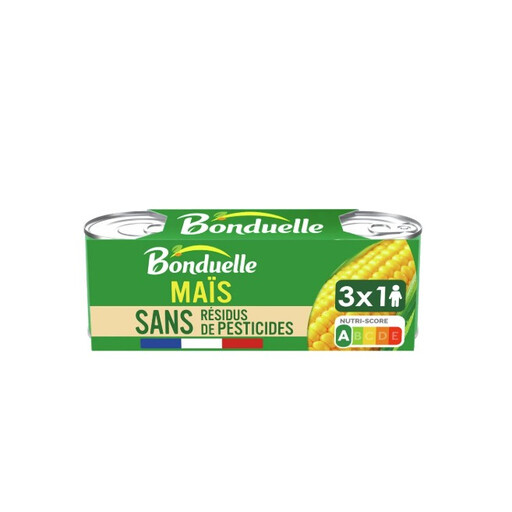 Image unavailable
The sweetcorn kernels are described as suitable for salads and side dishes. Before choosing this variety, check exactly what the ‘1/4 x 3’ pack contains, its drained weight and the claims on the packaging.
Check the drained weight per tin and how many tins you’ll use. For an individual lunch, a small tin can save you having to store a larger amount after opening.
No. Sweetcorn with no added sugar can still contain naturally occurring sugars, as shown on a Bonduelle product listing. Check the ingredients and the ‘of which sugars’ line for the product you choose.
Follow the storage instructions on your tin. For one Auchan product, they say to transfer the sweetcorn to an airtight container, refrigerate it and eat it within two days. The time may vary for other products.
When comparing pre-packed tinned foods, check the product name, ingredients, net quantity and nutritional information. The DGCCRF notes that pre-packed food labels also include a date relevant to the product; follow the storage instructions on your tin.
Tinned sweetcorn can be the base for a salad or served as a side, but what else you include depends on the meal you want to put together. Also check that the size you choose lets you use up or store any leftovers properly.