What should you look for first?
When doing your first food shop, start by thinking about how much you’ll use once the tin is open. Then compare the ingredients and product-specific information, rather than assuming that two label claims mean the same thing.
| What to consider |
What to check |
Who is this for? |
| Leftovers once opened |
The drained weight and the storage instructions once opened. |
If I’m cooking for myself, I’d rather open an amount I can use without leaving a large tin unfinished. Around 33% of consumers prioritise cutting down on leftovers. |
| Amount you’ll use |
The drained weight of each tin and, for a multipack, how many tins you’ll need to open separately. |
When I’m making several portions, I want the size to match how much I’ll actually use. Getting the right amount comes first for around 27% of consumers. |
| Salt and ingredients |
The ingredients list, the “salt” line in the nutritional information and the claims made for the specific variety. |
If I want to season it myself, I check whether the recipe contains salt rather than relying on the “no added sugar” claim alone. Around 27% of consumers prioritise ingredients first. |
| Organic and origin |
The organic certification and origin shown for the product you’ve chosen, if these matter to you. |
If the production method or origin guides my shopping, I check the label on the specific product. These are the top priority for around 13% of consumers. |
Brands to consider
These brands offer products you can compare based on the size and recipe you’re looking for. The characteristics of one tin don’t automatically apply to the brand’s other products.
Bonduelle
The range includes sweetcorn products with stated drained weights of 140 g or 285 g.
- Bonduelle’s product information for its no-added-sugar sweetcorn lists the ingredients, drained weight and storage instructions once opened.
- Check which variety you’re choosing: Bonduelle’s no-added-sugar product contains salt.
Carrefour Classic’ / Carrefour Bio
Carrefour products let you compare different recipe claims, including “no added salt” and “organic”.
- The product and size shown make it easy to compare options based on what you need for your cupboard.
- Check the ingredients list for each variety: claims made for the range don’t apply to every tin.
Notre Jardin / Bio Village / Eco+ (E.Leclerc)
These E.Leclerc brands cover several types of tinned sweetcorn, including crunchy, organic and no-added-sugar varieties, depending on the product.
- E.Leclerc catalogues include products with stated weights of 140 g and 285 g, which you can compare based on the portions you have in mind.
- Check the drained weight and claims on the specific tin before comparing two sizes.
ALDI BIO® / ALL SEASONS®
ALDI France offers organic sweetcorn and crunchy sweetcorn, including products with a stated weight of 285 g.
- ALDI BIO® product information states that its product is certified organic and contains no added sugars.
- Don’t assume these claims apply to ALL SEASONS® sweetcorn: check the label on the product you choose.
Géant Vert
The brand offers an organic sweetcorn product with no added salt or sugar.
- Carrefour’s product information for this variety lists organic sweetcorn and water as the ingredients.
- Other Géant Vert varieties have different ingredients, so check the list for the size you choose.
Products to stock your cupboard
These Joybuy products include three sizes of sweetcorn kernels and a tin of baby corn. First choose the type of corn that suits your recipes, then pick an amount you’ll be able to use once opened.
 Image unavailable
Bonduelle organic sweetcorn, 2 × 140 g
Two tins that you can open separately could be a good choice if you use small amounts of sweetcorn across several meals.
The pack is listed as 2 × 140 g. To work out how much sweetcorn you’ll get in each portion, check the drained weight and storage instructions once opened on the packaging.
View on Joybuy
 Image unavailable
Bonduelle sweetcorn with no pesticide residues, 285 g
This size could be a good fit if you’re planning several portions close together, rather than using a small amount just once.
The tin is listed as 285 g. Check its drained weight to plan your portions. If you’re looking for a no-added-salt recipe, check the ingredients list separately.
View on Joybuy
 Image unavailable
Bonduelle Supersweet Corn 570 g
A tin this size is worth considering if you’re planning to make several portions and use the leftovers soon after opening.
The stated size is 570 g: check the drained weight and storage instructions. If you have any concerns about allergens, check the packaging information too.
View on Joybuy
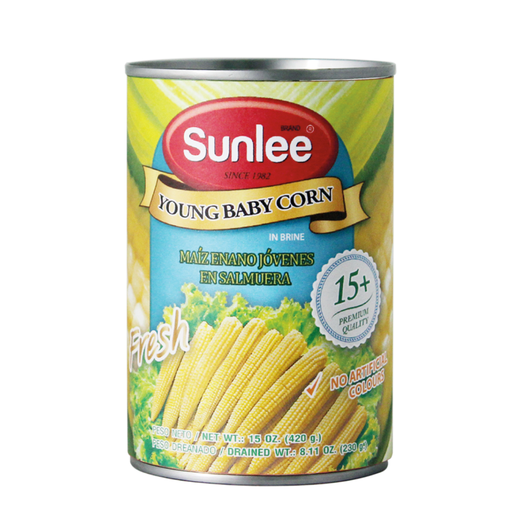 Image unavailable
Sunlee baby corn 420 g
Baby corn is an option for recipes that call for small cobs, rather than regular sweetcorn kernels.
The tin is listed as 420 g. Check the drained weight, as well as the preparation and storage instructions once opened.
View on Joybuy
Frequently asked questions
Should you choose a large tin when stocking your first cupboard?
Not necessarily. Choose a large tin if you expect to use several portions once it’s open. If your meals are further apart, smaller tins that you open separately may suit you better. Either way, follow the storage time shown on the opened product.
Does “no added sugar” mean “no added salt”?
No. Bonduelle’s no-added-sugar product, as described by the brand, contains sweetcorn, water and salt. If salt matters to you, check the ingredients list and the “salt” line in the nutritional information for the variety you’re buying.
How should you store sweetcorn once the tin is open?
Follow the instructions on the product you’ve bought. For its no-added-sugar sweetcorn, Bonduelle advises keeping it at a maximum of 4 °C and eating it within 48 hours. Don’t assume the same time limit applies to other products.
Can you use tinned food after its best-before date?
Going past the best-before date doesn’t automatically mean the food can’t be eaten: the DGCCRF says a product may still be consumed if its packaging is undamaged, although its taste and quality may change. Check the condition of the tin before opening it.
What should you do if a tin is swollen or smells suspicious?
Don’t eat what’s inside. Anses advises discarding tins that are swollen or misshapen, as well as any product that smells suspicious when opened.


