Anyone stocking a versatile cupboard
You want to be able to add sweetcorn to a salad or hot dish, and know how to store any leftovers after opening. Bonduelle’s product information suggests these uses for its no-added-sugar product.


When stocking your cupboard, compare the drained weight, ingredients and storage instructions after opening. A small tin can help reduce leftovers if you’re cooking for one or two. Check the exact product for claims such as ‘no added salt’ or ‘no added sugar’ rather than assuming they apply to every product from a brand or in a particular size.
You want to be able to add sweetcorn to a salad or hot dish, and know how to store any leftovers after opening. Bonduelle’s product information suggests these uses for its no-added-sugar product.
You compare the recipe claims rather than assuming they’re all the same. Bonduelle, Carrefour and E.Leclerc product information includes options with salt, no added salt or organic ingredients.
You’d rather open an amount that suits the meal. Carrefour and E.Leclerc list tins with a drained weight of 140 g, while Auchan describes its Jardin Bio carton, with a drained weight of 230 g, as serving two people.
Start with the amount you’ll serve and the ingredients you’re looking for, then check how to store the product before and after opening.
| Criteria | What to check | Who is it for? |
|---|---|---|
| Ingredients | The ingredients list and any ‘no added salt’, ‘no added sugar’ or organic claims for the exact product. | If ingredients matter most to me, I want to distinguish a recipe with salt from one with no added salt. Around 25% of consumers put ingredients first. |
| Portions and uses | The drained weight of each pack and the amount you need for your meals. | When I’m making a small salad, I’d rather open an amount I can finish. Portions are the main consideration for around 25% of consumers. |
| Storage | The best-before date, the condition of the tin and the instructions for after opening. | When keeping tins in stock, I want to be able to check their packaging and plan how to use any leftovers. Storage is the top priority for around 25% of consumers. |
| In-store choice | Whether the product is available at your shop or for click and collect, and how many containers are in the pack. | If I’m stocking up during my usual shop, I need to be able to find the size I’ll use. Around 25% of consumers prioritise this practical consideration when shopping in-store. |
The DGCCRF distinguishes between the best-before date (DDM) and the condition of the tin. A past date is no reason to eat the contents of a tin that is bulging, rusty or misshapen.
Check the date and condition of the tin before storing or opening it. If you’re unsure it’s intact, don’t eat the contents.
Bonduelle, Carrefour and Auchan list different ingredients, with variations including salt, sugar and lemon juice.
If a particular recipe claim matters to you, read the ingredients list and nutritional information for the product you’ve chosen.
Net weight includes the liquid, while drained weight tells you how much sweetcorn is left once the tin has been drained.
To plan your portions, compare the drained weights shown on the packaging.
For its product with a drained weight of 285 g, Bonduelle recommends storing it at a maximum of 4 °C and consuming it within 48 hours of opening.
If you only use a little sweetcorn at a time, consider smaller containers or plan another meal within the timeframe shown on your product.
Bonduelle lists a 340 g net tin of sweetcorn with no added sugar, including 285 g drained weight.
Carrefour lists an organic product with no added salt or sugar, in two tins with a drained weight of 140 g each.
E.Leclerc lists a 285 g tin of organic sweetcorn and states that the corn is grown in France.
E.Leclerc lists a pack of three tins of sweetcorn, each with a drained weight of 140 g.
Auchan lists organic sweetcorn in a carton with a drained weight of 230 g, described as serving two people.
These sweetcorn products let you compare a pack of two small tins with sizes sold as individual tins or multipacks. To choose the right portions and recipe, check the information on each pack.
 Image unavailable
If you’d like to open one small tin at a time, this pack contains two 140 g tins. Check the drained weight and storage instructions after opening on the packaging.
 Image unavailable
If you’re planning to use the same tin over several meals, this size is listed as 285 g. Check its drained weight to find out how much sweetcorn you’ll be serving.
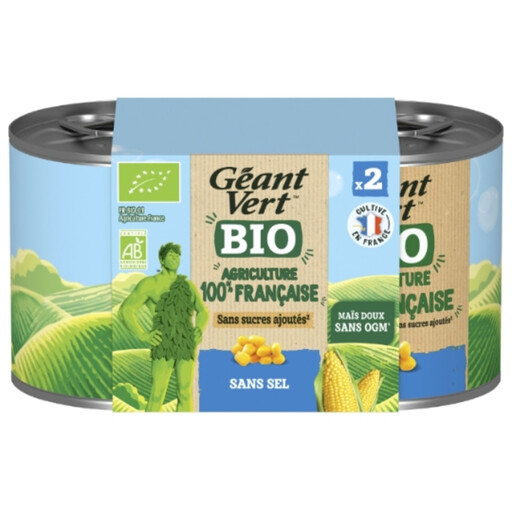 Image unavailable
If you’re looking for this organic variant, check the ingredients before assuming it has no added salt: the information about salt is contradictory. Also check the quantity and pack contents on the packaging.
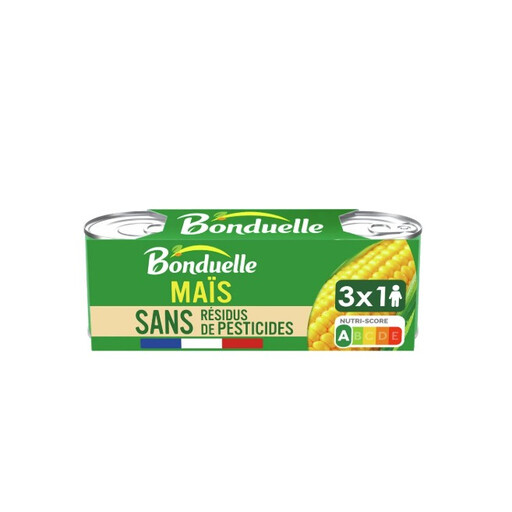 Image unavailable
For salads or side dishes, check the number of containers and the amount in each one: the label ‘1/4 x 3’ isn’t enough to work out the portions. Check the drained weight too.
A past best-before date doesn’t, by itself, mean you can’t eat the contents of a tin. However, the DGCCRF says you should also consider the condition of the packaging; don’t apply this principle to a tin that is rusty, bulging or misshapen.
If you’re unsure whether the tin is intact, don’t eat its contents. The DGCCRF warns that bulging, rust and deformation can be signs of deterioration.
Follow the instructions for the product you’ve bought. For its no-added-sugar sweetcorn with a drained weight of 285 g, Bonduelle recommends storing it at a maximum of 4 °C and consuming it within 48 hours of opening.
No. This claim doesn’t rule out naturally occurring sugars. Bonduelle lists sugars in its no-added-sugar product; if you’re comparing two products, check the ‘of which sugars’ line in the nutritional information.
Choose according to how much you’ll serve and the storage time after opening shown on the packaging. Two separate tins with a drained weight of 140 g each let you open one at a time, while a tin with a drained weight of 285 g gives you more sweetcorn in one go.