Households of one or two
If you only use sweetcorn occasionally in a salad or as a side dish, match the amount in the tin to the number of meals you have planned.


If there are one or two of you, choose an amount of sweetcorn you can use in the meals you have planned, rather than buying a large tin with no plans for the leftovers. Compare the drained weight and number of tins, then check the exact product for any claims that matter to you, such as ‘no added salt’ or ‘organic’.
If you only use sweetcorn occasionally in a salad or as a side dish, match the amount in the tin to the number of meals you have planned.
Buying separate tins means you can open only as much as you need. If you have an opened tin, follow the storage instructions for the product you’ve bought.
If you’re looking for a specific feature, check that it’s stated on the tin you choose. Claims such as ‘no added salt’, ‘organic’ or a particular country of origin don’t necessarily apply to an entire product range.
For a small household, start with the meals you have in mind. Then consider how much you’ll use straight away and how much you’d need to store once opened.
| What to consider | What to check | Who is it for? |
|---|---|---|
| How much you’ll use | Drained net weight and number of tins in the multipack. | For an occasional meal, I look for an amount I can use up in one go; around 36% of consumers would put the amount they’ll actually eat first. |
| Leftovers after opening | Whether the tins can be opened separately and the product’s storage instructions. | If I haven’t planned another meal soon, I’d rather not leave opened sweetcorn in the fridge; around 29% of consumers would prioritise keeping leftovers to a minimum. |
| Added salt | The ‘no added salt’ claim on the exact product and its ingredients list. | I want to choose based on the amount of added salt, without assuming every recipe is the same; almost 21% of consumers would make this their main consideration. |
| Production claims | The exact wording of any ‘organic’, ‘no pesticide residues’ or country-of-origin claims on the tin. | A specific production claim can guide my choice, as long as it applies to the product I’m buying; around 14% of consumers would prioritise this. |
In a household of one or two, some of the sweetcorn could go unused if you haven’t planned another meal. For its ‘no added sugars’ product, Bonduelle recommends storing it at a maximum of 4 °C and using it within 48 hours of opening.
Save larger tins for meals you’ll be having close together; otherwise, consider tins that can be opened separately. In all cases, follow the instructions for the product you’ve bought.
Claims such as ‘organic’, ‘no pesticide residues’ and ‘no added salt’ apply to specific products, which may come in different pack sizes.
Check the product name, ingredients and claims on the exact tin before you choose.
Anses advises against eating tinned food if the tin is swollen or damaged, or if the product has an unusual smell when opened.
Set the affected tin aside; don’t taste its contents to check them.
The brand offers a range of tinned sweetcorn, including classic and organic products.
These own-label brands include 285 g tins. Carrefour Classic’ also offers a ‘no added salt’ product in two tins, each with a drained net weight of 140 g.
E.Leclerc offers, among other products, 285 g tins of its ‘no added sugars’ crunchy sweetcorn, as well as multipacks.
The Auchan range includes, among other products, a Pouce multipack of three 140 g tins and 285 g Auchan tins.
The brand offers several varieties of tinned sweetcorn, including products with specific production claims.
This selection includes separate tins, 285 g, 400 g and 570 g packs, and products with specific claims. Match each pack size to the meals you have planned and check the details of the product you choose.
 Image unavailable
The two tins make it easy to use the sweetcorn separately in a small household.
This product carries an organic claim. Check the drained weight to see how much you’ll get for your meals.
 Image unavailable
This tin could suit you if you’re planning to use its contents across meals close together.
The product information states that it has ‘no pesticide residues’ and is of French origin. Check the drained weight and the details on the label.
 Image unavailable
Think about how you’ll use the contents if one meal won’t need the whole tin.
The stated pack size is 400 g. Check the label for the drained weight and instructions for after opening.
 Image unavailable
This pack can be used across several meals if you’ve already planned how to use the contents.
The stated pack size is 570 g. The product information advises refrigerating any opened sweetcorn in an airtight container and using it within two days; check the label for instructions.
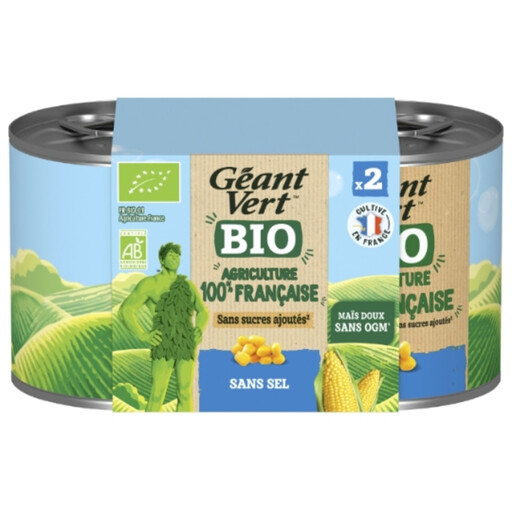 Image unavailable
To decide whether this product suits your planned meals, check the packaging details directly.
Check the label for the weight, number of tins, ingredients and any ‘organic’ or ‘no added salt’ claims.
Follow the instructions on the tin you’ve bought and refrigerate any leftover sweetcorn. For its ‘no added sugars’ product, Bonduelle recommends storing it at a maximum of 4 °C and using it within 48 hours. The brand also advises transferring opened vegetables to an airtight container.
The DGCCRF says a product can be eaten after its best-before date if the packaging is intact, although some aspects of its taste may have changed. Check the exact wording of the date: a use-by date should not be treated in the same way.
Don’t eat its contents. Anses advises discarding tins that are swollen or damaged, as well as any that have an unusual smell when opened.
First, check the net weight and, if stated, the drained weight. Then look at the ingredients list, nutritional information and any claims specific to each product. These details can help you choose the right amount without assuming that a feature of one product applies to an entire brand.