Households planning back-to-school meals
You want to keep tinned sweetcorn in the cupboard without buying a size that could leave some unused.


For your back-to-school shop, choose the amount of tinned sweetcorn to suit the meals you’re actually planning. Small tins work well if you’ll use them at intervals, while a larger tin means planning how to use the leftovers once it’s open. If the ingredients or a claim such as “organic” matters to you, check the specific product rather than relying on the brand name alone.
You want to keep tinned sweetcorn in the cupboard without buying a size that could leave some unused.
You’re looking for tins that suit the portions you have planned, and can take storage instructions into account once a tin has been opened.
You compare the ingredients, salt content and claims for each product before choosing.
Start with the portions you’re planning for the week, then compare the quantities shown on the tins. Ingredients and specific claims can help you choose between products that suit your needs.
| What to check | Look for | Shoppers who may find this relevant |
|---|---|---|
| Amount you can use | Compare the net quantity and, where shown, the drained weight; they are not the same measurement. | I want to buy an amount of sweetcorn that will actually be used in the meals I’ve planned. Around 36% of consumers would prioritise keeping their purchases to the right amount. |
| Portions and leftovers | Check how many tins are in the pack and the storage instructions for each product once opened. | For packed lunches, I’d rather open a small tin than keep leftovers for too long. Managing portions would come first for around 29% of consumers. |
| Ingredients and claims | Read the ingredients and nutritional information per 100 g; distinguish between “organic”, “no added salt” and “no pesticide residue” claims. | If a particular ingredient list or claim influences my choice, I need to check that it applies to the product I buy. Around 21% of consumers would put this check first. |
| How you’ll use it | Choose sweetcorn kernels that suit your planned recipe and check the product description. | I first choose the sweetcorn I need for salads or hot dishes. How it will be used would be the main consideration for around 14% of consumers. |
Two different sizes won’t necessarily contain the same amount of sweetcorn you can use, particularly if there’s liquid in the tin.
Check the net quantity and the stated drained weight, then compare them with the portions you plan to prepare.
Any leftovers need to be stored and used according to the instructions for the product you’ve chosen. Bonduelle recommends storing its 285 g drained-weight product at a maximum of 4 °C and using it within 48 hours of opening.
If you’ll use sweetcorn at intervals, choose a pack of smaller tins instead and check the instructions for each one.
Leftovers that aren’t used within the stated time may end up in the bin.
“Organic”, “no added salt” and “no pesticide residue” describe different characteristics.
Decide which claim matters to you, then check its exact wording, the ingredients list and the nutritional information on the tin you choose.
A best-before date does not mean the same as a use-by date. The condition of the packaging matters too.
Check the date and make sure the tin is intact. The DGCCRF says a product may still be considered after its best-before date if the packaging is intact; a use-by date must be followed.
The range includes plain, organic and “no pesticide residue” sweetcorn products.
Carrefour offers individual tins and multipacks of sweetcorn under this brand.
Auchan’s range includes a POUCE multipack of three 140 g tins, as well as AUCHAN products with different claims.
ALDI offers a BIO® sweetcorn product for shoppers looking for this claim.
These sweetcorn kernel products let you compare small tins, single tins and claims shown in product titles. To choose between them, match the pack size to the portions you have planned and check the details that matter to you on each product.
 Image unavailable
The two 140 g tins are a good option if you’re planning to use them separately. The product title describes it as organic; check the claim on the product if it affects your choice.
For a more accurate comparison of the amount of sweetcorn, also check the drained weight on the packaging.
 Image unavailable
This 285 g tin could suit a meal where you’re planning to serve several portions of sweetcorn. The claim about residues appears in the product title; check the wording on the packaging if it matters to you.
Check the drained weight and the storage instructions for this specific product.
 Image unavailable
The 400 g tin is worth considering if you’re planning to use several portions soon after opening. Plan to use any leftovers according to the instructions for this product.
Check the drained weight if you’re comparing it with other pack sizes.
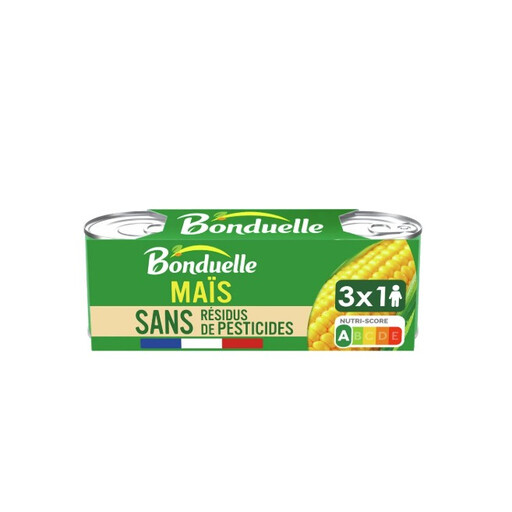 Image unavailable
If you’re looking for the “No Residues” claim, check its exact wording on the packaging; the product title is not independent verification of the claim.
Before choosing this variant for several meals, check the net quantity, drained weight and pack contents on the packaging.
Start by comparing the stated net and drained weights, then consider how many portions you’ll actually use. Drained weight is particularly useful when comparing tins that contain liquid.
Small tins work well when you’ll use them at intervals; a larger tin means planning how to use the leftovers. Follow the instructions for the product you’ve bought: for its product with a drained weight of 285 g, Bonduelle recommends storing it at a maximum of 4 °C and using it within 48 hours of opening.
No. Nutri-Score is nutritional information, while “organic” and “no pesticide residue” are different types of claim. Read the ingredients, nutritional information and exact wording of each claim on the product you choose; none of these tells you everything about the product on its own.
Check the product name, ingredients, net quantity, nutritional information and date marking. The DGCCRF notes that these details form part of the labelling requirements for prepacked food in France; also check the instructions for storing the product after opening.
According to the DGCCRF, a product may still be used after its best-before date if the packaging is intact, although its taste may have changed. Check the condition of the tin and don’t confuse a best-before date with a use-by date, which must be followed.