Hosts looking to minimise leftovers
Whether you’re making appetisers, a salad or a side dish, you’ll want a quantity that suits the number of guests. The drained weight can help you choose between small tins, multipacks and larger sizes.


For New Year's Eve, choose the drained weight to suit your recipes and the number of guests, then pick a tender or crunchy texture that works with your dish. Check the ingredients and product claims for the exact item you’re buying. If you choose a large tin, make sure you have a plan for using up any leftovers once it’s open.
Whether you’re making appetisers, a salad or a side dish, you’ll want a quantity that suits the number of guests. The drained weight can help you choose between small tins, multipacks and larger sizes.
You might want tender kernels for a topping, or crunchy ones to add contrast to a salad. The descriptions used by E.Leclerc and Auchan vary from one product to another.
You may want to check the salt content, ingredients or claims such as organic, French origin or GM-free. Check each of these details on the product you choose.
If you’re preparing several dishes for New Year's Eve, start by working out how much sweetcorn you’ll need. Then compare the texture, ingredients and storage instructions to find the products that suit your recipes.
| Factor | What to check | Who it matters to |
|---|---|---|
| Usable quantity | Check the drained weight and, if you’re buying a multipack, the number of tins. The DGCCRF says the drained weight must appear on the label when a food is sold in a covering liquid. | For a buffet, I want enough sweetcorn for each dish without opening too many tins. Around 31% of shoppers prioritise managing quantities this way. |
| Texture | Look for tender, crunchy or extra crunchy on the product you’re considering for your recipe. | For a salad, I look for crunch; for a milder side dish, I prefer tender kernels. Texture comes first for around 31% of shoppers. |
| Ingredients | Read the ingredients and nutritional information, and check the exact wording of any claims that matter to you, particularly those relating to salt or origin. | If I’m looking for a particular kind of product, I want to check the details on the tin rather than assume they apply based on the brand. Ingredients are the top priority for around 23% of shoppers. |
| Storage | Check the condition of the tin and read the product’s storage instructions for after opening. | If I’m preparing the meal in advance, I need to be able to store the unopened tin and use any leftovers promptly. Around 15% of shoppers prioritise how they manage cupboard storage and leftovers. |
One product might be crunchy, while another is tender or carries a different claim. Auchan also says that the ingredients in one of its sweetcorn products may vary depending on the store you choose and the date of purchase.
Check the ingredients and claims on the local product page or on the packaging of the product you’re buying.
Choose a pack size that matches the quantity you’ll serve, as storage instructions change once the tin has been opened.
If several dishes only need a little sweetcorn, consider smaller containers. For one of its products, Bonduelle advises storing it at no more than 4 °C and using it within 48 hours of opening. Follow the instructions on your tin.
According to the DGCCRF, bulging, rust or dents may be signs that a tin has deteriorated.
Do not use a tin with any of these signs, even if its best-before date has not passed.
Bonduelle offers several sweetcorn products, including organic options and varieties with no added sugar.
These Carrefour ranges include products with no added salt and organic options.
E.Leclerc’s range includes products described as tender, crunchy with no added sugar, and organic.
Auchan’s ranges include different types of sweetcorn, including crunchy and organic options.
Some Géant Vert products are described as extra crunchy or extra tender.
These Bonduelle products come in different pack sizes, suitable for New Year's Eve salads and side dishes. Before planning portions, compare the quantity shown for each product with its drained weight.
 Image unavailable
The two-pack could be a good choice if you’re dividing the sweetcorn between several smaller dishes.
Don’t mistake the 140 g per container for the drained weight. Check the drained weight to work out how much you’ll have to serve.
 Image unavailable
This 285 g pack could be a good option for preparing a moderate quantity.
The product name includes a claim about pesticide residues. Check the exact wording on the packaging, along with the drained weight.
 Image unavailable
The 570 g pack could be a good choice if you’re using sweetcorn in several dishes to share.
This is not listed as the drained weight, so check the drained weight before calculating portions and plan how you’ll use the contents after opening.
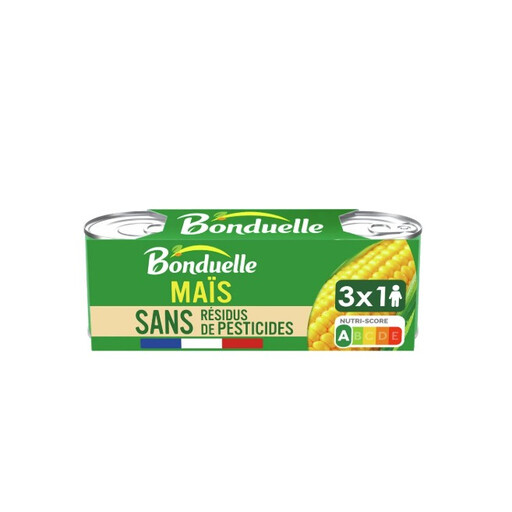 Image unavailable
Consider this product if you’re looking for sweetcorn for a salad or side dish.
Check what the ‘1/4 x 3’ pack format refers to, then check the quantity and drained weight on the packaging before planning portions. Also check the exact wording of the claim about residues.
Base your choice on the drained weight your recipes need, rather than just the weight shown in the product name. The DGCCRF says that the drained weight must be shown for food sold in a covering liquid. Add up the drained weights if you’re buying several tins.
A tin is not automatically unsafe to eat after its best-before date, as long as the packaging is intact. However, the DGCCRF says its taste may have deteriorated. A best-before date should not be confused with a use-by date.
Do not use a tin with any of these signs. The DGCCRF says they may indicate that the product has deteriorated, whatever date is printed on the tin.
Follow the instructions for the product you’ve bought and keep any opened sweetcorn in the fridge. For one of its products, Bonduelle advises storing it at no more than 4 °C and using it within 48 hours of opening. Other products may have different instructions.
No. This claim on its own does not tell you how the crop was grown. For the products concerned, Bonduelle defines it as a residue concentration below the quantification limit it specifies, which is 0,01 mg/kg. Check the exact wording on the tin you choose.