People avoiding added sugar
You’re making a salad or bowl for lunch at work and want to avoid recipes containing added sugar. Read the ingredients list as well as the label: according to Anses, naturally occurring sugars may still be present.


If you want to avoid added sugar in tinned sweetcorn, choose a product labelled ‘no added sugar’ and check the ingredients list. This label doesn’t mean the sweetcorn contains no naturally occurring sugars. For lunch at work, also compare the salt content, drained weight and storage instructions once opened.
You’re making a salad or bowl for lunch at work and want to avoid recipes containing added sugar. Read the ingredients list as well as the label: according to Anses, naturally occurring sugars may still be present.
You also want to take the salt content of your lunch into account. Check this separately: tinned sweetcorn with no added sugar isn’t necessarily salt-free.
You’re looking for a quantity that suits your salad and want to keep leftovers to a minimum. Drained weight and storage instructions after opening matter just as much as the sugar information.
Start with the sugar claim and ingredients, then compare products by salt content and how much you’ll use for lunch.
| Criteria | What to check | Who is it for? |
|---|---|---|
| Added sugars | Look for ‘no added sugar’ and read the ingredients; compare the ‘of which sugars’ figure per 100 g without confusing it with the presence of added sugar. | I want a recipe with no added sugar for my salad, but I don’t necessarily need it to contain 0 g of naturally occurring sugars. Around 38% of consumers preparing this type of lunch make this their top priority. |
| Salt | Compare the ‘salt’ figure per 100 g and, if this is a deciding factor, look for a product explicitly labelled ‘no salt’. | If I’m also keeping an eye on salt in my meal, I can’t work out how much it contains from the sugar claim alone. This is the top priority for around 37% of the consumers concerned. |
| Pack size and leftovers | Check the drained weight and storage instructions after opening for the product you’re considering. | For an individual lunchbox, I prefer a quantity I can use without having lots of leftovers to store. Pack size is the top priority for around 25% of consumers who prepare this type of lunch. |
According to Anses, ingredients in a product with no added sugar may still contain naturally occurring sugars. So ruling out every product whose ‘of which sugars’ figure is above zero would mean confusing two different things.
Read the claim, ingredients list and nutritional information together to understand what each one tells you.
Some sweetcorn products with no added sugar list salt among their ingredients. Another product may carry both ‘no salt’ and ‘no added sugar’ claims: check these details on the specific product.
If salt matters to you, compare the figure per 100 g using the same basis.
For an individual lunch, you may need less than the contents of a large tin. Storage instructions after opening also vary by product.
Compare drained weights and follow the storage advice on the packaging you choose.
These claims answer different questions: here, you’re looking for a recipe with no added sugar, not a general promise of sugar reduction.
Look for the claim that matches your needs, then check the ingredients and the ‘of which sugars’ figure.
The brand offers sweetcorn products with no added sugar, including an organic option whose listed ingredients are organic sweetcorn, water and salt.
An organic sweetcorn product listed by Carrefour is labelled ‘no salt’ and ‘no added sugar’; its ingredients list shows organic sweetcorn and water.
This brand offers organic sweetcorn products with no added sugar, including a pack of three tins with a drained weight of 140 g each.
E.Leclerc offers Bio Village organic sweetcorn with no added sugar in a pack of two 140 g tins.
E.Leclerc offers Notre Jardin crunchy sweetcorn with no added sugar, including a pack of three 140 g tins and a 285 g tin.
These tinned sweetcorn products can be used to prepare lunch at work. If no added sugar is your priority, check the claim on the exact product before choosing; also consider the pack size and salt content.
 Image unavailable
A pack size to compare with the amount of sweetcorn you plan to use in your work lunch salad.
The title states 285 g. Check the drained weight, ‘no added sugar’ claim and storage instructions after opening on the packaging.
 Image unavailable
The two tins may suit you if you’d like to open one at a time for your lunches.
The title states two tins of 140 g. Check the drained weight, ‘no added sugar’ claim and storage instructions after opening on the product you choose.
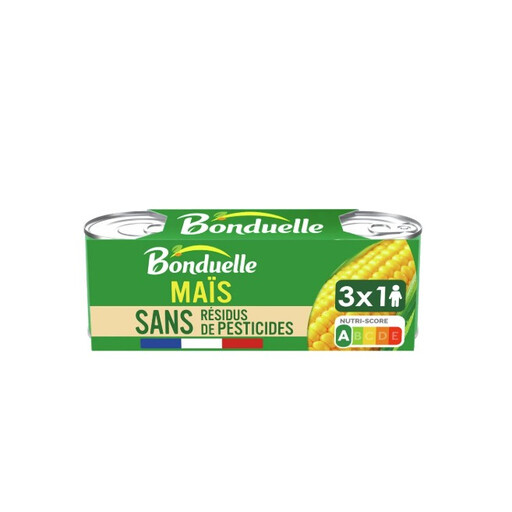 Image unavailable
For a lunch salad, choose the quantity to suit your portions rather than relying on the ‘1/4 × 3’ description alone.
Check the exact net weight, ‘no added sugar’ claim and storage instructions after opening on the packaging.
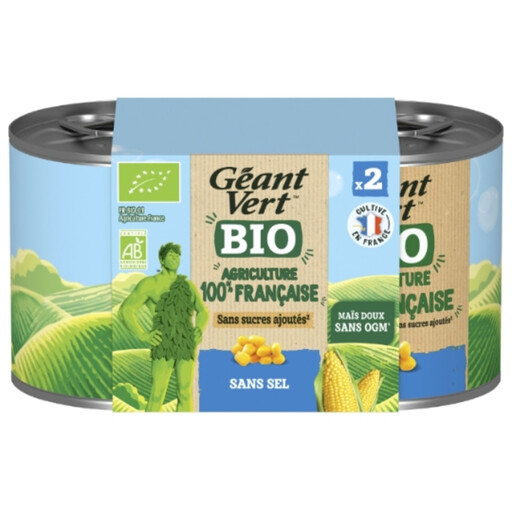 Image unavailable
If you’re also looking for a salt-free tin for lunch, check this product particularly carefully before buying.
The title and description give conflicting pack sizes; the ‘no salt’ claim in the title also conflicts with the ingredients list, which includes salt. Check the pack size, salt content, ‘no added sugar’ claim and storage instructions after opening on the packaging.
No. According to Anses, this claim doesn’t rule out naturally occurring sugars in the ingredients. To find out the declared amount for a product, check the ‘of which sugars’ figure in its nutritional information.
Look for the ‘no added sugar’ claim on the exact product, then read its ingredients list. For example, listings for several products offered by Carrefour and E.Leclerc give the ingredients as sweetcorn, water and sometimes salt; always check the composition of the product you’re buying.
Yes, if salt is one of your criteria: no added sugar doesn’t mean ‘no salt’. Compare the ‘salt’ figure per 100 g on the same basis and check for a ‘no salt’ claim on the specific product.
Follow the instructions for the product you’ve bought. For one sweetcorn product with no added sugar, Bonduelle advises storing it at a maximum of 4 °C and consuming it within 48 h of opening; don’t assume the same applies to another tin.