People with a diagnosed food allergy
Check the ingredients, declared allergens and any precautionary statements on the exact product you’re buying, taking your specific allergy into account.


If you’re buying tinned sweetcorn with a food allergy, first check the ingredients list, allergen information and precautionary statements on the packaging of the product you’ve chosen. Then compare the sugars per 100 g and the drained weight. ‘No added sugar’ does not mean ‘sugar-free’, and a recipe containing just sweetcorn, water and salt is not enough to confirm that a product is suitable for a specific allergy.
Check the ingredients, declared allergens and any precautionary statements on the exact product you’re buying, taking your specific allergy into account.
You’re looking for a recipe with no added sugar, while comparing the ‘of which sugars’ line in the nutrition information. This also includes sugars that occur naturally.
You’re choosing between individual tins, multipacks and larger sizes. Drained weight, storage instructions after opening and availability at your local store can all help you decide between products.
If you have an allergy, start with the label on the tin you’re buying. Then compare sugars per 100 g on a like-for-like basis, followed by the drained weight to make sure you get the amount of sweetcorn you need.
| Criteria | What to check | Who it matters to |
|---|---|---|
| Specific food allergy | Read the ingredients, declared allergens and precautionary statements on the exact pack. | If I need to avoid a specific allergen, I want to check the label on the tin I’m buying rather than rely on the label for another pack size; around 46% of consumers would make this their top priority. |
| Added and total sugars | Check the recipe and the ‘of which sugars’ line per 100 g; ‘no added sugar’ does not mean ‘sugar-free’. | If I’m limiting added sugars, I want to distinguish what goes into the recipe from the total amount of sugar. Around 36% of consumers would consider this their main concern. |
| Pack size, organic status and availability | Compare the drained weight and number of tins, then check that the product meets your organic preference and is available locally. | When I’m preparing smaller quantities, I look for a pack size that suits my meals and is available at my local store; around 18% of consumers would prioritise pack size, organic status or availability. |
Bonduelle France lists 5.1 g of sugars per 100 g for its no-added-sugar product; the Notre Jardin product page from E.Leclerc shows 5.2 g per 100 g. So the claim on the front of the pack doesn’t, by itself, tell you the total sugar content.
Check the ingredients and the ‘of which sugars’ line per 100 g, then take the portion you use into account.
A short ingredients list isn’t enough to conclude that a product is suitable for every allergy. The recipe and statements on the pack you buy are what matter when checking for your specific allergy.
Read the ingredients, declared allergens and any precautionary statements on the packaging again. If you’re unsure how to interpret them in relation to your allergy, ask the healthcare professional who supports you for advice.
The Bonduelle tin shown by the brand contains 340 g net, of which 285 g is drained weight. The first figure includes the covering liquid.
Use the drained weight to compare how much sweetcorn you’ll have for your meals.
The Bio Village product page on E.Leclerc refers to availability at the selected store or collection point. Finding a product online doesn’t guarantee you’ll find it locally.
Check availability at your local store or collection point, then make sure the product you receive is the same one you looked at.
Bonduelle France’s no-added-sugar product comes in a 340 g net tin, with a drained weight of 285 g.
Carrefour offers organic sweetcorn with no added sugar in a pack of three tins, each with a drained weight of 140 g.
E.Leclerc’s organic product comes in a pack of two 140 g tins.
E.Leclerc offers crunchy sweetcorn with no added sugar under this brand, in a 285 g tin.
Auchan offers organic sweetcorn with no added sugar in a 230 g jar.
These sweetcorn products let you compare different pack sizes. For each one, base any decision related to an allergy on the information shown on the product you receive.
 Image unavailable
Worth considering if you’re looking for a 285 g tin of sweetcorn kernels. Before buying it for an allergy or to limit added sugars, check the ingredients, allergen statements and nutrition information on the packaging.
 Image unavailable
This multipack could suit you if you prefer to open a small tin at a time and are looking for organic sweetcorn. Check the drained weight to compare portions, along with the ingredients and allergen statements on each tin.
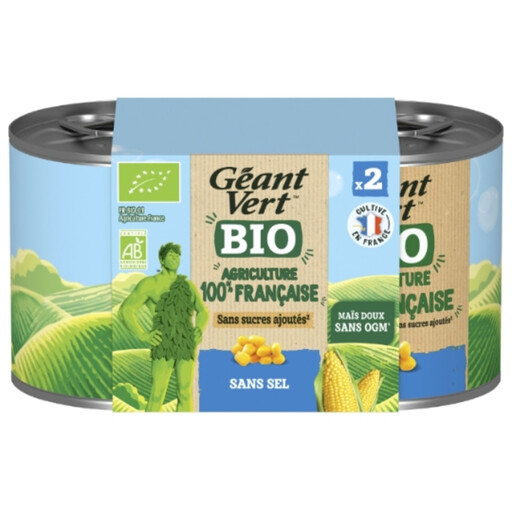 Image unavailable
Worth a look if you’re after another organic sweetcorn option. Check the pack size, drained weight and ingredients on the product you choose. You’ll need this information to compare portions and check for your specific allergy.
No. Sugars that occur naturally may still be listed in the nutrition information. Bonduelle France lists 5.1 g of sugars per 100 g for the product in question; check the ‘of which sugars’ line on the tin you choose.
No. This ingredients list doesn’t guarantee that the product is suitable for every allergy. Read the allergen information and any precautionary statements on the packaging of the product you actually buy, taking the allergy in question into account.
Use the drained weight to compare the amount of sweetcorn once the liquid has been removed. Bonduelle France’s product, for example, shows a net weight of 340 g and a drained weight of 285 g. These figures refer to different amounts.
Follow the instructions for the tin you’ve bought. For its no-added-sugar sweetcorn, Bonduelle France recommends storing it at a maximum of 4 °C and using it within 48 hours of opening.