If you want to avoid added sugars, choose a tin labelled “no added sugars”, then compare the “of which sugars” figure per 100 g: “no added sugars” does not mean “sugar-free”. If you’re a student moving into a new place, also check the drained weight, salt content and storage instructions after opening, so you can choose an amount you’ll be able to use.
Who is this choice for?
Students keeping an eye on their food budget
If you’re stocking your cupboards for the first time, check how much sweetcorn you’ll actually be able to use rather than looking only at the tin’s stated size. France’s High Council for Families, Children and Older People has documented food insecurity among students in France, but it does not recommend any particular sweetcorn brand or format.
Students watching their added sugar intake
You want to tell the difference between no added sugars and the total sugar content. As Bonduelle and Carrefour explain on their product information sheets, sweetcorn labelled “no added sugars” still contains naturally occurring sugars, so check the “of which sugars” figure per 100 g too.
Students with limited fridge space
It’s worth choosing an amount that suits the meals you have planned and checking the storage instructions on the tin you buy. For the “Sweetcorn with no added sugars” product featured here, Bonduelle says to store it at a maximum of 4 °C and consume it within 48 hours of opening.
What should you look for?
If no added sugars is the reason you’re buying it, start by checking for that wording. Then compare the nutritional information and choose an amount you’ll be able to use after opening.
| What to consider |
What to check |
Who it matters to |
| Amount you can use |
Check the net drained weight and choose an amount that suits the meals you have planned. |
When stocking your cupboards, you may want to avoid buying more than you can finish; around 33% of consumers would make this their top priority. |
| Added sugars |
Check the wording on the specific product, the ingredients list and the “of which sugars” figure per 100 g. |
If I want to avoid added sugars, I need to be able to distinguish them from the sugars naturally present in sweetcorn. Around 27% of consumers would make this their priority. |
| Salt and ingredients |
Read the ingredients list and the “salt” figure per 100 g; “organic” on its own does not tell you how much salt it contains. |
If I want to season my own meals, I may prefer a recipe with no added salt and check its sugar content separately; around 20% of consumers would put the ingredients first. |
| How much you’ll have after opening |
Check how many tins are included and the storage instructions for the product you’re buying. |
With limited fridge space, I want to open an amount I can finish within the time stated; around 20% of consumers would make this their top consideration. |
Mistakes to avoid
-
Confusing “no added sugars” with “sugar-free”
Bonduelle’s “Sweetcorn with no added sugars” contains 5.1 g of sugars per 100 g. The label does not mean that the sweetcorn contains no naturally occurring sugars.
To compare two tins, check the “of which sugars” figure for each, using the same 100 g basis.
-
Opening a large tin without planning how to use the rest
Once opened, a tin must be stored according to the instructions for that particular product. For the “no added sugars” sweetcorn featured here, Bonduelle says to consume it within 48 hours of opening and store it at a maximum of 4 °C.
Before choosing a large tin or multipack, think about how many meals you’ll prepare and check the instructions on each tin.
Tinned sweetcorn brands to consider
Bonduelle
Bonduelle’s “Sweetcorn with no added sugars” comes in a tin with a drained weight of 285 g and can be eaten hot or cold.
- According to Bonduelle’s product information, the ingredients are sweetcorn, water and salt. It contains 5.1 g of sugars and 0.28 g of salt per 100 g.
- Bonduelle says to store this product at a maximum of 4 °C and consume it within 48 hours of opening. Check the instructions for any other product from the brand separately.
Carrefour Classic'
Carrefour Classic's “Sweetcorn with no added sugars” comes in a tin with a drained weight of 285 g.
- Carrefour’s product information lists sweetcorn, water and salt, and explains that naturally occurring sugars are still present despite the “no added sugars” label.
- To compare this tin with another, check the “of which sugars” figure and exact pack size on both labels.
d'aucy
d'aucy describes its Maïs Bio Engagé as organic and made with no added sugars.
- d'aucy’s product information gives, per 100 g drained, 4.9 g of sugars, 0.43 g of salt and 3.8 g of fibre.
- “Organic” and “no added sugars” do not mean “sugar-free” or “salt-free”: check the figures for the product you choose.
Géant Vert
Géant Vert’s “Organic Sweetcorn, No Salt” is an option if you’re looking for sweetcorn without salt, which is a different consideration from added sugars.
- Géant Vert lists organic sweetcorn and water as ingredients, and states that the product contains 0.00 g of salt per 100 g.
- The same product information gives 7.4 g of sugars per 100 g. Don’t assume that “no salt” means it is low in sugars.
Tinned sweetcorn available on Joybuy
These Bonduelle products come in a range of sweetcorn kernel formats to consider for student meals. If you’re looking for no added sugars, check the label on the specific product before choosing.
 Image unavailable
Bonduelle sweetcorn kernels “Without Pesticide Residue”, 285 g
If you’re considering a 285 g tin, check its drained weight to see how much sweetcorn you’ll be able to use. The product name alone does not confirm that it is labelled “no added sugars”, so check the label and the “of which sugars” figure.
View on Joybuy
 Image unavailable
Bonduelle Supersweet Corn, 570 g
The stated 570 g size may suit you if you’re planning to make several meals from one tin. Before choosing it, check the drained weight, the wording about added sugars and the storage instructions.
View on Joybuy
 Image unavailable
Bonduelle organic sweetcorn kernels, 2 × 140 g
With two tins stated to be 140 g each, you can open one at a time if that suits your meals. “Organic” does not tell you how much sugar the product contains: compare the “of which sugars” figure per 100 g and check separately for a “no added sugars” label.
View on Joybuy
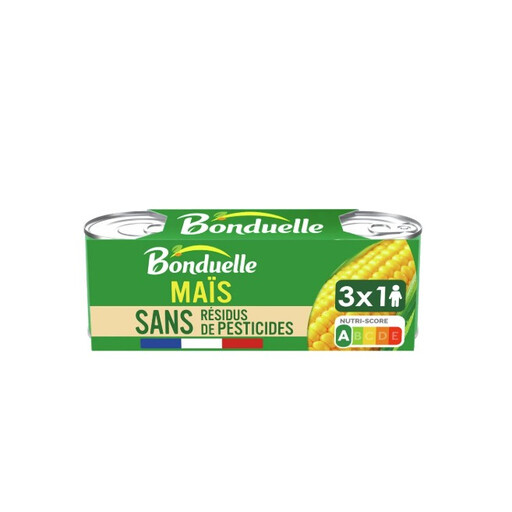 Image unavailable
Bonduelle Sweetcorn “No Residues”, pack format 1/4 x 3
If you’re interested in this product, check the quantity and “salt” figure on the label before choosing: these details are inconsistent between its titles and descriptions. Also check whether it is actually labelled “no added sugars”.
View on Joybuy
Frequently asked questions
Does “no added sugars” mean the sweetcorn is sugar-free?
No. Sweetcorn can contain naturally occurring sugars even when a tin is labelled “no added sugars”. Bonduelle’s “Sweetcorn with no added sugars”, for example, contains 5.1 g of sugars per 100 g. Compare the “of which sugars” figures on the tins you’re considering.
What should I check on the label to compare two tins?
Read the ingredients list, the nutritional information per 100 g and how much sweetcorn you’ll be able to use. France’s Directorate-General for Competition Policy, Consumer Affairs and Fraud Control points out that the product name and ingredients list are among the details shown on prepacked foods. If the sweetcorn is in liquid, check the drained weight too.
How long can I keep sweetcorn after opening?
Follow the instructions on the tin you buy, as the storage time can vary between products. For the “Sweetcorn with no added sugars” featured here, Bonduelle says to store it at a maximum of 4 °C and consume it within 48 hours of opening.
Is the date on a tin a use-by date?
A tin may have a best-before date, shown as “best before”, which is different from a use-by date. Anses lists tinned foods among the products that can carry a best-before date. Check the exact wording on the tin and make sure its packaging is intact.


