Families who use sweetcorn often
You regularly serve it in salads, as a side dish or in family meals. The drained net weight and size of each tin help you work out how much you’ll have for your meals.


For a large family, choose a tin size based on how much sweetcorn you’ll actually serve. A multipack is a good option if its tins match several meals you have planned, while a large tin needs you to plan how you’ll use the leftovers soon after opening. Compare the drained net weight of each option, then check the ingredients of the variant you’re considering if added salt, organic certification or another claim matters to you.
You regularly serve it in salads, as a side dish or in family meals. The drained net weight and size of each tin help you work out how much you’ll have for your meals.
You prefer a recipe with no added salt. Check the ingredients for the exact product: one Carrefour Classic' listing shows sweetcorn and water, with no added salt, while another product from the brand also contains salt.
You’re looking first for an organic product, a stated country of origin or a “no pesticide residues” claim. These refer to different characteristics, so check which one appears on the tin you choose.
First decide how much sweetcorn you need per meal, then check the ingredients and claims for each product.
| What to consider | What to check | Who it matters to |
|---|---|---|
| Amount to serve | Drained net weight and number of tins in the multipack. | If sweetcorn is often served with family meals, I want to know how much will actually go on the plates; around 36% of consumers put this first. |
| Leftovers after opening | Amount per tin and storage instructions for the product. | If I only use part of a large tin, I need to plan another meal for the rest; managing leftovers is the priority for around 29% of consumers. |
| Ingredients | Ingredients list and whether salt or sugar has been added. | To choose a recipe that suits my meal, I check the ingredients rather than relying on the range name alone; around 21% of consumers prioritise ingredients. |
| Production claims | Organic certification, country of origin or the exact wording of a claim on the variant. | When I’m mainly looking for a certification or a particular production claim, I want to see it on the tin I buy; around 14% of consumers put this first. |
Two containers of different sizes won’t necessarily give you the same amount of sweetcorn to serve. The DGCCRF states that the drained net weight must appear on the label of food sold in a covering liquid.
Check this weight for each product, and factor in the number of tins if you’re choosing a multipack.
For the Auchan Maïs croquant product reviewed, Auchan advises keeping the sweetcorn in a suitable airtight container in the fridge and eating it within two days of opening.
Choose a tin that suits the meal you have planned, or plan another use for the leftovers in line with the instructions on your product.
Carrefour listings show that one Classic' product contains sweetcorn, water and salt, while its no-added-salt version contains sweetcorn and water. An Auchan POUCE product also contains sugar and salt.
Check the ingredients list for the variant you’re planning to buy.
These claims relate to different criteria. Bonduelle describes its own “no pesticide residues” claim in terms of a quantification threshold of 0,01 mg/kg; this definition does not compare all tinned sweetcorn products with one another.
Choose the criterion that matters to you, then check the exact claim on the product in question.
The range includes sweetcorn products with different ingredients and pack sizes.
The brand offers classic and organic sweetcorn, as well as products labelled “no pesticide residues”.
Auchan’s range includes sweetcorn and organic sweetcorn.
Some products highlight organic certification, no added salt or a particular texture.
ALDI offers an organic sweetcorn product in a 285 g tin.
These Bonduelle products include two small tins, a pack listed as “1/4 x 3” and a 570 g tin. To choose between them, compare each pack size with the meals you have planned and check the drained net weight of the variant you select.
 Image unavailable
Two 140 g tins could be a good choice if you’re planning to use the sweetcorn on two separate occasions. Check the drained net weight of each tin to work out how much you’ll have to serve.
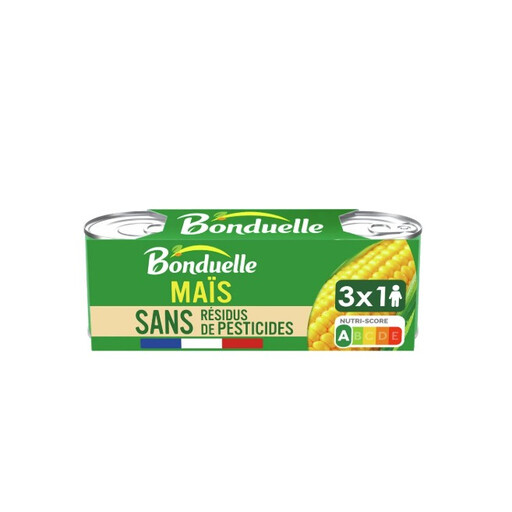 Image unavailable
This product may appeal to shoppers looking for the “No Residues” claim. “1/4 x 3” appears in its name, so check the number of containers and their drained net weight for the variant on offer before planning portions.
 Image unavailable
This 570 g size is worth considering if you plan to serve several portions from one tin. Compare its drained net weight with the amount you need, and follow the storage instructions on the product after opening.
Check the drained net weight to see how much sweetcorn you’ll have once the liquid has been drained away. The DGCCRF states that this information appears on the label of food sold in a covering liquid. If you’re buying a multipack, also check how many tins it contains.
Follow the instructions on the tin you’ve bought. For the Auchan Maïs croquant product reviewed, Auchan advises putting the leftovers in a suitable airtight container in the fridge and eating them within two days.
No: these claims relate to two different ingredients. Bonduelle’s listing for a “no added sugars” sweetcorn product includes salt; if you’re looking for no added salt, check for that claim and read the ingredients list for the exact product.
No: organic refers to a certification, while “no pesticide residues” is a claim to check on the product in question. Bonduelle states a quantification threshold of 0,01 mg/kg for its own claim; don’t assume that one characteristic applies simply because the other is present.