People who check ingredients carefully
You’re looking for a recipe whose ingredients list and allergen information meet your needs when shopping for lactose-free food.


To stock a lactose-free cupboard, start by checking the ingredients and allergen information on the tin you choose. Some plain sweetcorn products list only sweetcorn, water and salt. Then compare the pack size, sugars and salt to suit your needs. A recipe with no milk listed does not guarantee that there are no traces of milk. If that distinction matters to you, ask the manufacturer for more information.
You’re looking for a recipe whose ingredients list and allergen information meet your needs when shopping for lactose-free food.
You compare the drained weight and number of tins to make sure you have the right amount for your meals, while also checking what to do with any leftovers after opening.
You may also check the sugars, salt or growing-method information, without assuming that these tell you whether the product contains milk.
Start with the ingredients for the exact product you’re considering, then choose a pack size that suits how you’ll use it. Information about sugars, salt or growing methods relates to other priorities.
| What to look at | What to check | Who is it for? |
|---|---|---|
| Ingredients and allergens | Read the ingredients list and allergen information on the tin you buy. A list that does not declare milk does not, by itself, tell you whether there may be traces. | If milk in the recipe is my main concern, I want to check the information on the tin rather than rely on the “plain sweetcorn” category. Around 33% of consumers put this check first. |
| Pack size and storage | Compare the drained weight, the number of tins and the storage instructions for after opening. | If I only prepare a few portions at a time, I prefer an amount I can use in line with the pack instructions. This is the priority for around 27% of consumers. |
| Added sugars | Compare the wording on the packaging, the ingredients and the “of which sugars” line in the nutrition information. | I want to distinguish any added sugar from the sugars that occur naturally in sweetcorn. Avoiding added sugar is the priority for around 20% of consumers. |
| Salt and growing method | Depending on what matters to you, check the salt per 100 g or look for specific information about organic farming or pesticide residues. | If my main concern is salt or a particular growing method, I want to compare that separately from whether the recipe is milk-free. Around 20% of consumers prioritise one of these factors. |
Bonduelle explains that its sweetcorn labelled “no added sugars” contains sugars that occur naturally.
Check the ingredients list and the “of which sugars” line in the nutrition information.
These claims refer to different things and do not show that a recipe is milk-free.
Check the specific claim you’re interested in separately from the ingredients list for the product you choose.
How much you can use after opening may matter more than how many tins you can keep in the cupboard.
Compare the drained weight with the portions you plan to make, and check the storage instructions for each product.
If you open a tin that’s too large for your needs, you may have sweetcorn to use quickly or throw away.
Auchan says that the ingredients for its product may vary depending on the online grocery service and the date of purchase.
When your order arrives, check the ingredients and allergen information on the tin you’ve actually received.
Bonduelle says its sweetcorn product labelled “no added sugars” contains sweetcorn, water and salt.
Carrefour’s listings include sweetcorn products with different claims, including “no added salt”.
Auchan lists 285 g of drained weight for its crunchy sweetcorn, with a “no pesticide residues” claim.
E.Leclerc’s organic sweetcorn product comes in two 140 g tins and lists sweetcorn, water and salt.
Aldi lists 285 g of crunchy sweetcorn, advertised as having no added sugars.
d’aucy lists 285 g of crunchy sweetcorn with a “no pesticide residues” claim.
These tinned sweetcorn products come in different pack sizes and feature different on-pack claims. When shopping for lactose-free food, always check the ingredients and allergen information on the tin you choose.
 Image unavailable
The two tins may suit you if you prefer to open a smaller amount at a time. Check the ingredients and allergen information on the packaging; organic certification does not guarantee that there are no traces of milk.
 Image unavailable
This product may appeal if you’re looking for this specific claim in a 285 g pack. It doesn’t replace checking the ingredients and allergen information on the tin.
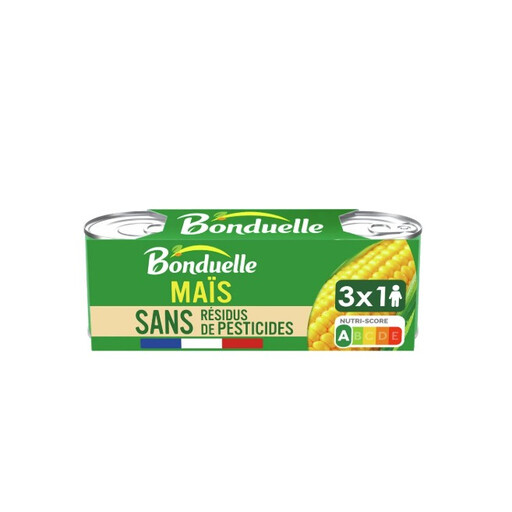 Image unavailable
If this variant interests you for your cupboard, check the packaging to see what the “1/4 x 3” pack includes and what its drained weight is. Also check the ingredients and allergen information on the tin you buy.
 Image unavailable
The 400 g pack is a good choice if you’re planning to use that amount. Check the ingredients and allergen information on the tin, and plan to use the contents soon after opening, following the storage instructions.
 Image unavailable
With a 570 g pack, you’ll need to plan how to use the contents after opening. The product listing says it may be handled in facilities that process milk. If traces are a deciding factor for you, check the labelling and ask the manufacturer for more information.
No. The category does not guarantee the ingredients of every product. The Bonduelle and Bio Village products featured here list sweetcorn, water and salt, but you should still check the tin you buy. If you also need to avoid traces of milk, ask the manufacturer for more information.
No. Bonduelle explains that its product bearing this claim contains sugars that occur naturally in the sweetcorn. When comparing tinned products, also check the “of which sugars” line in the nutrition information.
Follow the instructions on your tin, as these vary by product. For the products described here, Bonduelle recommends storing at a maximum of 4 °C and eating within 48 hours. Auchan advises transferring the contents to a suitable airtight container, refrigerating it and eating it within two days.
Read the ingredients list: the DGCCRF says that allergens in pre-packed foods must be emphasised in the list. This makes allergens included in the product easier to spot, but does not, by itself, guarantee that there are no traces.