People short on time in the evening
You’re looking for tinned sweetcorn to quickly round off a hot meal, in a quantity that suits the number of people you’re feeding and won’t leave you with lots of leftovers.


To quickly round off a comforting dinner, choose a quantity that suits the number of people you’re feeding, then check the ingredients list and the stated texture. No-added-salt, organic and ‘no pesticide residues’ options meet different criteria. Check each claim on the product you choose rather than assuming one covers the others.
You’re looking for tinned sweetcorn to quickly round off a hot meal, in a quantity that suits the number of people you’re feeding and won’t leave you with lots of leftovers.
Your dish already contains a sauce or other seasoned ingredients, so whether the sweetcorn contains added salt or sugar matters when you’re choosing.
You’re looking for an organic option or one labelled ‘no pesticide residues’. These claims refer to different characteristics and should be checked on each product.
Start with how much you plan to open and the dish you’re making, then check the ingredients and storage instructions for after opening.
| Criterion | What to check | Who it matters to |
|---|---|---|
| Quick and convenient format | Number of tins and stated quantity per tin, based on how many people you’re feeding. | If I’m making an evening meal that needs something extra, without opening more sweetcorn than necessary, the pack size comes before the other criteria. Around 33% of consumers prioritise convenience and pack size. |
| Texture of the dish | Whether it’s described as ‘tender’ or ‘crunchy’, and how the kernels will be used in the recipe; these terms aren’t measured consistently across brands. | For a stir-fry or gratin, I want to choose the stated texture that matches the result I’m after. This culinary choice comes first for around 27% of consumers. |
| Ingredients and claims | Ingredients, salt content and, if it matters to you, an organic claim or the definition of the claim displayed. | If dinner is already seasoned or I’m looking for a specific claim, I check the recipe and label first. Ingredients or a particular set of standards are the priority for around 20% of consumers. |
| Leftovers after opening | Drained weight, number of tins and storage instructions after opening. | If I’m cooking a small amount, I’d rather be able to use the opened tin within the stated time than leave leftovers. Around 20% of consumers put managing leftovers first. |
The Bonduelle product listed by Auchan contains sweetcorn, water and salt; the Notre Jardin tender sweetcorn listed by E.Leclerc also contains sugar. So the product name alone doesn’t tell you how it’s seasoned.
Read the ingredients and nutritional information on the tin you choose, especially if your dish already contains salty ingredients.
These claims refer to different criteria. The Auchan Bio product described by the retailer contains salt, so organic certification alone doesn’t tell you how the sweetcorn is seasoned.
Choose the characteristic that matters for your recipe, then check any other claims and the ingredients list separately.
The DGCCRF says that dents, traces of rust or bulging may be signs of deterioration. Anses advises against eating the contents of a dented or bulging tin.
Set aside any tin showing these signs, and don’t eat its contents if you’re in any doubt.
Several Bonduelle sweetcorn products feature in the French ranges listed by the retailers mentioned, with different recipes and claims.
Carrefour’s range includes standard, no-added-salt and organic products to consider depending on the recipe you have in mind.
E.Leclerc’s range includes tender sweetcorn, crunchy sweetcorn with no added sugar, and organic options.
Auchan’s range includes sweetcorn products with various claims, including a 2 × 140 g multipack of Auchan Bio sweetcorn.
ALDI offers a BIO® organic sweetcorn product for shoppers looking for this claim.
These tins of sweetcorn come in different sizes and carry different claims to consider for the dish you have in mind. Compare the drained weight and label of each product before choosing.
 Image unavailable
This two-tin multipack is a good option if you want to open just one tin for a small dish. Check the drained weight to work out how many kernels you’ll have, and follow the storage instructions after opening.
 Image unavailable
Consider this 570 g size if you’re planning to use more sweetcorn for dinner. Check the drained weight, ingredients and storage instructions after opening to make sure it suits your recipe.
 Image unavailable
This 285 g product is for shoppers who want to look into the ‘no pesticide residues’ claim on a tin of sweetcorn. Check the definition on the label, along with the drained weight and ingredients.
 Image unavailable
This 400 g size may suit you if you need sweetcorn kernels to round off a dish. Check the drained quantity and storage instructions, especially after opening, before planning to use it more than once.
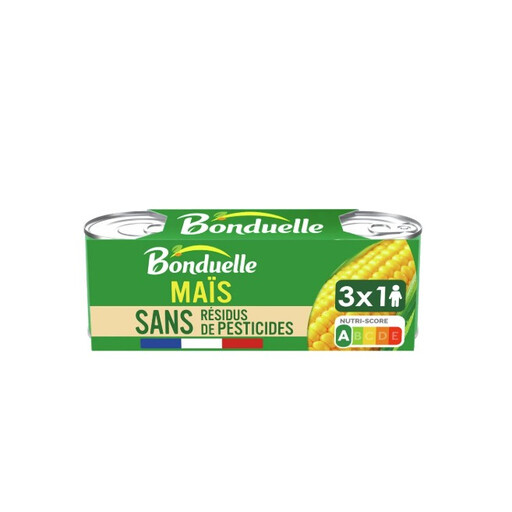 Image unavailable
This product carries the ‘No Residues’ claim and may be worth considering if this characteristic matters to you. Check the packaging to see what the claim covers, as well as the ingredients, number of tins, quantities and storage instructions after opening.
Choose based on how many people you’re feeding and how much sweetcorn you’ll use once the tin is open. A multipack of small tins lets you open one at a time. Check the drained weight to compare the quantity of kernels, rather than relying on the weight shown on the front of the pack.
No: this claim doesn’t mean the product is free from the sugars naturally present in sweetcorn. Check the ingredients list and nutritional information for the product you choose to distinguish its recipe from its sugar content.
Follow the instructions on the packaging of the product you’ve bought. For its 2 × 140 g multipack of organic sweetcorn, Auchan advises refrigerating the contents in a suitable container and using them within two days of opening. Check before applying this timeframe to other products.
The best-before date doesn’t mean you can skip checking the condition of the tin or ignore the manufacturer’s storage instructions. The DGCCRF warns that dents, traces of rust or bulging may indicate deterioration. If in doubt, don’t eat the contents.
According to Bonduelle, this claim means that none of the active chemical pesticide substances tested for were quantified above the stated limit of 0.01 mg/kg. It depends on which substances are tested for and the brand’s testing protocol; it doesn’t mean the product is certified organic or that it contains no substances at all.