Parents mindful of texture
You can start with textures your child already enjoys, choosing kernels described as tender or crunchy, then offer a small portion on the side. Manger Bouger advises against forcing a child to eat.


For a fussy eater, start with a texture they already accept and an amount your household can use after opening: a small tin is a better choice for a first try than a large one. Then compare the ingredients, salt, sugars and drained net weight. “No added sugars” does not mean “sugar-free”. Neither an organic recipe nor a claim that the corn is crunchy can tell you on its own whether your child will enjoy it.
You can start with textures your child already enjoys, choosing kernels described as tender or crunchy, then offer a small portion on the side. Manger Bouger advises against forcing a child to eat.
If only a few people will be eating sweetcorn, the drained net weight and size of each tin matter more than the number of tins in a multipack. Also check the stated storage time after opening.
You may want to distinguish a recipe with no added salt from one that contains salt, or check what “no added sugars” means. The ingredients list and nutritional information let you compare specific products.
For a first meal, start by choosing a texture that suits your child and an amount that’s easy to use. Then compare the products by their ingredients.
| What to consider | What to check | Who is it for? |
|---|---|---|
| Texture and presentation | Check the texture description and consider how comfortable your child is with pieces of food. | If my child accepts some textures but refuses others, I want to be able to offer a few kernels without putting pressure on them. Around 42% of consumers would rank texture and presentation as their top priority. |
| Ingredients and salt | Check the ingredients list, and the salt and sugars per 100 g; distinguish “no added salt” from “no added sugars”. | I want to know what’s in the tin before adding it to a meal, rather than relying on the word “sweet” alone. Ingredients would be the priority for around 33% of consumers. |
| Pack size and storage | Compare the drained net weight of each tin and the manufacturer’s instructions for storage after opening. | If I’m serving only a small amount with a meal, I’d rather not open more than we can finish. Around 25% of consumers would prioritise pack size and storage. |
Sweetcorn naturally contains sugars. The Bonduelle product reviewed is labelled “no added sugars”, and its ingredients list includes sweetcorn, water and salt.
Also check the “sugars” line in the nutritional information per 100 g and read the ingredients list.
Any leftovers should be stored according to the instructions for the specific product. Bonduelle says its no-added-sugars sweetcorn reviewed here should be consumed within 48 h of opening and kept at no more than 4 °C.
For a first try, compare the drained net weight of each tin and plan how you’ll use the leftovers within the stated time.
Any food that isn’t eaten in time may have to be thrown away.
Auchan notes that the ingredients in the crunchy sweetcorn product reviewed may vary depending on the online grocery listing and purchase date.
If a particular ingredient matters to you, check the details for the product you’ve selected, then check the label on the product you receive.
Pressuring your child to eat can make trying a new food feel like a chore. Manger Bouger advises against forcing a child to eat.
Offer a small amount alongside the rest of the meal, without insisting that they finish what’s on their plate.
The no-added-sugars sweetcorn kernels product reviewed contains 285 g drained net weight.
The organic product listed by Carrefour comes as two tins, each with a drained net weight of 140 g.
Carrefour lists products with no added salt and no added sugars, depending on the product.
One crunchy sweetcorn product reviewed has a drained net weight of 285 g.
ALDI sells a crunchy sweetcorn product under its Fleur des Champs brand.
These sweetcorn kernel products are handy store-cupboard options for meals. If you’re only planning to serve a small amount, compare the size of each tin and check the drained net weight, along with the storage instructions after opening.
 Image unavailable
Two separate tins mean you can open just one for a first serving. The title states 140 g per tin; compare the drained net weight before deciding how much to serve.
 Image unavailable
This 570 g size is worth considering if several people will be eating sweetcorn or you’re planning to use the leftovers. Check the drained net weight and storage instructions after opening.
 Image unavailable
If you’re serving sweetcorn as a side with a meal, compare this 400 g size with the amount your household will use. Check the drained net weight and instructions for after opening before opening the tin.
 Image unavailable
This 285 g size may be worth comparing for a family meal. “No pesticide residues” is part of the product name; check the drained net weight separately to decide how much to open.
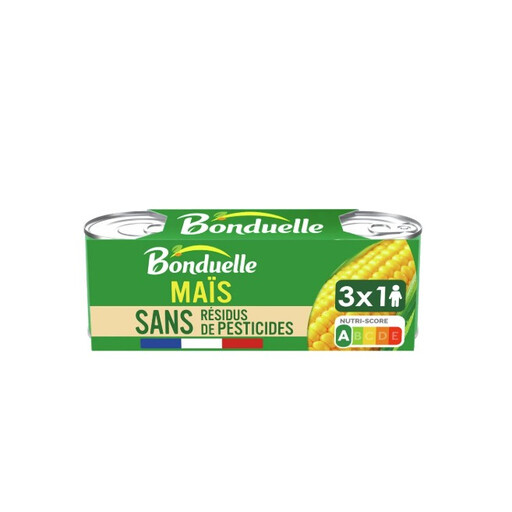 Image unavailable
If you’re looking for several portions to serve with different meals, check what “1/4 × 3” refers to before choosing this variant. Check the total quantity, drained net weight and storage instructions after opening on the product.
Serve a small amount alongside the other food and let your child decide whether they want to try it. Manger Bouger advises against forcing a child to eat or using rewards and punishments at mealtimes.
No. The Bonduelle product reviewed is labelled “no added sugars”, but it also contains naturally occurring sugars. Check the “sugars” line per 100 g in the nutritional information, as well as the ingredients list.
Follow the instructions on the tin you’ve chosen, as storage times and conditions depend on the product. For its no-added-sugars sweetcorn reviewed here, Bonduelle advises keeping it at no more than 4 °C and consuming it within 48 h of opening. The DGCCRF reminds consumers to follow the manufacturer’s instructions.
The way it’s prepared should suit your child’s stage of weaning and how comfortable they are with pieces of food: age alone isn’t enough to determine the right texture. Manger Bouger recommends introducing new textures and foods gradually.