Cyclists preparing quick meals
You’re looking for ready-to-drain kernels to add to a salad or a meal around your training, without making sweetcorn the only source of carbohydrates on your plate.


To round off meals around a bike ride, choose tinned sweetcorn based on the recipe of the specific product, then pick a pack size you can use without leaving leftovers. Sweetcorn provides carbohydrates, but it isn’t a meal in itself: Bonduelle lists 15 g of carbohydrates per 140 g serving of its “No Added Sugar Corn” product, while INSEP describes starchy foods as a source of carbohydrates to consider depending on the situation.
You’re looking for ready-to-drain kernels to add to a salad or a meal around your training, without making sweetcorn the only source of carbohydrates on your plate.
You compare the drained weight of the sweetcorn and choose a pack size whose contents you’ll be able to use.
You check the ingredients, nutritional values and claims for each product, particularly those relating to added salt or organic ingredients.
When choosing a tin for several meals, start with the amount of usable kernels, then check the recipe and what you’ll do with the contents after opening.
| Criterion | What to check | Who is it for? |
|---|---|---|
| Amount to prepare | The drained weight and the number of meals you have in mind. | If I’m cooking for several meals, I want to know how many kernels I can actually serve; around 33% of consumers would prioritise this usable quantity. |
| Recipe and salt | The ingredients and the “salt” figure per 100 g for the product you’re considering. | If other foods in the meal are already salty, I’d rather be able to check whether salt has been added to the sweetcorn; this would be the main consideration for around 25% of consumers. |
| Leftovers after opening | The number of tins in the pack and the storage instructions after opening. | If I’m preparing just one meal, I want to avoid leaving a large tin open; around 25% of consumers would make managing leftovers their priority. |
| Organic and other claims | The organic claim, stated origin and exact wording of any other claims. | If a production criterion guides my choice, I want to see it on the tin I’m buying; it would be a priority for around 17% of consumers. |
The claim refers to added sugar: it doesn’t mean the sweetcorn contains no sugar, and on its own it says nothing about the role it could play in a cyclist’s meal.
Also check the “of which sugars” and “carbohydrates” figures in the nutritional information for the product you’re considering.
A recipe containing sweetcorn, water and salt doesn’t necessarily describe every tin in the range. For example, Carrefour describes a Géant Vert organic variant with no added salt or sugar as containing organic sweetcorn and water.
Check the packaging of the exact variant if you’re looking for a particular recipe or claim.
For its “No Added Sugar Corn” product, Bonduelle advises storing it at a maximum of 4 °C and consuming it within 48 hours of opening.
Choose a pack size that suits the meals you have planned and follow the instructions on your tin.
Some of the contents may go to waste if you can’t use them within the stated time.
The brand offers tinned sweetcorn, including its “No Added Sugar Corn” product.
These own-label brands offer various tinned sweetcorn products.
An organic sweetcorn product is available in a pack of two 140 g tins.
The range includes products with different claims, including organic and no added salt.
ALDI France lists a 285 g tin of organic sweetcorn.
These packs of sweetcorn can round off meals around a bike ride. Pack sizes and claims vary, so check the recipe and instructions for after opening on each product.
 Image unavailable
Two small tins to consider if you’re preparing separate meals. Check the recipe and instructions for after opening on the packaging.
 Image unavailable
Sweetcorn kernels to consider for a salad or side dish. Check the wording and conditions of the claim on the packaging; it doesn’t mean “no added salt”.
 Image unavailable
This pack size could suit you if you’re planning to use sweetcorn in several meals. Check the storage instructions before opening the tin.
 Image unavailable
Sweetcorn kernels to add to a salad or serve as a side dish. Compare the drained weight on the packaging with that of the other pack sizes you’re considering.
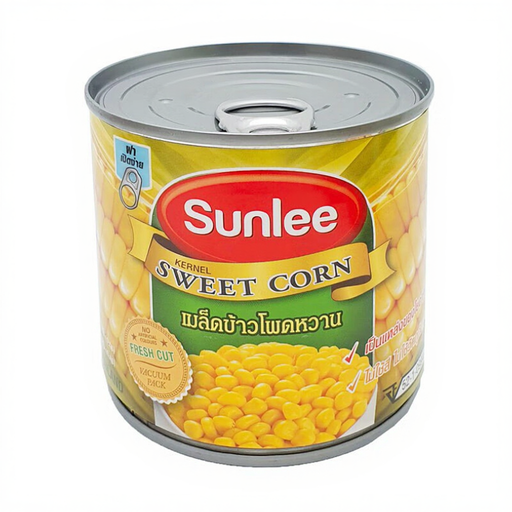 Image unavailable
This vacuum-packed sweetcorn could be a good addition to a salad or side dish. Before choosing it, make sure the product label matches this pack and check its instructions for after opening.
Sweetcorn can be part of this meal, but it doesn’t necessarily need to be the only source of carbohydrates. Bonduelle lists 15 g of carbohydrates per 140 g serving of its “No Added Sugar Corn” product; INSEP also includes starchy foods among the sources of carbohydrates to consider depending on the situation.
Compare the recipe, carbohydrates and salt per 100 g, then check the drained weight of the sweetcorn. The DGCCRF notes that prepacked food labels include details such as the ingredients list and nutrition declaration; check this information on the specific products you’re considering.
Follow the time limit and temperature shown on the tin in question. For its “No Added Sugar Corn” product, Bonduelle advises storing it at a maximum of 4 °C and consuming it within 48 hours of opening; these instructions shouldn’t be assumed to apply to every product.
According to the DGCCRF, food can be eaten after its best-before date if the packaging is intact, although its taste and quality may change. Check the exact date wording on the tin and discard any damaged packaging; this principle doesn’t apply in the same way to a use-by date.