Households stocking up
You’re looking for sweetcorn that’s ready to serve, in a pack size that suits how much you use across your meals. Drained weight makes it easier to compare tins and multipacks.


When stocking your store cupboard, start by comparing the drained weight and the number of tins: the total weight doesn’t always tell you how much sweetcorn you can actually use. Then choose a recipe and pack size to suit your meals, and check the best-before date and packaging before putting it away.
You’re looking for sweetcorn that’s ready to serve, in a pack size that suits how much you use across your meals. Drained weight makes it easier to compare tins and multipacks.
You want to distinguish recipes containing sugar or salt from those with a different ingredients list. The ingredients and nutrition information for the specific product will help you choose.
You look for an organic label, information about where the product comes from or packaging that’s easy to store. Check these details for each individual product, even within the same brand.
When choosing a tin to keep in your store cupboard, start with how much sweetcorn you’ll use, then compare recipes and packaging to suit the way you plan to use it.
| Criterion | What to check | Who it’s for |
|---|---|---|
| Usable quantity | Compare the drained weight per tin and the number of tins in a multipack. | If I’m stocking up for several meals, I want to know how much sweetcorn I’ll actually be able to serve. Around 36% of consumers say this is their main concern. |
| Recipe | Check the ingredients and the sugar and salt values per 100 g for the specific product you’re considering. | When I choose a recipe to suit my preferences, the ingredients matter more to me than the brand name. The ingredients list is the top priority for around 29% of consumers. |
| Use and texture | Choose a quantity that suits the dishes you have in mind, and check any texture information on the specific product. | For salads or side dishes, I mainly look for a pack size and stated texture that suit the way I plan to use the sweetcorn. Around 21% of consumers would put this use first. |
| Organic status, origin and packaging | Check the organic and origin details on the specific product, as well as the type of packaging. | If an organic label, stated origin or easy-to-store packaging influences my purchase, I check these details before choosing. This is the main criterion for around 14% of consumers. |
Bonduelle states that its product labelled ‘no added sugar’ contains naturally occurring sugars. This claim also tells you nothing, on its own, about the salt content.
If these details matter to you, check the ingredients and nutrition information per 100 g on the exact product you’re buying.
The DGCCRF warns that bulging, rust or dents can be signs of deterioration.
Check the tin before buying it or putting it away. If you’re unsure about its condition, don’t eat the contents.
Ingredients, quantities and packaging claims can vary between products in the same range.
Check the size and label of the product you’ve chosen, particularly if you’re buying it for its organic status, stated origin or lack of a particular added ingredient.
The range includes a product labelled ‘no added sugar’. For this product, Bonduelle lists sweetcorn, water and salt, and a drained weight of 285 g.
Carrefour lists a 285 g tin of SIMPL sweetcorn, with sweetcorn, water, sugar and salt in the ingredients list.
Carrefour’s range includes an organic Géant Vert product in two tins, each with a drained weight of 140 g. The ingredients list includes organic sweetcorn and water.
The Jardin Bio product featured by Carrefour comes in a carton and contains organic sweetcorn, water, sea salt and organic concentrated lemon juice.
E.Leclerc lists a 285 g drained-weight ECO+ product of vacuum-packed sweetcorn, made with sweetcorn, water, sugar and salt.
These sweetcorn products are worth considering if you’re stocking up your store cupboard. To compare them by quantity or recipe, check the label on the exact size before ordering, especially if the product information is contradictory.
 Image unavailable
A pack of sweetcorn to consider if you want something ready to serve in your store cupboard. The title states 400 g; check the drained weight on the product to find out how much sweetcorn you can use.
 Image unavailable
A sweetcorn product to consider if this size suits your meals. The title states 285 g: check the drained weight and the claims on the label of the exact product. Don’t assume it has the same features as another Bonduelle tin.
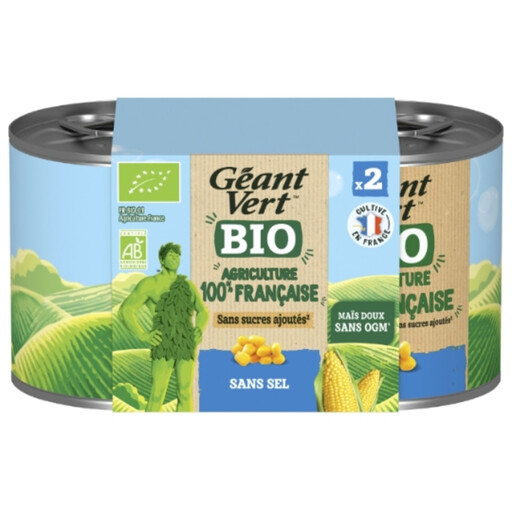 Image unavailable
A sweetcorn product to consider for your store cupboard, but pay particular attention to the stated size and salt content. The advertised quantities don’t match, and the title says ‘Unsalted’ even though an associated ingredients list includes salt. Check the exact packaging, including the organic claim and drained weight, before choosing this product.
To compare how much sweetcorn you can use, check the drained weight when it’s packed in liquid. The DGCCRF says that, in this case, the drained weight must be shown on the label as well as the net quantity.
No. A tin labelled ‘no added sugar’ may contain naturally occurring sugars, as Bonduelle states for the product in question. To find out how much sugar it contains, check the nutrition information per 100 g for the product you’ve chosen.
Before opening, follow the best-before date and storage instructions on the packaging. Once opened, follow the guidance for the product you’ve bought rather than relying on the instructions for a different size.
If you’re unsure whether the tin is intact, don’t eat the contents. The DGCCRF says rust, bulging or dents can be signs that the product has deteriorated.
Check the product name, ingredients, nutrition information, quantity and best-before date. For food packed in liquid, the DGCCRF says the label must also state the drained weight.