Occasional home bakers
If you only make cornbread now and again, a tin containing 140 g drained matches the amount used in Bonduelle’s recipe, so you won’t need to store any leftovers.


For a recipe calling for 140 g of drained sweetcorn, such as Bonduelle’s, a small tin containing 140 g drained makes it easy to measure out what you need without leaving an opened tin. A multipack of tins containing 285 g drained is a better choice if you’re planning to bake several loaves or can use the leftover sweetcorn quickly. Whether you buy a single tin or a multipack, check the drained weight and storage instructions after opening.
If you only make cornbread now and again, a tin containing 140 g drained matches the amount used in Bonduelle’s recipe, so you won’t need to store any leftovers.
A multipack of larger tins gives you a supply for several bakes. If you don’t use a whole tin, though, plan when to use the remainder and follow the storage instructions for the product you buy.
If you’re looking for an organic label, a specific country of origin or particular ingredients, check the tin you choose. These details can vary between products, even within the same brand.
Start with the drained weight of sweetcorn your recipe calls for, then choose how many tins to buy based on the number of batches you’re planning. If you only use 140 g, a tin containing 285 g drained will leave you with some sweetcorn to use up.
| What to consider | What to check | Who is it for? |
|---|---|---|
| Stock for several batches | Multiply the drained weight per tin by the number of tins in the multipack. | If I’m making several loaves, I want enough drained sweetcorn in the cupboard; around 36% of consumers would prioritise having this supply. |
| Portion size and leftovers | Compare the drained weight of one tin with the 140 g used in Bonduelle’s recipe, and check the instructions for after opening. | If I’m only making one loaf, I’d rather open an amount close to what my recipe needs than have leftovers to manage; around 29% of consumers would prioritise this. |
| Ingredients and salt | Check the ingredients and the amount of salt per 100 g on the product you choose. | When seasoning my dough, I want to know how much salt the tinned sweetcorn already adds; around 21% of consumers would put this check first. |
| Claims and origin | Check the claim you’re looking for and the stated origin on the exact product packaging. | If I choose a product based on an organic claim or its origin, I want to be able to find that information on the tin I buy; around 14% of consumers would make this their priority. |
Three tins containing 140 g drained each won’t give you the same amount for your recipes as three tins containing 285 g drained each.
Check the drained weight on each tin and work out the total for the multipack before choosing how much to stock up on.
A recipe using 140 g drained won’t use up a tin containing 285 g drained. The Bonduelle and Auchan products we checked advise refrigerating the remainder and using it quickly.
Choose a smaller tin or plan another dish for the rest, following the instructions for the product you buy.
Without a plan to use it up, the leftover sweetcorn could go to waste.
Bonduelle’s ‘no added sugars’ claim doesn’t mean its sweetcorn contains no sugar: the brand says it contains naturally occurring sugars.
Read the claim alongside the ingredients list and nutritional information on the tin you choose.
The condition of the tin matters too: Anses advises against eating food from a tin that is bulging, deformed or gives off a suspicious smell when opened.
Discard a tin like this, even if the printed date seems acceptable.
Bonduelle offers a sweetcorn product containing 285 g drained, among others, with different claims depending on the product.
The Carrefour products we checked include multipacks of three tins containing either 140 g or 285 g drained per tin.
Both E.Leclerc ranges offer multipacks of three tins containing 140 g drained each, which is a suitable amount for Bonduelle’s recipe.
The Pouce product we checked is a multipack of three tins containing 140 g drained each, or 420 g drained in total.
ALDI offers a single 285 g tin of organic sweetcorn for shoppers who prioritise this feature.
This selection of tinned sweetcorn kernels includes a small multipack, a pack size to check and a single tin. To see how they fit your bread recipe, check the drained weight: the amounts in their product titles alone won’t tell you how many 140 g portions you’ll get.
 Image unavailable
This multipack of two tins could suit you if you’re only making a few loaves at a time and want this organic product. Check the drained weight of each tin before assuming you’ll have 140 g of usable sweetcorn for each bake.
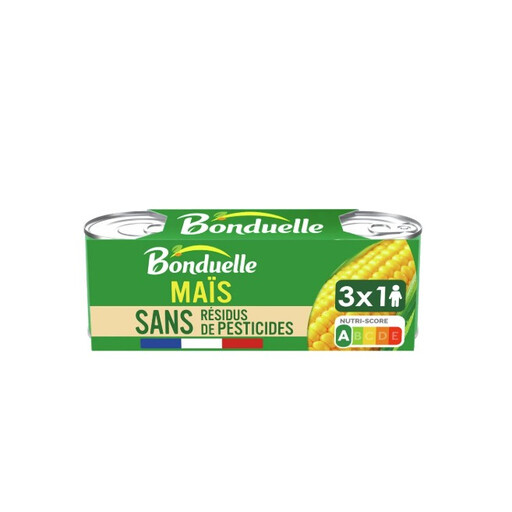 Image unavailable
If you’re stocking up for several batches, check what the ‘1/4 × 3’ pack includes before buying. Also check the drained weight per tin so you can compare it with the 140 g in the recipe. The ‘no residue’ claim is Bonduelle’s own.
 Image unavailable
This single tin could suit an occasional need rather than stocking up with a multipack. The stated 285 g doesn’t tell you the drained weight, so check this to work out how much to use in your bread and plan what to do with any leftovers. The ‘no pesticide residues’ claim is Bonduelle’s own.
Bonduelle’s cornbread recipe for four people uses 140 g of drained sweetcorn. Use the amount in your own recipe as a starting point, then compare it with the drained weight of the tin.
Yes, if your recipe gives a drained weight: the 140 g in Bonduelle’s recipe refers to the sweetcorn after draining. Don’t use the total weight printed on the tin instead.
Put the leftovers in an airtight container in the fridge and follow the time limit on the product you bought. The Bonduelle and Auchan listings we checked advise using it within two days of opening.
The DGCCRF says that food with a best-before date can be eaten after that date if its packaging hasn’t been damaged, although some qualities, such as flavour, may have deteriorated. Check that it’s a best-before date and not a use-by date.
Don’t eat its contents. Anses advises against eating food from tins that are bulging or deformed, or that give off a suspicious smell when opened.