People who count protein per portion
You want to know how much protein you’ll actually get from the amount of soup you serve, rather than relying on the presence of lentils or a claim on the packaging.


If you’re buying several cupboard soups as part of a high-protein diet, start by comparing the grams of protein in the portion you’ll actually eat. The presence of lentils or the recipe name alone isn’t enough. Auchan’s listing for a La Potagère soup gives 1.4 g of protein per 100 mL, or 3.5 g in a 250 mL bowl. Also check the salt, ingredients and storage instructions after opening. If your chosen soup doesn’t meet your needs, tinned pulses can help you put a meal together, but they aren’t a ready-to-serve soup themselves.
You want to know how much protein you’ll actually get from the amount of soup you serve, rather than relying on the presence of lentils or a claim on the packaging.
You’re comparing cartons, sachets and tinned pulses by portion size, preparation and storage instructions.
Before buying several units of the same recipe, you need to check the salt, ingredients of animal origin, allergens and any possible traces.
The format determines how you prepare and store the soup; then the label helps you compare protein and salt for the amount you’ll serve.
Choose this if: you want a soup that’s ready to heat and can compare its nutritional values per portion.
Bear in mind: a carton isn’t a tin, and the protein content depends on the recipe and serving size.
Choose this if: portioning and compact storage matter more to you than having soup that’s ready to heat.
Bear in mind: you’ll need to add water and prepare each portion; several sachets don’t make a multipack of tins.
Choose this if: you’re happy to put a meal together by adding pulses to a soup.
Bear in mind: this takes extra preparation and isn’t a substitute for a ready-to-eat soup.
| What to compare | What to check | Who is it for? |
|---|---|---|
| Protein per bowl | The grams of protein in the portion you’ll serve. If the label only gives the value per 100 mL, calculate it for your bowl size. | If I’m relying on soup to contribute to my protein intake, I want to know how much I’ll actually eat. Around 33% of consumers put this need first. |
| Format and storage | The packaging material, number of portions, preparation method and instructions after opening. | To keep several portions in the cupboard without opening a container that’s too large for my needs, I choose a format that suits my routine. This comes first for around 20% of consumers. |
| Ingredients and allergens | The ingredients list and any warnings about traces on each recipe, particularly for milk, gluten or ingredients of animal origin. | If certain ingredients don’t suit me, I need to be able to rule out a recipe before buying several. Around 20% of consumers prioritise this. |
| Salt and nutritional information | The grams of salt in your planned portion, alongside the protein content. If shown, Nutri-Score is an additional guide. | I want to compare the overall nutritional value of a bowl, not just focus on protein. For around 27% of consumers, this balance is the top priority. |
The amount depends on the recipe and serving size. Auchan’s listing for La Potagère butternut squash, red lentil and cream soup gives 1.4 g of protein per 100 mL, or 3.5 g per 250 mL.
Compare the grams of protein in the same serving size before buying several units. A “high in protein” claim follows a separate rule and doesn’t, by itself, tell you how many grams are in your bowl.
These types of packaging may need different preparation and may not keep in the same way once opened.
Check the exact container, number of portions and instructions after opening before deciding how much to store.
Carrefour’s listing for Knorr Petit Salé aux Lentilles soup mentions pork and milk in the form of lactose, among other ingredients. Other recipes checked may contain allergens or possible traces.
Read the ingredients list and allergen information for the specific product you’re buying, even if lentils feature prominently in its name.
Anses lists soups and broths among the foods that contribute to salt intake. Auchan’s listing for La Potagère soup gives 0.5 g of salt per 100 mL, or 1.25 g per 250 mL.
Compare protein and salt for the same portion. If a Nutri-Score is shown, use it alongside the nutritional values and ingredients.
The 10-vegetable and crouton dried soup listed by Carrefour comes in three sachets. It’s suited to separate portions, not to anyone looking for soup in a tin.
The Petit Salé aux Lentilles dried soup listed by Carrefour is one option to consider if you want a recipe that states the proportion of lentils.
The butternut squash, red lentil and cream liquid soup listed by Auchan lets you compare the nutritional values of a carton soup.
The organic lentil and thyme soup listed by Carrefour comes in a 66 cL bottle, rather than a tin.
This selection features prepared lentils to add to soup or serve alongside it, not tinned soup or a multipack of tins.
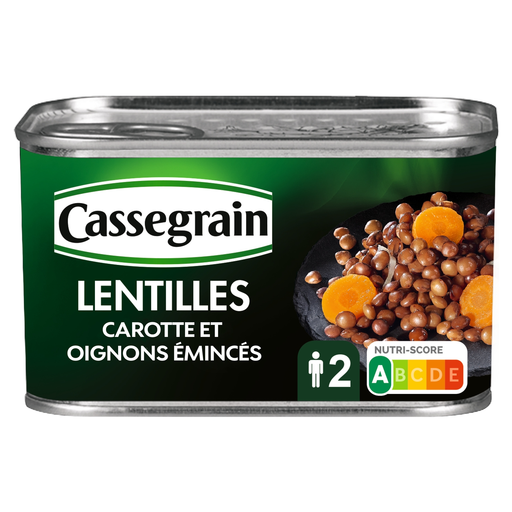 Image unavailable
Use these tinned lentils to put together a meal with soup; they aren’t a ready-to-eat soup.
265 g tin with carrots and onions. Check how many lentils you’ll add to each portion of soup.
Under European Union Regulation (EC) No 1924/2006, this claim can only be used if at least 20% of the product’s energy value comes from protein. It doesn’t replace checking the grams of protein in the portion you’ll eat.
Not necessarily: the amount of lentils and protein per bowl varies by recipe. Auchan’s La Potagère butternut squash, red lentil and cream soup gives 1.4 g of protein per 100 mL, or 3.5 g per 250 mL. Compare this with the portion you plan to serve.
Follow the instructions on the packaging. Auchan’s listing for La Potagère butternut squash, red lentil and cream soup says to keep it refrigerated and consume it within two days of opening. Don’t assume the same storage time applies to other recipes.
No. Check the grams of protein for the portion you’ll serve. Santé publique France describes Nutri-Score as a voluntary label that complements nutritional information, not a substitute for the nutrition table or ingredients list.
Check the ingredients, allergens, net quantity, nutritional values and storage instructions for each product. The DGCCRF states that allergens must be emphasised on food labels; also check any warnings about traces on the product you buy.