People who check the salt content first
You want to tell a tin labelled ‘no added salt’ apart from a recipe that may contain salt. The ingredients list and salt content per 100 g let you check the product you’re considering.


When choosing a single tin of peeled tomatoes as part of shopping with diabetes in mind, compare the ingredients, carbohydrates, sugars and salt per 100 g, then choose an amount that suits your recipe. A 240 g tin can help avoid leftovers for a small dish, while a 400 g tin is suitable if your recipe needs more tomatoes. If you’re looking for a product with no added salt, check this claim on the exact product rather than assuming it from the name or brand.
You want to tell a tin labelled ‘no added salt’ apart from a recipe that may contain salt. The ingredients list and salt content per 100 g let you check the product you’re considering.
If you’re cooking a small amount, you may prefer a 240 g tin to a larger one, provided its contents suit your recipe.
You’re planning a recipe that uses a 400 g tin of whole peeled tomatoes, and can adjust the amount used to suit the number of portions.
When comparing individual tins, Assurance Maladie recommends checking the nutritional information per 100 g. Then check how much your recipe needs and read the ingredients list for the specific product.
| Criterion | What to check | Who this matters to |
|---|---|---|
| Added salt | The ‘no added salt’ claim, the ingredients list and the salt content per 100 g on the tin you’ve chosen. | If I’m mainly looking for a recipe with no added salt, I need to distinguish this claim from the salt content shown on its own. Around 36% of consumers would make this their top priority. |
| Amount and leftovers | The stated weight and the amount of tomatoes needed for the recipe; storage instructions after opening if you won’t use the whole tin. | For a small dish, I prefer an amount that doesn’t leave me with most of the tin to store. This would be the main concern for around 29% of consumers. |
| Ingredients and carbohydrates | The product description and ingredients, followed by the carbohydrates and sugars per 100 g and in the amount you’ll actually use. | When I’m preparing a meal, I want to know what’s in the tin and how many tomatoes I’m adding. Around 21% of consumers would put checking the ingredients first. |
| Texture and quantity | Look for ‘whole peeled tomatoes’ rather than chopped tomatoes, passata or sauce, and choose a tin size that suits the recipe. | If my sauce or slow-cooked dish needs whole tomatoes, their form and quantity are the deciding factors. This would be the priority for around 14% of consumers. |
These descriptions don’t necessarily mean the same thing: added ingredients can vary.
Read the product description and ingredients list, then compare carbohydrates, sugars and salt per 100 g.
This guide doesn’t replace checking the ingredients or the nutritional values that help you compare two products.
Check the carbohydrates, sugars and salt per 100 g on each tin you’re considering.
Auchan says the ingredients in its whole peeled tomatoes in juice can vary depending on the click-and-collect store and purchase date; one variant contains salt.
Check the product information for your store and the label on the tin you receive, especially if you’re looking for a product with no added salt.
A small recipe may only use part of a 400 g or 480 g tin.
Choose a size that suits the amount you’re cooking, and follow the storage instructions on the tin after opening.
Mutti sells its Pelati peeled tomatoes in 400 g and 800 g tins, as well as in packs of two 400 g tins.
Cirio sells whole peeled tomatoes in 400 g and 800 g tins, promoted for sauces and long cooking.
The Jardin BiO étic whole peeled tomatoes sold by Auchan come in a 240 g tin labelled ‘no added salt’.
E.Leclerc sells Notre Jardin whole peeled tomatoes in juice in a smaller tin.
Auchan sells whole peeled tomatoes in juice in a 480 g tin.
If your recipe calls for 400 g of tomatoes, this tin of cherry tomatoes is worth considering. Before choosing it as a tin of peeled tomatoes, check the product description and ingredients list on the label.
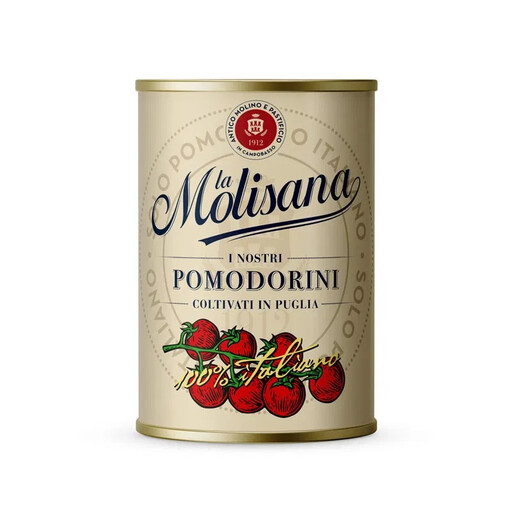 Image unavailable
Consider this 400 g tin if your recipe uses this amount of tomatoes; for a small dish, plan how you’ll use the leftovers.
Check the tin to make sure these are whole peeled tomatoes, then read the ingredients and nutritional values per 100 g. Follow the storage instructions on the packaging after opening.
No. Assurance Maladie doesn’t generally prohibit any particular food as part of a diet for diabetes. When choosing a tin, read the ingredients, carbohydrates, sugars and salt, then consider how much you’ll use in your meal.
No. For peeled tomatoes, use it alongside the ingredients list and the carbohydrate, sugar and salt values per 100 g for the products you’re comparing.
Follow the instructions on the tin you bought. The Auchan product information for Jardin BiO étic recommends refrigerating its product after opening and using it within two days; this guidance doesn’t necessarily apply to every brand.
Not necessarily. Auchan says the ingredients in its product may vary depending on the click-and-collect store and purchase date, with one variant containing salt. Check the product information for your order and the label on the tin you receive.