For a Sunday meal where you want to adjust the seasoning yourself, choose plain peas and compare their drained weight, ingredients and salt content. A peas and carrots mix gives you two vegetables in one tin, while a recipe with onions or flavourings works well if its taste already suits the dish. In both cases, you have less control over the ingredients in your side dish. Choose a size to suit the number of people you’re serving, and follow the storage instructions once opened.
Who are these tinned options for?
Anyone planning a cupboard-friendly side dish
A tin lets you plan a side dish without having to buy fresh vegetables on the day. In its 2024 survey on tinned and frozen vegetables, UNILET highlights consumers’ interest in how easy they are to preserve and store.
Cooks who like to adjust the seasoning
If your sauce or main course already has a strong flavour, compare the ingredients rather than relying on the “extra-fine” label alone: the plain pea recipes reviewed don’t all contain the same flavourings.
Smaller households keeping an eye on leftovers
For one or two people, the drained weight helps you choose how much to serve. The products mentioned include a 265 g drained Bonduelle mix and 560 g drained tins of Bonduelle or Carrefour Classic’ peas. Check how long your chosen product can be kept after opening, too.
What should you check before buying?
First, check that the tin can be stored in the cupboard before opening. Then choose the recipe and drained weight to suit your menu and the number of people you’re serving.
Plain peas
Choose these if: you want to season the side dish yourself to complement your main course.
Good to know: “plain” doesn’t mean you can skip the ingredients list: some of the products mentioned contain a natural flavouring.
Peas and carrots
Choose these if: you want to serve two vegetables from one tin.
Good to know: the proportion of each vegetable can vary by product. This mix isn’t suitable if you want to serve peas on their own.
Peas with onions
Choose these if: the onion flavour suits the side dish you have in mind.
Good to know: this recipe gives you less control over the final flavour. Compare the salt content per 100 g as well.
| What to consider |
What to check |
Who is it for? |
| Availability and preparation |
How the product should be stored before opening, and the preparation instructions on the packaging. |
If I’m planning a meal without buying fresh vegetables, I want to be able to take a side dish from the cupboard and prepare it quickly. This would be a priority for around 36% of consumers. |
| Recipe and seasoning |
The ingredients list, including whether it contains sugar, salt, flavourings, carrots or onions. |
If I’m serving a strongly flavoured sauce, I’d rather season the side dish myself. Around 29% of consumers would make this flexibility their priority. |
| Size and leftovers |
The drained weight and storage instructions after opening, rather than the total weight alone. |
For a small gathering, I want to open an amount we can finish within the recommended time. This would be the top priority for around 21% of consumers. |
| Origin and ingredients |
The origin, where stated, the ingredients and the salt content per 100 g. |
If the origin or ingredients guide my choice, I want to be able to compare two similar tins by checking their labels. This would be the main deciding factor for around 14% of consumers. |
Mistakes to avoid
-
Comparing the total weight only
The total weight includes the liquid, but not all of it will end up on your plate as drained vegetables.
When planning the side dish, compare tins by their drained weight.
-
Assuming “extra-fine” means nothing has been added
The extra-fine products mentioned may contain sugar, salt and, depending on the product, a natural flavouring. The label describes the peas, not the recipe as a whole.
Check the ingredients list if your main course is already seasoned or you’re looking for a milder flavour.
-
Opening a large tin without planning for leftovers
How long the product keeps changes once it’s opened and depends on the instructions for the product you’ve bought.
Choose a drained weight to suit the number of people you’re serving, then transfer any leftovers to a suitable container and follow the time limit on the packaging.
-
Confusing tinned peas with a pea snack
A pea-based snack and a tin of peas intended as a side dish have different uses.
Check the product category, ingredients and storage instructions before choosing it as a side dish.
Brands to compare
These brands offer the types of recipes discussed here. Check the label on the specific product you’re considering rather than relying on the brand name alone.
Bonduelle
The brand offers tinned peas and peas and carrots mixes. Bonduelle states that the peas in the plain product mentioned are of French origin.
- The product details for this plain variety include the drained weight, ingredients and instructions for after opening.
- Check the recipe and size of each tin: details for one product don’t apply to the whole range.
Carrefour Classic’
The extra-fine peas mentioned have a drained weight of 560 g.
- The ingredients list makes it easy to compare the recipe with other tinned peas.
- It contains a natural flavouring, which is worth bearing in mind if you want to season a mild-tasting side dish yourself.
Notre Jardin (Marque Repère, E.Leclerc)
The products mentioned include extra-fine peas and a peas and carrots mix.
- E.Leclerc states that the peas in the plain product mentioned are from France and have a drained weight of 560 g.
- Compare the ingredients and weight of each product: the mix and the plain peas suit different needs.
d’aucy
The extra-fine peas and carrots mix mentioned has a drained weight of 530 g and is stated to be from France.
- It brings two vegetables together in one tin, and the label gives storage instructions for after opening.
- This mix is less suitable if you want to serve peas on their own or portion out the carrots separately.
Cassegrain
The product mentioned combines peas with pearl onions.
- According to the product details shown by Auchan, this recipe contains 1% pearl onions, so you can decide whether their flavour will suit your meal.
- The same product details list a natural flavouring and 0.8 g of salt per 100 g. Compare this with the salt content of the other products you’re considering.
A peas and carrots option on Joybuy
This tinned mix is a good fit if you want two vegetables in one side dish for Sunday lunch. If you’re looking for peas on their own or a recipe you can season entirely yourself, compare the ingredients of a plain variety instead.
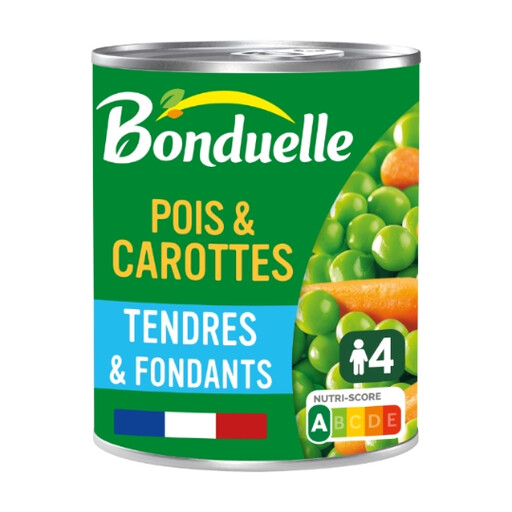 Image unavailable
Bonduelle peas and carrots in brine, 530 g
A mix to consider if you’d like to serve peas and carrots together as a side dish. The tin is labelled 530 g; check the drained weight on the packaging to work out how much vegetable you’ll have to serve. Check the ingredients list and salt content as well if you want to adjust the seasoning for your meal.
View on Joybuy
Frequently asked questions
What should I compare when choosing between two tins of peas?
First, compare the drained weight to estimate how much vegetable you’ll be serving, then check the ingredients and salt content per 100 g. The total weight also includes the liquid.
Plain peas or peas and carrots for Sunday lunch?
Choose plain peas if you want to decide on the seasoning yourself or serve peas on their own. A peas and carrots mix gives you two vegetables in one tin, but the proportions can vary from one product to another.
How long can I keep peas after opening?
Follow the storage time and temperature stated for the product you’ve bought. For the plain variety mentioned, Bonduelle recommends keeping it for up to 48 hours at a maximum of 4 °C. For the mix mentioned, d’aucy recommends two days in the fridge in a suitable airtight container.
Is the best-before date enough once a tin is open?
No. It doesn’t replace the storage instructions for after opening. The French Ministry of the Economy advises following the manufacturer’s recommendations for storing an opened product.


