When choosing a tin of peas as part of your food shop while managing diabetes, compare the carbohydrate and sugar values on the label, then check the drained weight against the amount you plan to serve. Plain peas and pea-and-carrot mixes may have different nutritional profiles, so check the ingredients and salt content of the specific product too, bearing in mind any individual dietary advice you’ve been given.
Who might find these criteria useful?
People who count the carbohydrates in their meals
The amount you serve and the ‘carbohydrate’ line in the nutritional information can help you work out how peas fit into your meal. The French Federation of Diabetes points out that plant-based foods can also contain carbohydrates.
Shoppers keeping an eye on added salt
If you want to limit your salt intake, compare the amount shown per 100 g and the ingredients list for each recipe. E.Leclerc’s product listing for a Notre Jardin pea-and-carrot mix with no added sugar or salt gives 0.0 g of salt per 100 g drained; this figure does not apply to the brand’s plain peas.
Smaller households looking to minimise leftovers
Drained weight and the number of individual tins matter more than the size stated on the front alone. For example, Carrefour lists a pack of three Classic' mini tins, each with a drained net weight of 140 g, while Auchan gives a drained weight of 280 g and two servings for a tin of Cassegrain peas.
Which criteria should you compare?
Start with the ingredients and nutritional information for the recipe you’re considering, then check whether the drained quantity is right for the meal you have planned.
| Criterion |
What to check |
Who it matters to |
| Carbohydrates in your portion |
Compare the carbohydrate and sugar values per 100 g, then work them out for the amount you plan to serve. Check which quantity the label refers to. |
If I count the carbohydrates in my meal, I need to match the portion I serve to the values on the tin; around 40% of consumers would put carbohydrates first. |
| Salt and ingredients |
Check the salt per 100 g and the ingredients list for the specific recipe, whether it’s plain peas or a mix. |
If I want to limit added salt, the exact recipe matters more than the range name alone. Salt and ingredients would be top priorities for around 30% of consumers. |
| Pack size and leftovers |
Check the drained net weight, the stated number of servings and, for a multipack, how many individual tins it contains. |
In a small household, I want to open an amount that suits the meal and minimise leftovers; around 30% of consumers would prioritise pack size. |
What mistakes should you avoid?
-
Assuming peas contain no carbohydrates
The French Federation of Diabetes points out that plant-based foods can contain carbohydrates. Ignoring how many peas you serve makes it harder to account for everything in your meal.
Check the ‘carbohydrate’ line on the tin and consider the portion you plan to serve, along with any individual guidance you already follow.
-
Relying only on the Nutri-Score or the ‘extra-fine’ description
These details don’t replace the ingredients list and nutritional values. Recipes listed by E.Leclerc, Carrefour and Auchan vary, particularly in whether they contain sugar, salt or other ingredients.
Compare the ingredients, carbohydrates, sugars and salt on the label of the product you’re thinking of buying.
-
Confusing tin weight with drained weight
The weight shown for the whole tin isn’t enough to tell you how many vegetables you’ll serve. A pack of mini tins is also different from a single tin.
Before choosing a size, check the drained net weight of each tin and the stated number of servings.
-
Treating a pea-and-carrot mix as plain peas
A mix contains another vegetable, so check the ingredients list and nutritional values for that specific recipe rather than relying on the information for a tin of plain peas.
First decide which recipe suits your planned meal, then compare the labels of the products that fit.
Brands to compare
The details below apply to the specific products mentioned, not every tinned product from each brand.
Notre Jardin (Marque Repère / E.Leclerc)
E.Leclerc lists 265 g tins of steamed peas, 140 g mini tins with a drained net weight of 140 g, and a 265 g pea-and-carrot mix with no added sugar or salt.
- The product listing for the steamed peas gives 8.8 g of carbohydrates and 0.5 g of salt per 100 g drained.
- The product listed as containing 0.0 g of salt per 100 g drained is a pea-and-carrot mix, not a tin of plain peas.
Carrefour Classic'
Carrefour describes a pack of three separate tins of extra-fine peas, each with a drained net weight of 140 g.
- The separate tins mean you can open one at a time.
- It’s a multipack, not a single tin; the ingredients list includes sugar, salt and a natural spice flavouring.
Cassegrain
Auchan’s listing for tender, soft peas gives a drained weight of 280 g and two servings.
- It lists 9.1 g of carbohydrates, 5.3 g of fibre and 0.8 g of salt per 100 g.
- The recipe also contains pearl onions, sugar, salt and a natural flavouring, so these aren’t plain peas.
Bonduelle
Bonduelle’s Petits Pois Bio Légumes 100 % Français product weighs 530 g, including 360 g drained.
- Bonduelle’s listing for this product gives 7.6 g of carbohydrates, 5.2 g of fibre and 0.48 g of salt per 100 g.
- At 530 g, this isn’t a small individual tin; don’t assume these values apply to another Bonduelle recipe.
D'Aucy
The Carrefour listing we checked features D'Aucy extra-fine peas in a 560 g tin.
- The ingredients listed are peas, water, sugar and salt.
- Don’t mistake the 560 g size for a small tin; check the pack size if you’re looking for a smaller portion.
A tinned vegetable on Joybuy
This Bonduelle tin is worth comparing if you’re considering a pea-and-carrot mix rather than plain peas. Check whether the 530 g size suits the amount you want to serve.
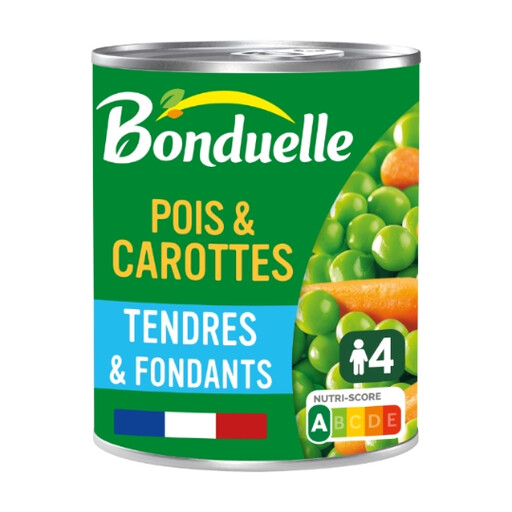 Image unavailable
Bonduelle Peas and Carrots in Brine, 530 g
Worth considering if you’re looking for a single tin of peas and carrots rather than a pack of mini tins or plain peas.
Net weight: 530 g. The recipe contains sugar and salt.
If the amount you serve is important to your choice, check the drained weight and the basis for the nutritional values per 100 g on the product label.
View on Joybuy
Frequently asked questions
Do tinned peas contain carbohydrates?
Yes. The French Federation of Diabetes points out that plant-based foods can also contain carbohydrates. Check the value per 100 g on the tin you’ve chosen and bear in mind how much you plan to serve.
Which details on the label can help you compare two tins?
The ingredients list, nutritional information and net quantity are a good place to start. The French Directorate-General for Competition Policy, Consumer Affairs and Fraud Control (DGCCRF) lists these among the details required on prepacked food labels. To work out how much veg you’ll get, also check the drained net weight if it’s shown.
What should you do with leftover peas once the tin is open?
Follow the storage instructions on the tin. For opened foods, Manger Bouger advises covering leftovers, keeping them chilled and eating them promptly.


