When choosing tinned peas while avoiding an allergen, check the label on the specific product rather than relying on its brand, format or organic labelling. Some recipes contain just peas, water and salt, while others include sugar or flavouring. Check the ingredients, highlighted allergens and any relevant precautionary statements. Frozen peas meet a different storage need, as they must be kept cold.
Who is this guide for?
People shopping to avoid a known allergen
Check each product for the allergen in question. The French Ministry of the Economy and the European Commission explain that allergens used as ingredients are highlighted in the ingredients list. Also check the packaging of the product you buy for any relevant precautionary statements.
Households stocking up on cupboard essentials
You’re looking for peas that can be stored according to the instructions on the packaging, with a recipe that’s easy to compare before you buy.
People comparing recipes
You want to see which products contain added sugar, salt or flavouring. The ingredient lists published by E.Leclerc and Auchan show that recipes vary from product to product.
What should you check?
Start with the allergen you need to avoid and the label on the product you’re buying. Then compare the ingredients and seasoning to suit your preferences.
| Criterion |
What to check |
Who is it for? |
| Allergen to avoid |
Read the ingredients list, check which allergens are highlighted and look for any precautionary statements on the packaging of the product you buy. |
If I need to avoid a specific allergen, the label should help me assess that particular product, not just its category. This would be the top priority for around 50% of consumers. |
| Clear ingredients list |
Compare the ingredients for the format you’ve chosen and check its storage instructions. |
When stocking up, I want to compare recipes quickly without assuming that a short ingredients list guarantees the product is free from traces. Around 30% of consumers would make this their top priority. |
| Seasoning |
Check the ingredients list for sugar, salt and flavourings in each product. |
When choosing a recipe, I want to know what’s been added to the peas. For around 20% of consumers, seasoning would be the top priority. |
Mistakes to avoid
-
Assuming all tins have the same recipe
Carrefour lists peas, water and sea salt for one Jardin Bio étic product. A Notre Jardin product featured by E.Leclerc also contains sugar and natural flavouring.
Check the ingredients again whenever you switch product or format.
-
Treating a short ingredients list or organic label as a guarantee
A short list is easier to read, but it doesn’t confirm that a product is suitable for every allergy. A precautionary statement may also be relevant to the allergen you need to avoid.
Base your decision on the label of the product you’re buying and the avoidance advice for the person concerned.
-
Confusing cupboard storage with frozen products
Tinned peas intended for storage at room temperature before opening shouldn’t be stored in the same way as frozen peas.
Check the storage instructions if you need a product that can be kept without a freezer. For frozen peas, maintain the cold chain.
Brands to compare when checking recipes
Bonduelle
Auchan lists a 560 g tin of Bonduelle peas, with other formats and recipes available from the brand.
- The published recipe for this product contains peas, water, sugar and salt.
- These ingredients don’t tell you about other Bonduelle products or whether they’re suitable for a specific allergy.
Notre Jardin
E.Leclerc lists, among other products, extra-fine Notre Jardin peas in a 3 × 140 g pack.
- The ingredients published for this format are peas, water, sugar, salt and natural flavouring.
- Check the format and label you’ve chosen: this recipe doesn’t represent the entire Notre Jardin range.
Jardin Bio étic
Carrefour lists a 400 g pack of Jardin Bio étic peas.
- The published ingredients for this product are peas, water and sea salt.
- Even with this short recipe, check the label on the product you buy before deciding whether it’s suitable for the allergen you need to avoid.
Joybuy products to consider
This mix of peas and carrots may be worth considering for your store cupboard if you’re happy with a recipe that includes ingredients other than peas alone. If you’re avoiding a food for dietary reasons, check the label on the product you buy.
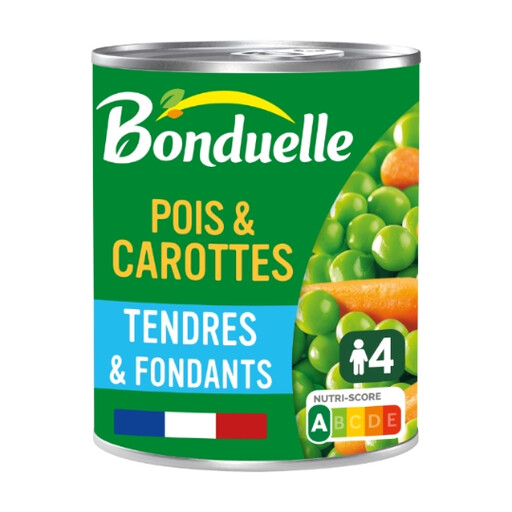 Image unavailable
Bonduelle peas and carrots in brine 530 g
This mix is a good option if you’re looking for peas with carrots, but not if you want peas on their own. Check the ingredients list, precautionary statements and storage instructions on the packaging of the product you buy.
View on Joybuy
Frequently asked questions
Are tinned peas automatically suitable for people with all allergies?
No. The category “peas” doesn’t tell you whether a product is suitable for someone avoiding a specific allergen. Check the ingredients, highlighted allergens and any relevant precautionary statements on the product you buy.
Is a short ingredients list enough if you have an allergy?
No. It means there are fewer ingredients to check, but it doesn’t replace reading the full label. You should also take any “may contain” statement into account, in line with the allergen and avoidance advice concerned.
Why compare two tins of peas?
Their ingredients may differ. Auchan lists a Bonduelle recipe with peas, water, sugar and salt, while E.Leclerc also lists natural flavouring for one Notre Jardin product. Choose based on the recipe for the format you’re buying.
Can you store tinned peas in the same way as frozen peas?
No. Follow the storage instructions for each product, particularly after opening. Frozen peas must be kept cold, unlike a tin whose packaging says it can be stored at room temperature before opening.


