If you’re looking for a recipe with sugars that are easy to compare, start with plain fillets: the Petit Navire and Pêche Océan products mentioned here contain 0 g of sugars per 100 g, while Saupiquet’s contains less than 0.5 g. Recipes in oil or sauce can also be low in sugars, but check the ingredients, the basis used for the nutritional values and the allergens for your chosen product before confirming your online grocery order.
Who are these options for?
People avoiding sugar in their recipes
If sugar content is your top priority, plain fillets are an easy starting point for comparison. The plain products from Petit Navire, Saupiquet and Pêche Océan each have a short ingredients list, but it’s still worth checking the values on the tin you choose.
People who prefer to season food themselves
You’re looking for a fish base to pair with whatever you fancy, rather than a ready-made sauce. Compare the plain fillets, then choose your seasoning separately.
People choosing a seasoned recipe
Tomato, shallot, mustard, white wine or olive oil: if the recipe is your main priority, compare the sugars, salt and allergens in each product too. Ingredients vary from one preparation to another.
What should you compare when shopping online?
First decide whether you want a base to season yourself or a ready-made recipe. Then compare labels using the same weight basis before checking your order with your chosen grocery collection service.
| What to compare |
What to check |
Who it matters to |
| Sugars and ingredients |
Compare “of which sugars” per 100 g on the same basis, then look for sugar in the ingredients list for the exact recipe. |
I want to quickly spot a recipe with no or very little sugar, without assuming that a sauce will also suit me. Around 45% of shoppers put this first. |
| Recipe and seasoning |
Tell plain fillets apart from recipes in oil or sauce; also compare the salt, fat and allergens listed. |
If I don’t want to season a meal myself, the flavour of the recipe matters more than its simplicity. This is the main priority for around 33% of shoppers. |
| Pack size and collection |
Check the stated net or drained weight and whether the product is available through your chosen grocery collection service. |
I want the pack size I planned for, without having to substitute an item when I check out. Around 22% of shoppers prioritise this convenience. |
Mistakes to avoid
-
Judging sugar content by the recipe name alone
Saupiquet’s grilled mackerel fillets in olive oil contain less than 0.5 g of sugars per 100 g drained, while Eco+’s tomato and basil recipe contains 1.6 g of sugars per 100 g and lists sugar among its ingredients. “Plain” is a useful comparison point, not a guarantee that applies to every tin.
Check both the “of which sugars” line and the ingredients for the product you plan to buy.
-
Comparing values based on different quantities
For Saupiquet’s grilled mackerel fillets in olive oil, the product information gives separate values for the whole product and the drained product. The figures therefore may not account for the same amount of sauce or oil.
Compare whole product with whole product, or drained product with drained product, using the same stated weight each time.
-
Forgetting to select your collection store before choosing
A product appearing in a catalogue doesn’t confirm that it’s available at your store. E.Leclerc, for example, advises checking availability of certain products with the relevant store.
Select your collection store and check the product and pack size before confirming your order.
-
Overlooking allergens in a prepared recipe
Simpl mustard fillets sold by Carrefour contain mustard; Eco+ fillets in white wine list sulphites. These ingredients depend on the exact recipe.
If an allergen affects you, check the product information and then the packaging you receive.
Brands and ranges to know
Petit Navire
The range includes 110 g tins of plain steamed mackerel fillets.
- According to Petit Navire, this product contains 99% mackerel and salt; it has 0 g of sugars and 1.0 g of salt per 100 g.
- These values apply to the plain steamed fillets, not every Petit Navire recipe.
Saupiquet
Saupiquet offers plain fillets as well as fillets grilled in extra virgin olive oil.
- According to Saupiquet, both products contain less than 0.5 g of sugars per 100 g; for the version in oil, this value is for the drained product.
- The grilled fillets in oil contain 19 g of fat per 100 g drained. Compare values on the same basis before choosing between the recipes.
Pêche Océan
This range, sold by E.Leclerc, includes 95 g packs of plain mackerel fillets.
- E.Leclerc’s product information lists mackerel fillets, water and salt for this product, with 0 g of sugars and 0.6 g of salt per 100 g.
- Check whether this pack size is available at your chosen E.Leclerc store.
Eco+
The E.Leclerc range includes mackerel recipes with tomato and basil, as well as white wine.
- E.Leclerc’s product information lists 1.6 g of sugars per 100 g for the tomato and basil recipe, and 0.5 g per 100 g for the white wine recipe.
- The tomato and basil recipe contains sugar; the white wine recipe lists sulphites. Check the ingredients for the product you choose.
Mackerel fillets available on Joybuy
To compare a recipe in olive oil with the plain or sauced options mentioned above, check the information on the tin, particularly the sugars per 100 g and the basis used for the nutritional values.
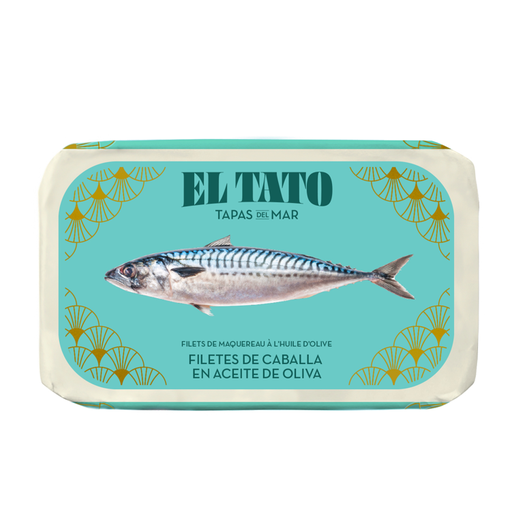 Image unavailable
EL TATO mackerel fillets in olive oil 115/80 g
Worth considering if you’d like a recipe in olive oil for your grocery shop. Before comparing it with plain fillets, check the label to see whether the values per 100 g refer to the whole product or the drained product.
View on Joybuy
Frequently asked questions
Do plain mackerel fillets always contain less sugar?
Not necessarily: check each product. The plain Petit Navire and Pêche Océan fillets mentioned here contain 0 g of sugars per 100 g, while Saupiquet’s contain less than 0.5 g. Saupiquet’s grilled fillets in olive oil also contain less than 0.5 g per 100 g drained.
Can a recipe in olive oil be a good choice if I’m comparing sugars?
Yes, depending on the product: Saupiquet states that its grilled fillets in olive oil contain less than 0.5 g of sugars per 100 g drained. That figure alone says nothing about fat content: the product information lists 19 g per 100 g drained.
Which allergens should I check in seasoned recipes?
As well as fish, check the ingredients specific to the recipe. The Simpl mustard fillets featured by Carrefour contain mustard, while the Eco+ fillets in white wine featured by E.Leclerc list sulphites. Always refer to the label on the exact product.
How should I store an opened tin of mackerel?
Follow the instructions on the tin you’ve bought. For the plain fillets and grilled fillets in olive oil mentioned here, Saupiquet advises keeping them in the fridge after opening and eating them within two days.


