Students who like to put their own meal together
You already have some carbs or vegetables and want a tin you can season yourself. In that case, the proportion of fish and the usable quantity matter more than whether it comes with a sauce.


For a student dinner on a tight budget, choose plain fillets if you already have something to serve them with and want to season the meal yourself. An olive oil, chilli or mustard recipe may be worth considering if it saves you a step, but compare the proportion of mackerel, drained weight and cost of the meal before paying extra for a particular recipe.
You already have some carbs or vegetables and want a tin you can season yourself. In that case, the proportion of fish and the usable quantity matter more than whether it comes with a sauce.
You want to add something straight from the tin to toast, a salad, pasta or rice. Check the proportion of fish and the drained weight: sauce or oil takes up some of the tin too.
You’re happy to spend a larger share of your dinner budget on a specific flavour or organic ingredients. Look for the feature you want on the label, then compare it with the amount of mackerel you get.
When choosing a tin for a student dinner, start with what you already have to serve it with, then compare the usable quantity and the ingredients in each recipe.
| What to compare | What to check | Who this matters to |
|---|---|---|
| Cost of the meal and quantity | Compare the cost for the same quantity and the net or drained weight, then consider what else you’ll need to make up your dinner. | If a small tin is going with my pasta or vegetables, I want to know how much it actually adds. The cost of the meal is the main priority for around 42% of consumers. |
| What’s in the fillets | Read the ingredients list, check the proportion of mackerel and look at the nutritional information per 100 g, particularly the salt content. | If I prefer to make my own sauce, I look for fillets with ingredients I can easily check. Around 33% of consumers put simplicity first. |
| Recipe and seasoning | Check the type and proportion of oil, any organic ingredients listed or the sauce, as well as the proportion of fish. | If I want to serve the mackerel without making a dressing, I might look for a particular flavour or organic ingredients. This is the main priority for around 25% of consumers. |
The proportions vary from one recipe to another. Carrefour lists 60% fillets and 37% extra virgin olive oil for its Carrefour Extra chilli fillets. E.Leclerc lists 56.2% fillets for its Pêche Océan Dijon mustard recipe. These figures relate to two specific products, not all seasoned tins.
Before choosing a seasoned recipe over plain fillets, compare the percentage of mackerel and, where shown on the packaging, the drained weight.
A small tin may be enough to top a dish, but that doesn’t necessarily mean it will make up the whole dinner you have in mind.
Check the stated weight and decide what you’ll serve it with before comparing two tin sizes.
An organic ingredients claim and a Nutri-Score don’t tell you the proportion of fish or everything in the recipe. Nutri-Score is no substitute for the nutritional information and ingredients list.
Choose the feature that matters for your meal, then check the ingredients and nutritional information per 100 g for the exact product.
Mackerel fillets contain fish; a mustard recipe may also contain mustard, as does the Pêche Océan recipe mentioned by E.Leclerc. Storage instructions after opening also depend on the product.
Check the allergens and instructions on the tin you buy, especially if you don’t plan to finish it once opened.
These brands offer different types of tinned mackerel to compare. The ingredients and proportions below apply only to the specific products named.
A brand to consider when comparing plain fillets with seasoned recipes.
Worth considering if you’re specifically looking for an olive oil recipe with organic ingredients listed.
A recipe to consider if you want to serve fillets that are already seasoned with chilli.
Plain and mustard recipes to choose between, depending on how you plan to serve them for dinner.
A small tin in olive oil to consider if you want to add something to a salad or toast.
These olive oil fillets could go well with a salad or another quick meal. To see how they fit into a dinner on a tight budget, compare the amount of fish and the tin size with the plain or sauced recipes you’re considering.
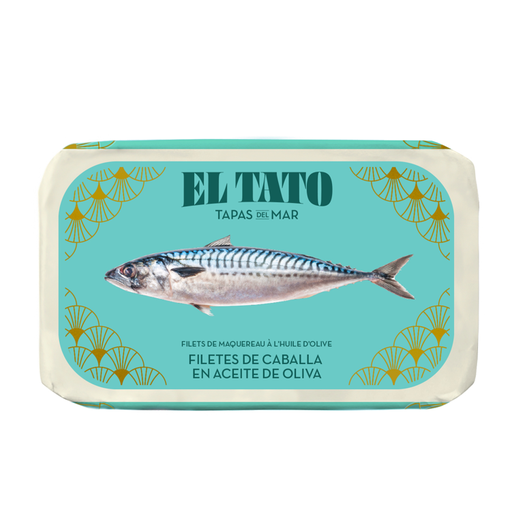 Image unavailable
Worth considering as a salad topping or to add to a quick meal with olive oil fillets.
The size is listed as “115/80 g”. Check the packaging to see what these two weights refer to, along with the proportion of mackerel, before comparing the usable quantity.
Compare their nutritional information on the same basis, then check the net weight, the drained weight if stated, and the proportion of mackerel. The DGCCRF states that nutritional declarations for prepacked foods are given per 100 g or 100 ml to make comparisons easier.
Not necessarily. It may suit the seasoning you’re after, but the proportions of oil and fish vary from tin to tin. To compare specific products, Auchan states that its 85 g fillets contain 12% olive oil, Saupiquet lists 20% for its organic olive oil fillets, and Carrefour lists 37% for its Extra chilli recipe.
Check the fish and any ingredients specific to the recipe. The Pêche Océan Dijon mustard product shown by E.Leclerc, for example, contains mustard. Read the ingredients list and allergen information on the tin you choose rather than relying on the sauce name alone.
Follow the storage instructions after opening on the product you’ve bought. If you don’t finish the tin with dinner, check the stated storage time and refrigeration instructions before keeping the rest.