What should you look for?
Start with the amount you’ll use once it’s opened, then compare the recipes and drained net weights. A claim on the front of the pack is no substitute for checking the ingredients.
| What to consider |
What to check |
Who it matters to |
| Portions and leftovers |
Compare the amount per portion and the storage instructions for after opening. |
If my schedule changes, I want to serve dessert without leaving a large tin open. Around 40% of consumers would put this need for convenience first. |
| Added sugars |
Read the ingredients, particularly to see whether syrup or concentrated juice is included, then check the ‘of which sugars’ line per 100 g. |
For household desserts, I’d like to know whether the recipe contains added sugar without confusing this with its total sugar content. This would be a priority for around 30% of consumers. |
| How much to keep in the cupboard |
Check the drained net weight and choose a pack size your household can finish, following the instructions on the packaging. |
If I’m planning several desserts, I want an amount I can use without throwing leftovers away. Around 30% of consumers would prioritise this cupboard-friendly option. |
Fruit in syrup for your cupboard
This Joybuy selection includes small tins and larger sizes for sharing. Choose according to how much fruit you want and the recipe shown on the pack: the products in syrup or light syrup featured here are not interchangeable with a recipe labelled ‘no added sugar’.
 Image unavailable
St Mamet fruit cocktail in syrup, 3 × 125 g
The three small tins let you open one at a time when mealtimes are irregular. This recipe is in syrup; check the ingredients if you want to avoid added sugars.
View on Joybuy
 Image unavailable
St Mamet Williams pear halves in light syrup, 455 g drained
This size is a good option if you’re planning several portions after opening. The 455 g is the drained weight, not necessarily the total weight including syrup; follow the storage instructions on the packaging.
View on Joybuy
 Image unavailable
St Mamet peach halves in light syrup, 230 g drained
Worth considering if you’d like to open fewer pieces of fruit than you’d get in a large tin. The stated drained weight is 230 g; check the total weight separately if that distinction matters to you.
View on Joybuy
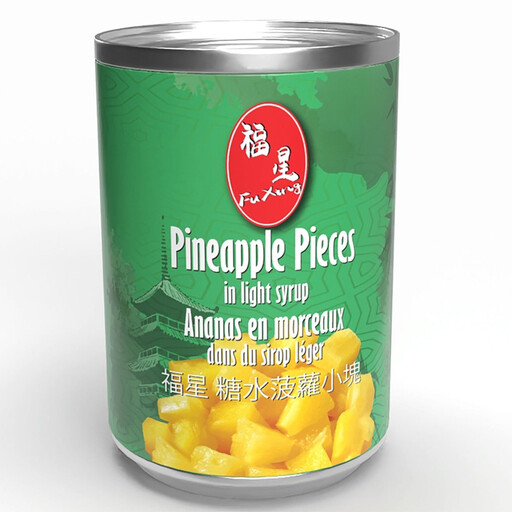 Image unavailable
Fu Xing pineapple pieces in light syrup, 565 g including 260 g drained
This size is worth considering for several portions or a planned recipe. The tin contains 565 g in total, including 260 g of drained fruit; sugar is listed in the ingredients.
View on Joybuy
 Image unavailable
St Mamet fruit cocktail in syrup, 425 g
This 425 g tin is better suited to a shared dessert than a single small portion. The recipe is in syrup; plan to store any leftovers according to the instructions on the packaging.
View on Joybuy
Frequently asked questions
Can fruit in syrup be kept in the cupboard for dessert?
Yes, you can keep it for a dessert or recipe without having to prepare fresh fruit. Choose the quantity according to how many people will be eating it, and check the label to distinguish recipes in syrup, in juice and those with no added sugar.
Does ‘no added sugar’ mean ‘sugar-free’?
No: sugars may be present in the fruit and juice in the recipe. The Auchan listing for the St Mamet peach, pear and pineapple mix labelled ‘no added sugar’, for example, states that it contains 12 g of sugars per 100 g. Check the ingredients and nutrition information for the product you choose.
What should you do with an opened tin of fruit in syrup?
Follow the storage temperature and time instructions on the packaging for after opening. As the French Ministry of the Economy points out in its food storage guidance, the printed date does not replace the instructions that apply once the product has been opened.
Is fruit in syrup for a family dessert also suitable for a baby?
Not automatically: a product intended for a family dessert is not, by itself, a suitable choice for every infant. Anses describes the introduction of solid foods as a gradual transition; take your child’s age, stage of weaning and the food’s texture into account with the healthcare professional who looks after them.
Can you use tinned food after its best-before date?
Being past its best-before date is not, on its own, enough to conclude that an intact tin is unsafe to eat. However, the DGCCRF recommends discarding tins showing signs of damage, including dents, rust or bulging. If you’re unsure about the condition of the tin, don’t eat its contents.


