
Livraison le jour même ou le lendemain

Qualité garantie

Débloquez vos offres de bienvenue: Livraison GRATUITE | Jusqu'à -80 % | 30 jours d'essai gratuits à JoyPlus
Téléchargez l'application
Whether for yoga, Pilates, or your home fitness sessions, a good mat is the foundation for a successful and pain-free practice. Yet, the market is flooded with marketing promises that often don't live up to the hype. A mat advertised as '?thick?' collapses under your weight, or a '?non-slip?' surface turns into an ice rink at the first drop of sweat. Beyond ruining your session, these flaws can even lead to injuries.
To avoid investing in equipment that will end up in a cupboard after a few weeks, let's review the most common pitfalls:
To avoid these pitfalls, you need to rely on objective technical criteria rather than marketing hype.
Choosing an exercise mat goes far beyond the colour or the thickness displayed on the packaging. Three parameters are crucial for guaranteeing comfort, safety, and longevity.
The choice of material directly impacts the grip, durability, comfort, and even the eco-friendliness of your mat.
Thickness alone doesn't make for a comfortable yoga mat. The true equation for comfort is: Cushioning = Thickness + Density.
A 6?mm high-density TPE mat will often protect your joints better and offer more stability than a 10?mm low-density NBR mat that flattens under your weight. For gentle practices (Yin Yoga, stretching) or if your joints are particularly sensitive, a thickness of 8 to 12?mm is a good choice, provided the density is high. For dynamic yoga (Vinyasa), a thickness of 4 to 6?mm is preferable: it promotes a better connection to the ground and therefore greater stability.
The effectiveness of a non-slip exercise mat largely depends on its surface texture. Look closely at the surface: is it smooth or textured with raised patterns (waves, lines, dots)? Many models feature a dual texture: one side that grips the floor (tile, wood) and another that ensures your hands and feet stay put, even when you're sweating.
To help you see how these criteria apply in practice, here are a few options tailored to specific needs.

Why we chose it: Ideal for beginners, those with sensitive joints, or for floor-based practices that demand excellent cushioning, like Pilates or stretching.
It combines a 10 mm thickness with high-density TPE. Unlike low-end NBR mats, it doesn't flatten (the ' sponge ' effect) and provides firm support while effectively protecting the knees and wrists.
Its dual-textured surface (lines for grip, waves for floor adhesion) ensures perfect stability on all floor types. The bonus: it comes with a carrying strap.
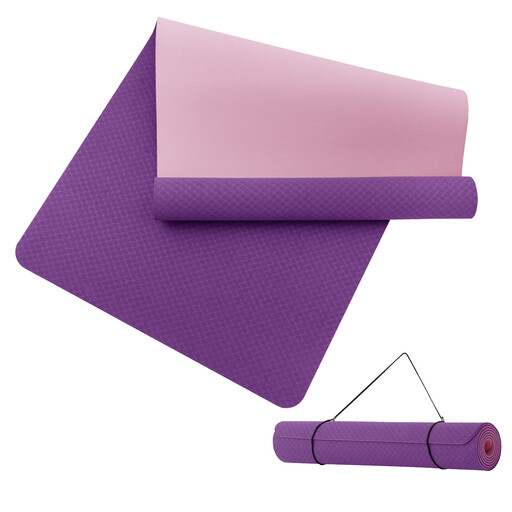
Why we chose it: Perfect for those who feel cramped on a standard mat and are looking for a versatile model that's equally suited for yoga, Pilates, or floor exercises.
Its 6 mm TPE thickness strikes the right balance between cushioning and stability, without the unstable feeling of overly soft mats. Its double-sided texture (leaf and wave patterns) prevents you from slipping on the mat and the mat from slipping on the floor.
Its extra-large dimensions of 190 x 80 cm offer unparalleled freedom of movement. A real luxury for taller individuals or for sequences that require more space.

Why we chose it: The solution for fans of dynamic yoga, Hot Yoga, or anyone who sweats a lot and for whom grip is non-negotiable.
It tackles the problem of a sweaty, slippery mat head-on. Its natural cork surface has the unique property of improving its grip with moisture, ensuring flawless stability during the most intense sessions.
The combination of a cork surface and a high-density TPE base checks all the boxes: superior grip and stable cushioning. As a bonus, cork is a natural, renewable, and very easy-to-maintain material.
Discover our complete, up-to-date selection of mats that meet our quality criteria and safety standards.
Most mats (TPE, PVC, NBR) can be easily cleaned with a damp cloth and a bit of mild soap (like Castile soap). Avoid harsh chemical cleaners. For cork, a simple damp cloth is sufficient. Crucially, always let your mat air-dry completely before rolling it up to prevent mould and odours. Also, avoid leaving it in direct sunlight, as UV rays can degrade the material.
Not necessarily. As explained above, the foam's density is just as crucial. A 10?mm mat that is too soft will collapse under your weight, offering only illusory protection. A good 6 or 8?mm high-density TPE mat will often be more effective. It's all about balance: enough cushioning for comfort without ever sacrificing the stability needed for standing poses.
Absolutely. A good thick, non-slip yoga mat is very versatile. It's perfect for Pilates, core work, sit-ups, push-ups, or stretching. Its grip is a real safety bonus. However, be aware: for high-impact workouts with trainers (like HIIT), it's better to opt for a dedicated shock-absorbing gym mat, often sold as interlocking tiles. These are designed to handle impact, wear from shoes, and the weight of equipment.