Households that already own a machine
You’d like to add an infusion to your shop without buying a new appliance. The system name on your machine and the compatibility information on the box will determine which capsules are suitable.


For your first shop, start by choosing capsules designed for your machine’s exact system: Lipton Verveine Menthe is for Nespresso Original, while SPECIAL.T requires its own infuser and a compatible machine. If you’re looking for a caffeine-free drink, check the specific recipe rather than relying on a ‘wellness’ label.
You’d like to add an infusion to your shop without buying a new appliance. The system name on your machine and the compatibility information on the box will determine which capsules are suitable.
If avoiding caffeine matters to you, distinguish between an herbal infusion explicitly labelled caffeine-free and a flavoured tea. For example, NESCAFÉ Dolce Gusto France describes SPECIAL.T Verbena as naturally caffeine-free.
You want to know what to do with each capsule after use. Check its material and the relevant recycling instructions; don’t assume that ‘biodegradable’ means it can go in your home compost.
Start with compatibility with your machine, then compare recipes based on their caffeine content and how you can dispose of the capsules.
| Criteria | What to check | Who is it for? |
|---|---|---|
| Compatibility | Compare the system shown on your machine with the one stated on the box. According to NESCAFÉ Dolce Gusto France, SPECIAL.T capsules require a SPECIAL.T infuser and a compatible machine model. | If I already own a machine, I want to use the capsules without changing my equipment. Around 42% of consumers would put compatibility first. |
| Recipe and caffeine | Check the product name, ingredients and any explicit information about the caffeine content of the product you’ve chosen; flavoured tea isn’t the same as a caffeine-free herbal infusion. | For a drink after a meal or in the evening, I’m mainly looking for a recipe that fits my preference to avoid caffeine. This would be a priority for around 33% of consumers. |
| Capsule waste | Check the material and the relevant recycling instructions. The ADEME recommends recycling aluminium or plastic capsules with packaging. | When every cup leaves me with a used capsule, I want to know how to recycle it. Around 25% of consumers would make end-of-life disposal their main criterion. |
MaxiCoffee says Lipton Verveine Menthe is compatible with Nespresso Original. SPECIAL.T capsules, on the other hand, require a SPECIAL.T infuser and certain machine models, according to NESCAFÉ Dolce Gusto France.
Check your machine’s model or system before choosing a box, then compare it with the product’s compatibility information.
Capsule ranges include both teas and herbal infusions, so the flavour alone won’t tell you which one you’re choosing.
If you want to avoid caffeine, read the ingredients and look for explicit information about the specific product. NESCAFÉ Dolce Gusto France describes SPECIAL.T Verbena as naturally caffeine-free.
A name that suggests better digestion or relaxation doesn’t, by itself, prove that the drink has those effects. The DGCCRF reminds consumers that health claims made about food must be authorised.
Choose a drink based on its recipe and compatibility, and don’t mistake its name for medical advice.
How you dispose of a capsule depends on its material; ‘biodegradable’ isn’t a universal recycling instruction.
Read the instructions on the box and check your local rules. The ADEME recommends recycling aluminium or plastic capsules with packaging.
MaxiCoffee lists the Verveine Menthe product, in a box of 10 capsules, for Nespresso Original machines.
Coffee Webstore lists capsules from this range as compatible with classic Nespresso machines.
According to NESCAFÉ Dolce Gusto France, this range includes tea and herbal infusion capsules designed for the SPECIAL.T infuser and certain machine models.
These products include an infusion and teas in capsules for the Nespresso Original or Dolce Gusto systems specified. If you’re looking for a caffeine-free infusion, remember that the two tea recipes are different products.
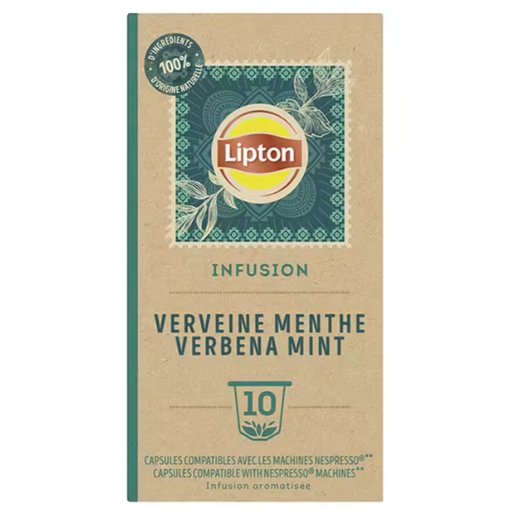 Image unavailable
Worth considering if you have a Nespresso Original machine and are looking for a verbena and mint infusion. Before choosing, check your exact machine model, as well as the information about caffeine and the capsule material.
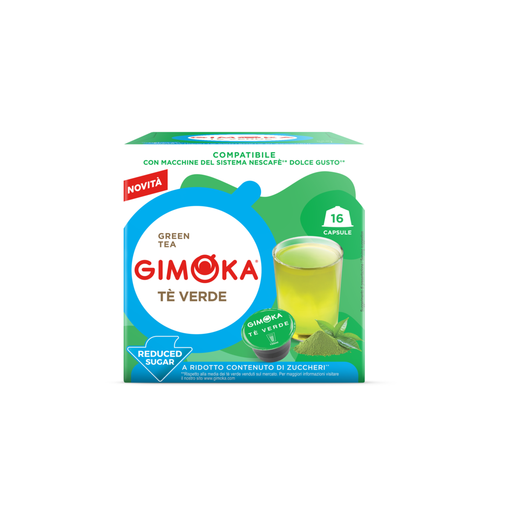 Image unavailable
This product is for anyone looking for green tea capsules for a compatible Dolce Gusto machine, rather than a caffeine-free herbal infusion. Check that your model is compatible; if the ingredients matter to you, read the list and nutritional information too.
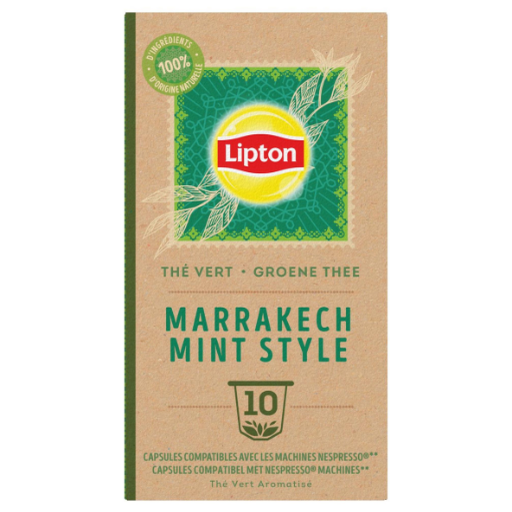 Image unavailable
Worth considering if you’d like mint tea in capsules and have a Nespresso Original machine. It isn’t a substitute for an infusion explicitly labelled caffeine-free, so check the recipe and compatibility information on the box.
No. Choose a capsule that’s designed for your machine’s exact system. MaxiCoffee lists Lipton Verveine Menthe for Nespresso Original, while NESCAFÉ Dolce Gusto France says SPECIAL.T requires its own infuser and certain compatible machine models.
No. That description doesn’t tell you enough about the recipe. Check the product name and ingredients. NESCAFÉ Dolce Gusto France explicitly says SPECIAL.T Verbena is naturally caffeine-free, but that doesn’t apply to all capsule teas and infusions.
No. A claim on a box isn’t enough to prove an effect. The DGCCRF reminds consumers that health claims on food must be authorised; don’t mistake a recipe’s name for a medical guarantee.
First, identify the capsule material and follow the relevant local instructions. In France, the ADEME says aluminium or plastic capsules should go in packaging recycling. Don’t assume that a capsule described as biodegradable is suitable for home composting.