
Livraison le jour même ou le lendemain

Qualité garantie

Débloquez vos offres de bienvenue: Livraison GRATUITE | Jusqu'à -80 % | 30 jours d'essai gratuits à JoyPlus
Téléchargez l'application
Eyeing a large-screen TV like the TCL 75Q7C? It's easy to get lost in the marketing jargon. Spec sheets promise the world, but behind the acronyms, not all technologies are created equal. As a Product Recommendation Manager at Joybuy, my role is to give you the keys to make an informed choice and avoid unpleasant surprises. Let's break down the three most common pitfalls together and, more importantly, how to outsmart them.
Don't be fooled by impressive-sounding numbers like 240?Hz or more. Often, these are the result of software optimisations (motion interpolation) and not the panel's true native capability. While this might make a movie appear smoother, it's a completely different story for video games. This technique introduces latency (the infamous input lag) and visual artefacts that can ruin a gaming session. For PS5, Xbox Series, or PC gamers, only one number matters: a native 144?Hz panel. It's the only guarantee of flawless responsiveness.
A TV can boast "compatibility" with Dolby Vision or HDR10+. In practice, this simply means it can read the signal. But without sufficient peak brightness and precise backlight control, the result is underwhelming: the image is washed out, and contrast is non-existent. True HDR is a visual spectacle built on abyssal blacks and dazzling peak brightness—a performance that basic backlighting systems are simply incapable of delivering.
The day-to-day user experience of a Smart TV depends entirely on its operating system. A laggy interface, apps that are never updated, a meagre app library... This is how a great investment quickly turns into a source of daily frustration. A modern and responsive ecosystem like Google TV is a game-changer, ensuring smooth navigation and virtually unlimited access to content.
To ensure your future 75-inch TV lives up to its promises, here are the three technical specifications on which you should make no compromises.
TCL's QD-Mini LED technology is a major breakthrough. It merges the best of both worlds:
This powerful duo is particularly effective at enhancing the dynamic range of Premium 4K HDR content.
For the lucky owners of a PS5, Xbox Series X, or a gaming PC, these acronyms are non-negotiable:
A good 75-inch 4K TV must be as smart as it is well-connected. The Google TV interface centralises all your apps (Netflix, YouTube, Prime Video...) and recommendations on a single home screen, with Google Assistant just a voice command away. On the connectivity side, the presence of multiple HDMI 2.1 ports is non-negotiable to unlock the full 4K at 120?Hz (or even 144?Hz) potential of new-gen consoles and PCs.
Here are a few options that meet these criteria, tailored to specific needs.
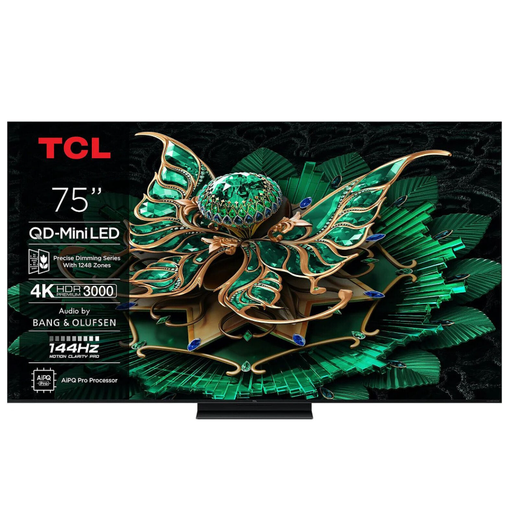
Editor's Pick: It checks all the boxes for hybrid use without any compromises. Its giant 75-inch panel, QD-Mini LED technology, and Dolby Vision IQ compatibility ensure an immersive cinema experience. On the gaming side, its native 144 Hz panel, VRR, and FreeSync Premium Pro will satisfy the most demanding gamers. This versatility is a recurring theme in reviews for the TCL 75Q7C.
It features a native 144 Hz panel, a Mini LED backlight for truly impactful HDR, and the fluid Google TV interface.
Its integrated Bang & Olufsen 6.2.2 sound system, compatible with Dolby Atmos, offers stunning audio immersion right out of the box, without needing to immediately invest in external equipment.

The Content That Makes the Difference: This is exactly the kind of content that justifies investing in a premium TV. A modern adventure game built on Unreal Engine 5 is a true technological showcase, designed to highlight the details, colours, and contrasts of an excellent 4K HDR screen.
This game puts your hardware to the test. Its next-gen graphics instantly reveal whether your TV truly lives up to its promises.
Exploring its grandiose environments (lush jungles, dark ruins) is an excellent test for judging the TV's ability to handle complex scenes.

The Ultimate Test of Responsiveness: In a fighting game, every millisecond counts. This is the ultimate test for a TV's responsiveness. This type of title immediately highlights the importance of minimal input lag and perfect motion clarity—non-negotiable qualities for online play.
Playing this on a non-optimised TV (high input lag, motion blur) is simply unplayable. It demonstrates why ALLM and 144 Hz modes are essential.
The collection includes a multiplayer mode with "rollback netcode," a technology that demands an ultra-stable display to be effective.
We have curated a full range of products that meet our demanding selection criteria and current standards.
Absolutely. Thanks to its HDMI 2.1 ports, it's perfectly equipped to handle 4K at 120?Hz signals from both consoles. Its VRR (FreeSync Premium Pro) and ALLM features activate automatically to ensure an ultra-smooth and responsive gaming experience. It's an excellent choice for a 144Hz gaming TV.
The 75Q7C integrates a Bang & Olufsen 6.2.2 sound system compatible with Dolby Atmos. For the vast majority of users, its power and sound quality will be more than sufficient for movies, shows, and video games, delivering a convincing immersive 3D effect. Of course, the most discerning audiophiles can always pair it with a dedicated soundbar or home theatre system, but it's by no means an immediate necessity.