If you don’t have access to a water supply, consider a mini dishwasher with manual filling, provided you can arrange drainage as described in the instructions. If the connections are already in place, a countertop or slimline model could suit you, depending on the space available and how much washing-up you have. Whichever type you choose, measure the space with the door open.
Which setup is right for you?
Renters without access to a water supply
If you don’t want to alter the plumbing, look for a model whose instructions allow you to fill it by hand. You’ll still need to arrange safe drainage and have a suitable socket. ANIL states that changes to a property or its fittings require the landlord’s written consent.
Studio-dwellers with spare worktop space
A countertop appliance can handle smaller loads if you can make room for it and access the connections it needs. For example, Candy France describes the CP 6E51LS as a countertop model with capacity for 6 place settings. This figure alone doesn’t tell you whether your plates will fit in the racks.
Small households with space for plumbing connections
If you have floor space and the necessary connections, a slimline appliance is worth considering when small loads aren’t enough. Miele France, for example, describes the G 5740 SC SL as a 45 cm freestanding dishwasher for compact kitchens.
What should you check before choosing?
Start by checking how the water flows in and out, then see how the model’s dimensions and capacity measure up to your kitchen and your washing-up.
Mini model with a water tank
Consider this if: you don’t have access to a water supply and the instructions allow manual filling.
Bear in mind: filling the tank doesn’t remove the need for drainage or for positioning the hose correctly.
Connected countertop model
Consider this if: you have space on your worktop and access to a water supply and a drain.
Bear in mind: its small size doesn’t make it self-contained, and it takes up valuable food-preparation space.
Connected slimline appliance
Consider this if: you have a suitable spot on the floor for the connections and a countertop model’s small capacity won’t meet your needs.
Bear in mind: it needs a dedicated space and connections that are compatible with your home.
| Your priority |
What to check |
Who is this for? |
| Avoid altering the plumbing |
Whether the instructions allow manual filling; the drainage route and how to secure the hose. |
If you can’t alter the plumbing in your home, being able to fill the appliance without a fixed connection is a priority. Around 42% of consumers would put avoiding alterations first. |
| Save space |
Width, depth, height and the clearance needed to open the door. |
If you also use your worktop to prepare meals, the space the appliance takes up while in use matters just as much as where it sits. Around 33% of consumers would make saving space their main priority. |
| Cut down on repeated small loads |
Stated capacity and the actual space available for the pans and dishes you use. |
If washing-up builds up every day in a small household, a limited capacity could mean running more cycles. Around 25% of consumers would put everyday capacity first. |
Mistakes to avoid
-
Assuming a self-contained water tank means no drainage
On models designed for this, a built-in tank means you don’t need a connected water supply, but the waste water still has to go somewhere. Daan Tech’s instructions explain these two steps separately for Bob. Instructions for a model documented by Eurosav say to direct the hose into a sink or bucket.
Before you buy, check the instructions for your chosen model to find out how to fill the tank, position the appliance and secure the hose during a cycle.
-
Measuring the width and nothing else
Candy France lists the CP 6E51LS as measuring 550 × 501 × 443 mm. These are the appliance’s dimensions, not the full space needed to open the door and access the hoses.
Measure the space in width, depth and height, then check the door clearance and the route for your chosen model’s connections.
-
Using an extension lead because the socket is in the wrong place
Promotelec recommends connecting a dishwasher directly to a dedicated circuit and warns that using extension leads with large appliances can cause an overload.
Check the electrical requirements in the instructions, and have the installation assessed if there isn’t a suitable socket nearby.
-
Altering the plumbing in a rental property without written consent
In France, ANIL states that changes to a property or its fittings require the landlord’s written consent. Even an installation intended to be temporary may involve altering the trap or water supply.
Work out exactly what changes would be needed and get consent before altering the installation.
Brands to consider for different setups
Daan Tech
The Bob range is an example of a tank-based solution. According to Daan Tech’s instructions, it can run without a connected water supply thanks to its built-in tank.
- The instructions cover filling, drainage and the power supply separately.
- Not needing a connected water supply doesn’t remove the need to arrange drainage.
HAVA
HAVA provides French-language instructions for its compact R01 and R09 models, so you can check the installation requirements for each one separately.
- The manuals let you check the guidance for each specific model.
- Check the exact variant and its sales and service arrangements before choosing a model you’ve seen in another market.
Candy
Candy France describes the CP 6E51LS as a countertop dishwasher with capacity for 6 place settings, measuring 550 × 501 × 443 mm.
- These dimensions help you see whether this particular model will fit your available space.
- This model isn’t described as having a self-contained water tank, so check which connections it needs.
Miele
Miele France describes the G 5740 SC SL as a 45 cm freestanding dishwasher for compact kitchens.
- Its slimline design is worth considering if you have space for a floor-standing appliance.
- You’ll need to be able to connect it to a water supply and a drain.
Joybuy models to suit your space and water supply
These countertop models suit two different situations: needing to fill the appliance by hand, or having access to a water supply. Check the instructions for each appliance before deciding on a temporary installation.
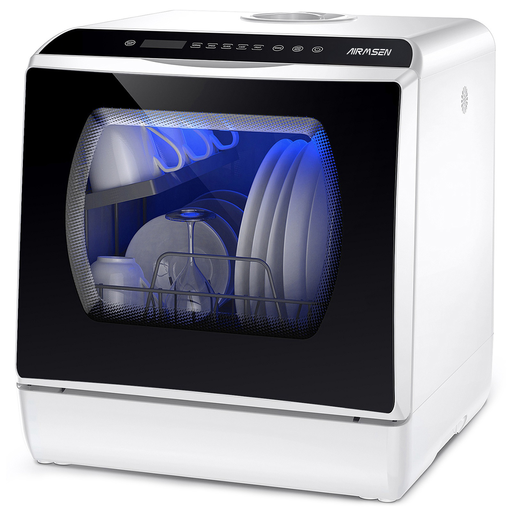 Image unavailable
AIRMSEN, countertop dishwasher with 5 L water tank
Worth considering if you want to avoid a fixed water connection in a small kitchen. The product name indicates a built-in 5 L tank and 5+1 wash cycles. Before choosing where to put it, check the instructions for filling, draining into a container and electrical requirements.
View on Joybuy
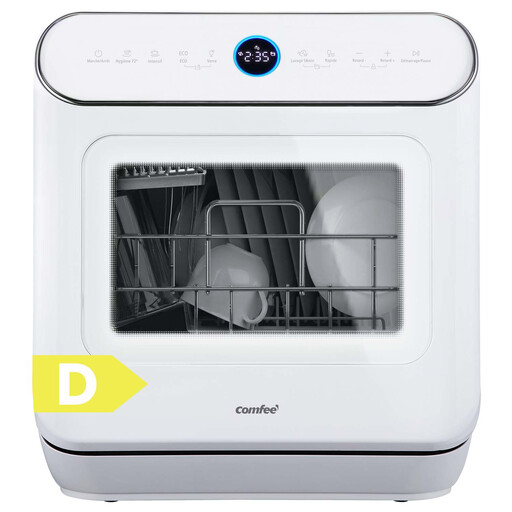 Image unavailable
COMFEE CDWMT305WD, white countertop dishwasher
If you’re considering this model for a kitchen without a fixed connection, check the instructions for manual filling and, especially, the route for the waste water. The product name lists 7 programmes and a 24-hour delay start. Check its electrical requirements before installation, too.
View on Joybuy
 Image unavailable
Heinrich's HTG 8840 Schwarz, 6 place settings
Consider this if your worktop and connections can accommodate a countertop dishwasher. The product name lists capacity for 6 place settings and 7 programmes. Measure your available space and check the instructions for dimensions, connections and electrical requirements.
View on Joybuy
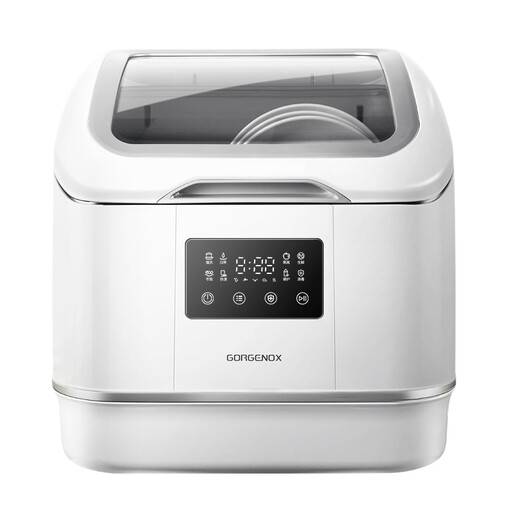 Image unavailable
GORGENOX DW4-D30A, countertop dishwasher for 3 place settings
Worth considering for smaller loads only if you can use the tap connection described for this model. Although its name suggests no installation is needed, check the instructions for the connection method, drainage, dimensions and electrical requirements before buying.
View on Joybuy
Frequently asked questions
Can a mini dishwasher with a water tank work without a water supply?
Yes, if the instructions for your model allow manual filling. The tank doesn’t remove the need for drainage, so check where to direct the drain hose and how to secure it before starting a cycle.
Can I direct the drain hose into the sink?
The instructions for the model documented by Eurosav say to put the end of the hose in a sink or bucket. For any other appliance, follow its own instructions, particularly for securing the hose and draining the water.
Can I use an extension lead for a temporary installation?
No. Promotelec recommends connecting a dishwasher directly to a dedicated circuit and warns that using an extension lead can cause an overload. Check your model’s requirements and have the installation assessed if there isn’t a suitable socket nearby.
Can I add a plumbing connection in a rented home?
In France, ANIL states that changes to a property or its fittings require the landlord’s written consent. Check whether the connection you have in mind would count as such a change, and get consent before starting work.


