
Livraison le jour même ou le lendemain

Qualité garantie

Débloquez vos offres de bienvenue: Livraison GRATUITE | Jusqu'à -80 % | 30 jours d'essai gratuits à JoyPlus
Téléchargez l'application
A leak at a threaded fitting can quickly become a real headache: water loss, remedial work or an extra visit to site. For professionals and DIY enthusiasts alike, Tangit Uni-Lock thread sealant for threaded fittings offers a practical solution for working on metal or plastic pipework.
However, it is important to choose a product that is suitable for the installation. Pipe diameter, thread type and the nature of the fluid must all be checked before buying. Rushing the application, or reading the product details too quickly, can lead to leaks that are difficult to detect.
A thread sealant may be designed for metal and plastic fittings without being suitable for every diameter or every fluid. In particular, you need to distinguish between:
According to the available information, Tangit Uni-Lock is suitable for metal pipes up to 10 cm in diameter and plastic pipes up to 3.8 cm, equivalent to 4 and 1.5 inches respectively. These limits must be compared carefully with the specifications of the installation concerned.
Over-tightening can damage the thread, deform a plastic component or place excessive strain on the pipework. The sealant should be wound evenly in the direction of tightening, after which the fitting should be tightened normally.
The aim is not to compensate for poor application with a large amount of force. If the threads are damaged, dirty or misaligned, it is better to clean them, correct the issue or replace the part before applying the sealant.
The sealing of a gas or water system is not subject to exactly the same requirements. For a gas installation, always check that both the product and the fitting are specifically intended for this use. You must then follow the manufacturer's recommendations and the regulations in force in France. If in doubt, consult a qualified professional.
Thread sealant does not replace an inspection of the installation, a leak test or compliance with the regulatory requirements applicable to the system.
Nylon thread sealant generally comes in the form of a spool that is wound directly onto the male thread. Compared with using hemp and sealing paste, this solution reduces residue and makes it easier to control the amount applied. It is particularly practical when keeping the work area clean and completing the job quickly are important.
However, the nylon should be applied without excessive overlapping or bulky sections. Uneven winding can make the fitting difficult to screw together and result in inconsistent sealing.
Before placing your order, determine whether the fitting has a parallel or tapered thread. Tangit Uni-Lock is advertised as being compatible with both configurations, but proper preparation remains essential:
This method is suitable for sealing threaded fittings made from different materials, provided you follow the instructions on the packaging and in the technical data sheet.
An 80 m spool of thread sealant provides a generous supply for numerous plumbing, maintenance or installation jobs. For a private individual, it can cover several repairs. For a tradesperson, it reduces the need to replace the consumable too frequently.
The amount required depends on the diameter, thread profile and the manufacturer's recommendations. Avoid removing a few turns simply to save sealant: applying it evenly remains the priority.
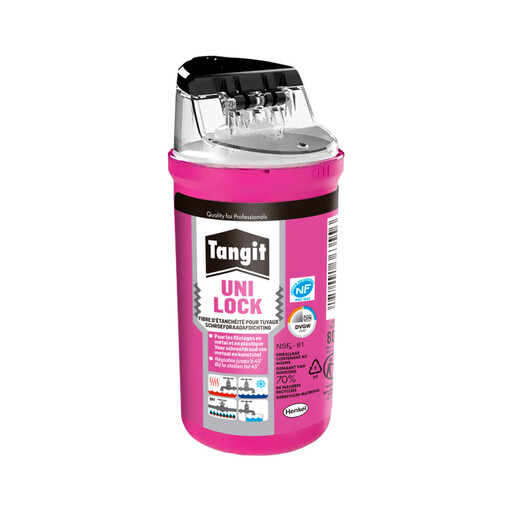
Why this is a sensible choice : The spool is ideal for occasional repairs without having to buy hemp and sealing paste separately. The thread is applied directly to the male thread.
The spool length and compatibility information encourage you to check the intended use before application rather than relying solely on the appearance of the fitting.
An 80 m nylon thread advertised as compatible with parallel and tapered threads on metal and plastic pipework.
Why this is a sensible choice : Anyone looking for a clean installation will appreciate not having to handle sealing paste, as well as the ability to adjust and dismantle the fitting during assembly.
Its adjustable application reduces the risk of having to start over if a fitting needs to be repositioned slightly.
Clean application, removable thread and advertised compatibility with several metals, as well as PVC, PP and ABS.
Why this is a sensible choice : Tradespeople and installers carrying out numerous connections can rely on an 80 m spool and a format suited to working with different materials.
The stated diameter ranges allow you to check compatibility before starting, particularly when the fittings are not all the same size.
An 80 m spool, advertised by the manufacturer for use on water and gas systems, with no sealing paste required.
The product is advertised as compatible with certain plastics, including PVC, PP and ABS, up to a 3.8 cm diameter for plastic pipes. Always check the type of fitting, the condition of the thread and the manufacturer's instructions before starting.
The product description states that the thread is adjustable and removable during assembly. However, how easily it can be dismantled depends on the tightening level, the condition of the fitting and the installation. After any work on a water or gas system, carry out an appropriate check before putting it back into service.
The spool length alone cannot be used to determine a universal shelf life or service life. Store it in the recommended conditions, away from moisture and dirt, then check the packaging for the manufacturer's guidance. The durability of the seal depends above all on the compatibility of the fitting, the condition of the thread and the quality of the application.