
Livraison le jour même ou le lendemain

Qualité garantie

Débloquez vos offres de bienvenue: Livraison GRATUITE | Jusqu'à -80 % | 30 jours d'essai gratuits à JoyPlus
Téléchargez l'application
Living with several cats, adult felines or large breeds requires thoughtful planning. A tall cat tree can offer each cat a space to climb, rest and sharpen their claws, without taking up too much floor space. However, be warned: an imposing structure isn’t necessarily practical or durable.
Before buying, three common pitfalls keep cropping up:
When comparing a 170 cm cat tree, a 212 cm model or a more compact structure, it’s far better to examine the overall design rather than relying solely on the number of levels advertised.
To judge the stability of a cat tree, look at the width of its base, the thickness of the panels and whether it has an anti-tip device. These features limit movement when cats leap from one level to another, but the quality of the installation is just as important.
Place the structure against a wall and use the fixing provided by the manufacturer. Make sure the floor is perfectly level and tighten the screws after assembly. In a home with several cats, a reinforced base is especially recommended, particularly for a cat tree designed for large breeds.
A large cat tree should offer platforms wide enough for a cat to turn around and stretch out comfortably. In practice, a 50 × 30 cm platform suits many adult cats, while a 60 × 40 cm surface will give larger cats more room.
The spacing between levels also deserves your attention. Gaps of 20 to 30 cm make it easier to move from one platform to another. A 6-level cat tree can therefore work well for cats that love to climb, provided the walkways remain accessible and the resting spaces are properly distributed.
A cat tree fitted with sisal scratching posts shouldn’t have all its poles concentrated in one spot. Columns placed at different levels allow cats to scratch while standing or in an inclined position, depending on their preference.
The sisal must be tightly wound around the poles and easy to reach. Having multiple scratching zones can help divert cats from sofas, curtains and other furniture, though it won’t guarantee every cat’s behaviour.
In a British flat, the best compromise often depends more on ceiling height than on the floor space available. A compact cat tree makes use of vertical space, but you must measure the available height before placing an order.
Choose models with removable, washable cushions, platforms that are easy to vacuum and fabrics that work with a lint roller or vacuum cleaner. A cave, a hammock and a basket offer different resting positions, which can help reduce tension between cats, provided each space is genuinely accessible.
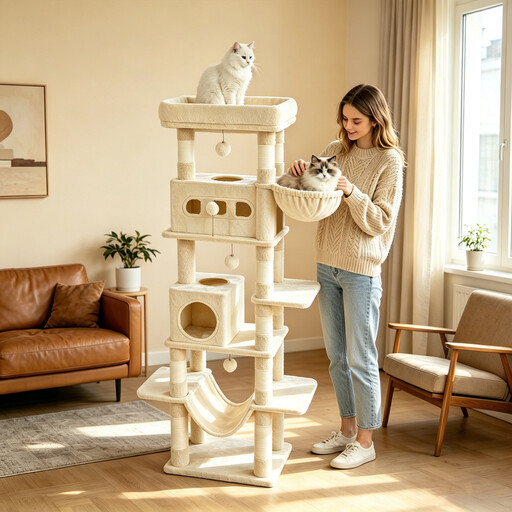
Why this choice suits this profile: With its six levels, two caves, hammock and large 50 × 30 cm platform, this model brings together the essentials in a vertical format that will easily fit into most living rooms.
The eight sisal-covered posts are spread across the structure, while the removable cushions make it easy to remove fur and dirt.
Six levels, two caves, a hammock, a large platform and removable, washable cushions.
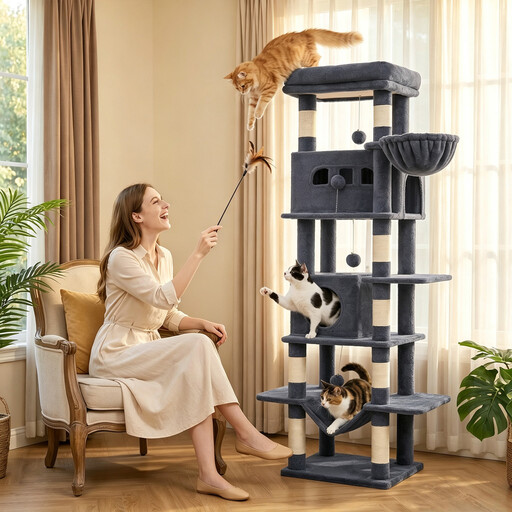
Why this choice suits this profile: At 212.5 cm tall, this model is aimed at homes with sufficient ceiling height who want to offer more vertical space to several cats.
The widened, reinforced base, thicker panels and anti-tip device address the main concerns for such a tall tower.
A 60 × 40 cm platform, eight sisal posts, two caves, a hammock, a basket and 400 g/m² fabric.
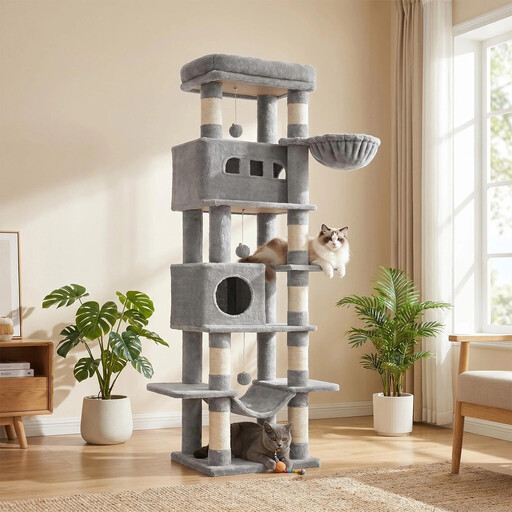
Why this choice suits this profile: This 170 cm model combines several sleeping areas, a 30 cm basket, two removable cushions and hanging toys. An interesting set-up for a household with multiple cats.
The scratching areas are spread across five levels, while the double-reinforced base is complemented by an anti-tip device.
17 posts, including 8 covered in sisal, six levels, two caves, a hammock and two removable, washable cushions.
We’ve put together a comprehensive, real-time updated list of products that fully meet these strict selection criteria and European safety regulations.
Once the tree is assembled, place it in a room where the cats spend a lot of time, near a window or a piece of furniture they like, but without blocking the flow of the room. If the manufacturer provides a wall fixing, use it, then check the joints after the first few play sessions.
To keep the structure in good condition and the sleeping areas clean:
The lifespan of the tree depends on the weight of the cats, how often they scratch, the quality of the joints and how well it’s maintained. Models with removable parts are generally easier to keep clean, but none of them can do without regular inspection.
A model of 170 to 175 cm can work well in a flat with a standard ceiling height. A 212 cm cat tree, on the other hand, requires precise measurement of the available space, as well as a suitable fixing. The number of platforms, their width and the stability of the base matter just as much as the overall height.
Place it on a level floor, tighten all the fixings properly and use the anti-tip device provided. Positioning it against a wall also limits movement. If several cats use it, or if some are particularly heavy, choose a wide, reinforced base and regularly check the screws and posts.
Yes, provided the spaces are numerous enough and spread across several levels. Two caves, a hammock, a basket and several platforms allow the cats to choose their favourite spot. However, do check the dimensions of each sleeping area and observe your pets’ habits once the tree is installed.