
Livraison le jour même ou le lendemain

Qualité garantie

Débloquez vos offres de bienvenue: Livraison GRATUITE | Jusqu'à -80 % | 30 jours d'essai gratuits à JoyPlus
Téléchargez l'application
A plate may seem easy to choose… until the day it cracks, warps beneath a hot dish or takes up half the cupboard. Whether you are preparing a family meal, hosting a reception, packing a picnic or equipping a professional kitchen, choosing the right tableware plates depends on the material, size, ease of care and frequency of use.
Attractive promotions can sometimes come with unwelcome surprises: a set that is too large or poorly suited to the number of guests, a disposable plate that softens when it comes into contact with sauce, or a material marketed as durable without clearly stating whether it is suitable for the dishwasher, oven or microwave. Here are the key points to check before placing your order.
A lightweight plate is not necessarily fragile, but it is not designed for the same uses as a ceramic or stoneware model. Unbreakable plastic plates, for example, are ideal for children, the garden or use on a boat. However, some models are not suitable for microwave use or direct heat.
Ceramic offers a more traditional presentation, but it can chip after being dropped or knocked against the sink. Durability should therefore always be assessed in relation to how and where the plate will be used.
Compostable plates made from sugar-cane fibre, palm leaves or bamboo can help reduce reliance on single-use plastic. However, the term “compostable” does not necessarily mean that the product can be placed in a home compost bin or in your local council’s collection container.
Check the packaging and the sorting guidelines that apply in your area. You should also verify how well the plate withstands hot food, greasy dishes and liquids. An uncoated kraft paper plate may be perfectly suitable for a cold buffet, but far less practical for soup or a generous serving of sauce.
A diameter of 15 cm is mainly suitable for desserts, appetisers and small portions. For a main course, a size between 21 and 27 cm is generally more practical. Deep plates are the better choice for soups, pasta, stews and saucy dishes.
Do not overlook storage. Stackable plates help maximise cupboard space, while heavier models require a sufficiently sturdy shelf.
A dishwasher-safe plate can save considerable time when it comes to cleaning. This information should nevertheless be stated clearly on the product listing. With ceramic models, it is best to avoid thermal shock and abrasive products.
Disposable plates are intended for single use. Do not reuse them or place them in the oven or microwave without explicit authorisation. Catering plates should also be selected according to service volume, storage capacity and the expected standard of presentation.
For a family meal, a set of four to six pieces is generally sufficient. For a party, wedding, buffet or community event, sets of 25 to 100 pieces are often more suitable. Compartmented plates simplify serving composed dishes and prevent foods from mixing.
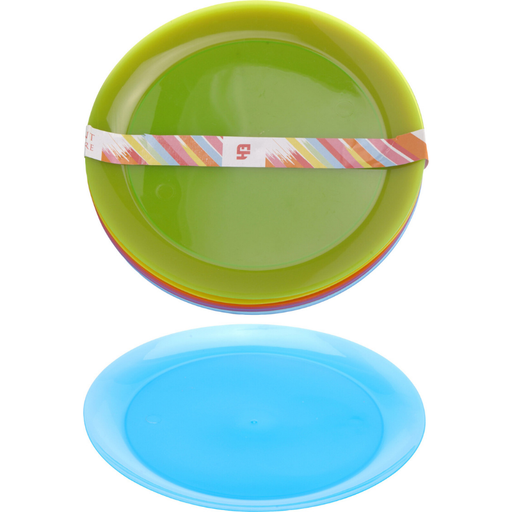
Why this choice suits this profile: A set of six polypropylene plates, ideal for family meals, children, garden dining, camping or picnics.
The product listing specifies that the plates are stackable, scratch-resistant and dishwasher-safe. It also states that they cannot be used in the microwave.
Six pieces, round shape, multicoloured finish, low weight and suitability for indoor and outdoor use according to the stated specifications.
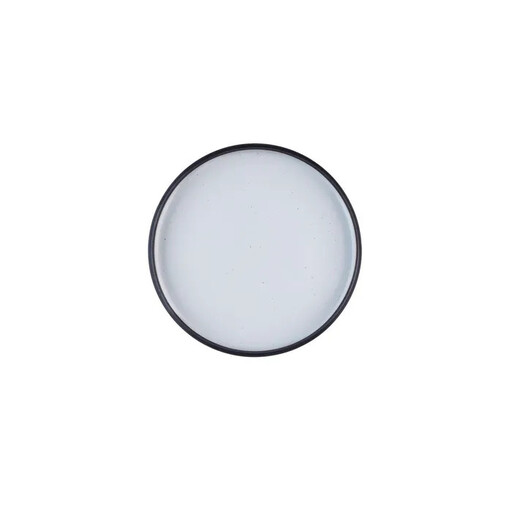
Why this choice suits this profile: With its Onyx finish and versatile shape, this set works equally well for everyday meals, dinner parties and carefully styled presentations.
The diameter is stated precisely, while the ceramic construction gives you a clear idea of the weight and fragility compared with a plastic model.
Set of four, 21.5 cm diameter, smooth surface, stackable design and hand washing recommended.
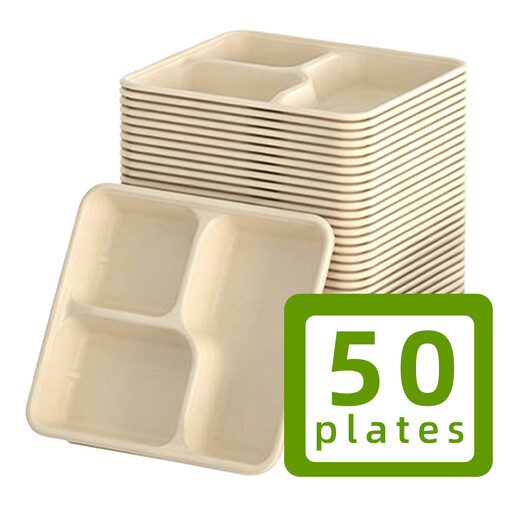
Why this choice suits this profile: A compartmented format designed for buffets, takeaway meals, events and catering services.
The three compartments keep preparations separate, while the 50-piece set helps ensure you do not run out of plates during an event.
The product listing mentions sugar-cane fibre construction, a compartmented format and resistance to oil. Check your local composting guidelines.
For outdoor tableware, choose a lightweight material that is less susceptible to impact. Bamboo or plant-fibre plates are available in sets of 25 to 100 pieces, making them suitable for a large celebration or occasional use. Kraft paper plates are easy to transport and well suited to barbecues, birthdays and picnics. However, their product listings may specify restrictions when used with very hot liquids.
For repeated use in a busy kitchen, 304 stainless steel is worth considering. The 24 cm Maxcook model is described as unbreakable, corrosion-resistant and compatible with several appliances. Always follow the heating precautions and use oven gloves when handling a hot plate.
A porcelain serving plate, such as the 30 × 18 cm Secret de Gourmet Nora oval platter, is better suited to serving and presentation. For a restaurant, hotel or catering operation, check the dimensions, weight, stackability and compatibility with the stated professional uses.
Explore an updated selection of plates for everyday meals, events, catering and outdoor activities.
For a main course, a diameter between 21 and 27 cm generally provides sufficient space. Smaller formats of around 15 cm are better suited to desserts, starters and lighter portions. For soups and saucy dishes, a deep plate is the more practical choice.
Not necessarily. The material, any treatment applied and local collection rules can vary. Always check the packaging and your local council’s guidelines before sorting them. The term “compostable” alone does not mean that the plate can be composted at home.
Only if the product listing or markings clearly confirm that they are microwave-safe. The Excellent Houseware set featured here is specified as incompatible with microwave use. When in doubt, use a plate designed for microwave cooking rather than relying on its appearance or thickness.