
Livraison le jour même ou le lendemain

Qualité garantie

Débloquez vos offres de bienvenue: Livraison GRATUITE | Jusqu'à -80 % | 30 jours d'essai gratuits à JoyPlus
Téléchargez l'application
Choosing a tablecloth? It seems simple enough. In reality, it's often an obstacle course. Between promises of easy care that vanish after the first wash and dimensions that just don't fit, it's easy to end up with a disappointing product. Yet, a tablecloth does more than just protect your table: it sets the tone and creates an atmosphere that reflects your style, for everyday life and special occasions alike.
As the Head of Product Curation at Joybuy, my mission is to help you navigate the options. Let's forget the marketing jargon and focus on what really matters. We'll review the most common pitfalls and, more importantly, how to avoid them to make the right choice.
To avoid these letdowns, you just need to check a few key points before you check out.
The choice of material is critical. It influences not only the style but, most importantly, the maintenance.
For a flawless look, your tablecloth should hang evenly over the edge of the tabletop. The ideal drop is between 20 and 30 cm on each side.
How to calculate?
A true stain-resistant tablecloth worthy of the name is coated (with acrylic, Teflon, etc.), which creates a genuine protective barrier on the fibres. Liquids and grease bead up on the surface and can be wiped away without a trace. In contrast, a simple water-repellent treatment fades with washing and offers only short-term protection.
To put theory into practice, here are a few models that meet specific needs and avoid the classic pitfalls.
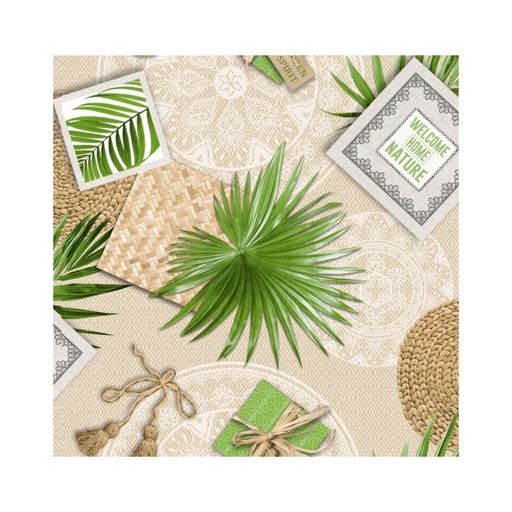
Why we recommend it: It combines a very current bohemian pattern with the absolute practicality of oilcloth. Perfect for protecting the table from everyday little accidents (spilled drinks, marker strokes, sauce…) without sacrificing your dining room's style.
Unlike a fabric tablecloth that is merely water-repellent, its vinyl surface is 100% waterproof. Stains don't penetrate; they wipe away in an instant. No more worrying about juice stains.
Virtually zero maintenance (a wipe with a sponge is all it takes) and a polished aesthetic that sheds the old-fashioned image of oilcloth.
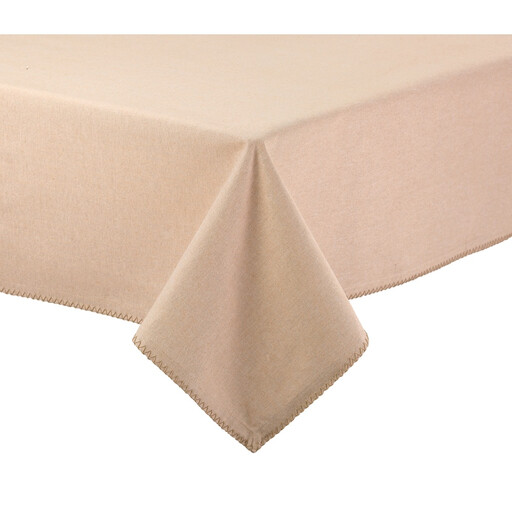
Why we recommend it: For those who want the elegance of fabric without compromising their eco-friendly values. Made from 80% recycled cotton, it offers a flawless drape and a very understated natural hue. The Oeko-Tex certification is a real bonus.
The blend with 20% polyester stabilises the fabric, which significantly limits the risk of shrinking in the wash. Its stain-resistant treatment provides effective protection without sacrificing the natural feel of cotton.
The perfect marriage of eco-responsibility (recycled cotton, Oeko-Tex) and elegance, with a neat blanket stitch finish as a bonus.
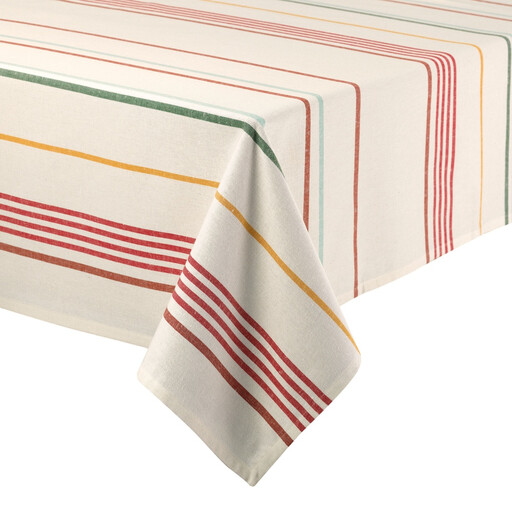
Why we recommend it: Finding a large-sized tablecloth that is both beautiful and high-quality is often a challenge. This 170 x 300 cm model is perfect for huge family tables. Its colourful stripes immediately create a festive and friendly atmosphere.
It solves the sizing headache right away with its generous dimensions. Furthermore, the "yarn-dyed" technique ensures that the stripe colours will remain vibrant and won't bleed, wash after wash.
Its XXL dimensions (170 x 300 cm) and durable composition make it the perfect partner for dressing holiday tables, year after year.
We have curated a complete selection of tablecloths that meet our quality criteria and current standards.
For everyday use, a drop of 20 to 30 cm on each side is ideal: it's aesthetically pleasing without being in the way. For a reception or a more formal event, you can go for a longer drop, up to 75 cm (floor-length), for a more dramatic effect.
It all depends on the technology. A tablecloth with a coating (acrylic, for example) will offer far superior protection to a simple water-repellent treatment. On a coated tablecloth, a wine or oil stain will bead on the surface. If you act quickly with an absorbent paper towel, it will disappear without a trace. A water-repellent treatment, on the other hand, only delays the inevitable for a few moments.
Cotton, even recycled, is a natural fibre that is sensitive to heat. To limit shrinkage, wash it at a low temperature (30°C, 40°C maximum) on a gentle spin cycle. Avoid the tumble dryer, which tightens the fibres, and opt for air-drying instead. A pro tip: ironing on the reverse side while the tablecloth is still slightly damp will help relax the fibres and restore its original shape.