
Livraison le jour même ou le lendemain

Qualité garantie

Débloquez vos offres de bienvenue: Livraison GRATUITE | Jusqu'à -80 % | 30 jours d'essai gratuits à JoyPlus
Téléchargez l'application
Whether you're a casual weekend player, a parent equipping a child for their club, or a seasoned competitor, choosing the right table tennis equipment can quickly become a headache. Faced with a jungle of product models, star ratings, and marketing claims, there's a high risk of ending up with unsuitable gear that will hinder your progress and ruin the fun.
As the Head of Product Recommendations at Joybuy, my mission is to help you see things more clearly. Let's cut through the technical jargon and get straight to the point to help you make the right choice.
Before we break down the technical specs, let's review the most frequent errors that lead straight to disappointment.
To avoid these pitfalls, focus on three fundamental technical aspects that determine the performance and suitability of your equipment.
A racket's performance relies on the synergy between its blade and its rubbers.
The grip on a racket is highly personal. The handle should feel like a natural extension of your hand. The three main shapes are:
For a child's ping-pong racket, a slimmer concave handle will often be better suited to their hand size.
In recent years, competition balls have moved away from celluloid in favour of ABS plastic. They are slightly larger (40+ mm) and a bit slower. To train under proper conditions, it is therefore crucial to use ABS 40+ table tennis balls. They guarantee a stable bounce and trajectory, compliant with current regulations. For clubs or intensive training, a pack of 1-star training balls represents an excellent balance of quality and price, with durability designed for long sessions.
To help you put this advice into practice, here are a few recommended options, each tailored to a specific need.
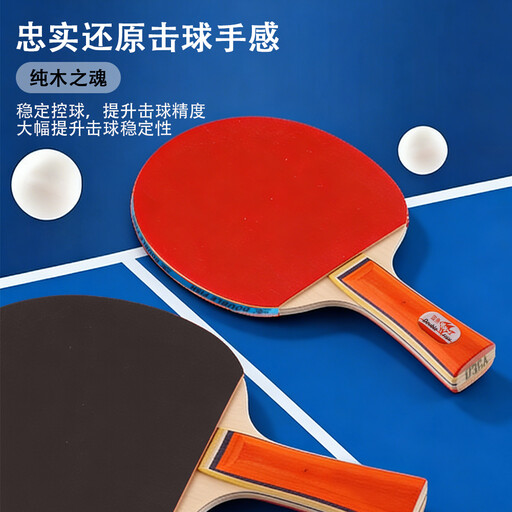
Why we chose it: Perfect for getting started with family or friends. This set offers a complete and balanced solution to discover ping-pong without breaking the bank, while still providing quality construction that ensures a good feel from the very first rallies.
Unlike low-end kits, this model combines a responsive blade with elastic rubbers that guarantee good ball control. No more frustration from unresponsive equipment!
Its thick edge tape increases its lifespan, while its comfortable grip is designed for all-round players.

Why we chose it: Designed for young players starting out in a club. Its lightweight design reduces fatigue, and its slim handle, adapted for smaller hands, makes it an excellent first racket for progression.
This 3-star model offers the perfect balance between performance and control. It's fast enough to facilitate progress but not so fast that it becomes overwhelming, allowing the child to develop their technique with confidence.
Optimised for a 'fast attack with top-spin' playing style. Its handle is non-slip and absorbs sweat.

Why we chose it: For advanced players seeking power and speed. The addition of a carbon fibre layer gives it superior explosiveness, which is essential for a high-intensity offensive game.
Here, the 6 stars aren't just a marketing gimmick. The hybrid wood-carbon construction is designed for technical players who can tame its power. The blade's geometry enlarges the effective contact area (*sweet spot*) for more consistency in your shots.
Explosive power thanks to the carbon fibre. Ergonomic concave handle for precise control and a powerful ball feel.
Also, consider game-changing table tennis accessories, like a ping-pong ball picker for long multi-ball training sessions, or quality bulk packs like the Double Fish B40+ 1-Star balls for clubs.
We've compiled a complete, up-to-date selection of products that meet these strict selection criteria and current standards.
1. How do I clean and maintain my table tennis racket? After each session, a quick wipe of the rubbers with a soft, dry cloth (or a very slightly damp sponge) is enough to remove dust and sweat. Avoid leaving it in direct sunlight or exposing it to extreme temperatures. Ideally, store it in a case to protect it from impacts and dust.
2. What is the lifespan of a ping-pong racket? It all depends on how often you play and how well you maintain it. The blade itself can last for years if it doesn't suffer any major impacts. The rubbers, however, lose their grip and elasticity over time. A regular player (several training sessions per week) will need to change their rubbers every 6 to 12 months to maintain optimal performance. For an 'all-in-one' racket, a complete replacement is necessary when the grip is gone.
3. What is the difference between 1-star and 3-star balls? 3-star balls represent the pinnacle of quality and are approved for official competitions. Their selection process is rigorous: roundness, weight, and bounce must be flawless. 1-star balls, on the other hand, are intended for training. They combine quality and durability for intensive use (like multi-ball drills), with slightly looser manufacturing tolerances than 3-star balls, which explains their more accessible price in large quantities.