
Livraison le jour même ou le lendemain

Qualité garantie

Débloquez vos offres de bienvenue: Livraison GRATUITE | Jusqu'à -80 % | 30 jours d'essai gratuits à JoyPlus
Téléchargez l'application
Upgrading to LED lighting for your car is an excellent way to modernise its look and improve visibility. However, the T10 W5W bulb market is an overwhelming landscape where it's easy to get lost. One wrong choice can lead to a frustrating dashboard error message or a ridiculously short lifespan.
As a Product Specialist at Joybuy, my mission is to help you navigate this complexity. Let's break down the common pitfalls and essential criteria for choosing the perfect LED bulb for your vehicle.
Before you pull out your credit card, be wary of these often-misleading marketing promises that can cost you dearly in both time and money.
To avoid these traps, focus on three non-negotiable technical specifications.
The Canbus (Controller Area Network) system is the electronic brain of your car. It constantly monitors that everything is working correctly, including the bulbs. A standard halogen bulb has a certain electrical resistance, whereas an LED's is much lower. The system, not expecting this, interprets the difference as a fault and triggers an alert.
A true t10 canbus led integrates an internal resistor to "trick" the on-board computer (OBC). Therefore, explicitly look for the OBD error free or "Canbus Error Free" label and prioritise models with proven compatibility with European vehicles.
Before you check out, one last reflex: check the bulb's dimensions. Some LED models are longer or wider than the original T10 halogen bulbs (sometimes called 194 bulb or 168 bulb) and may not fit into their housing. As for materials, a body made of aircraft-grade aluminium is an excellent indicator of effective heat dissipation, and therefore, longevity. Steer clear of all-plastic models!
To help you make your choice, here is a selection of models that meet specific needs, all validated against the criteria we've just discussed.
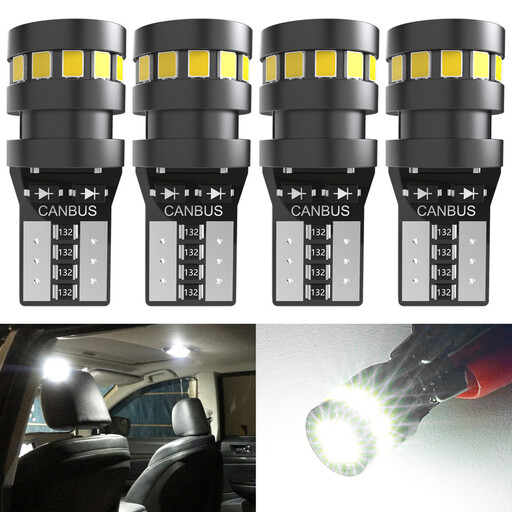
Why we chose it: Perfect for those who want a simple, reliable upgrade for their interior (dome light, glove box) or license plate. A "plug-and-play" replacement that offers a modern look without the hassle.
Its "Canbus Error Free" design is engineered for broad compatibility, minimising the risk of OBD errors. Its aluminium body ensures far better heat dissipation than all-plastic models.
An excellent balance between effective brightness (300 lm) and a pure white colour (6500 K), perfect for a look that is both clean and modern.
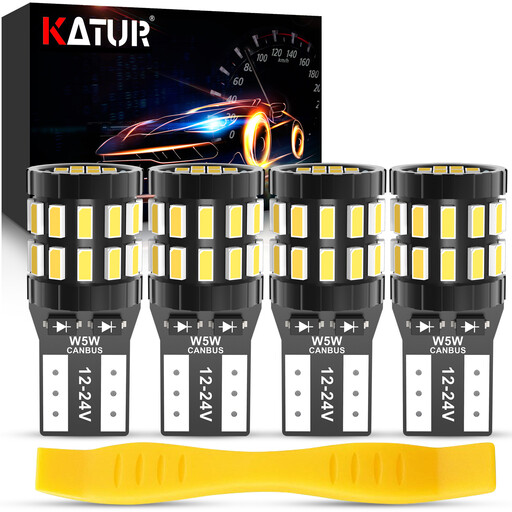
Why we chose it: Designed for those who demand maximum brightness for the boot, map lights, or any other application where powerful lighting makes a difference. Its wide voltage range (12-24V) is a testament to its robustness.
Its aircraft-grade 6063 aluminium body perfectly manages the heat from its 30 LED chips, preventing any risk of overheating. The "Canbus error-free" claim is clearly stated.
A very high light output of 450 lumens for maximum visibility and a wide voltage range (12-24V) that ensures excellent electrical stability.
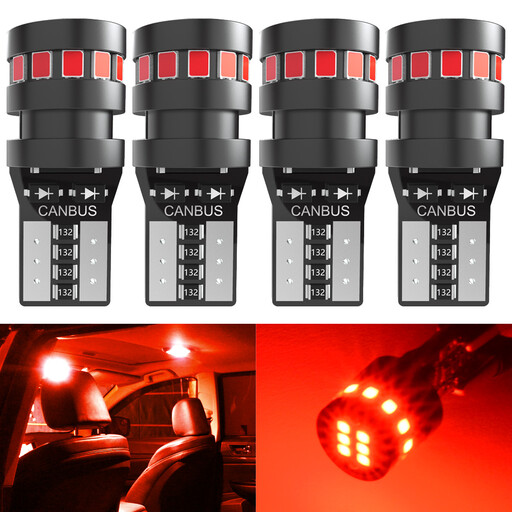
Why we chose it: Ideal for adding a touch of colour to interior ambient lighting (footwells, storage compartments), where regulations permit, without sacrificing technical reliability.
Low-end coloured bulbs are often a compatibility nightmare. This model maintains a serious Canbus design and an aluminium structure to ensure an error-free installation and lasting durability.
A rich, uniform red colour, light-years away from the garish output of cheap bulbs, while integrating the necessary technology for peace of mind.
We have put together a complete, up-to-date selection of products that meet our strict selection criteria and regulations.
No, the installation is "plug-and-play" and incredibly simple. Just turn off the ignition, let the old bulb cool down, remove it, and clip in the new LED. If it doesn't light up on the first try, don't panic: LEDs have polarity. Simply remove it, rotate it 180°, and reinsert it.
This is the classic symptom of an incompatibility with the on-board diagnostics (OBD) system. The LED's very low power consumption is interpreted by the on-board computer as a burnt-out bulb. To avoid this issue, it is essential to choose a model explicitly marked as t10 canbus led or OBD error free, which integrates a resistor to simulate normal power consumption.
A quality LED bulb can last for tens of thousands of hours, which is 10 to 20 times longer than a standard halogen bulb. Although their upfront cost is higher, their exceptional longevity and low energy consumption make them a very cost-effective investment in the long run.