
Livraison le jour même ou le lendemain

Qualité garantie

Débloquez vos offres de bienvenue: Livraison GRATUITE | Jusqu'à -80 % | 30 jours d'essai gratuits à JoyPlus
Téléchargez l'application
By the Editors, 23 July 2026
So, you've taken the plunge and bought a big-screen TV to turn your living room into a true home cinema. The next step is just as crucial: mounting it securely and flexibly to the wall. A swivel wall mount for a large-screen TV is more than just an accessory; it's the key component that ensures both the safety of your valuable television and your viewing comfort. But between VESA standards, mounting types, and technical specs, it's easy to feel overwhelmed.
This guide is here to help. We've broken down the essential criteria for choosing the ideal mount for your 55 to 100-inch TV, focusing on sturdiness, compatibility, and ease of installation.
Before you start, three technical points deserve your full attention. They are the foundation of a successful and long-lasting installation.
The VESA (Video Electronics Standards Association) standard defines the distance, in millimetres, between the four mounting holes on the back of your TV. It is the number-one compatibility factor. For example, a VESA 400x400 compatible mount will fit TVs where the mounting holes form a 40 cm square. A good rule of thumb: check this specification in your TV's manual before making any purchase.
Weight is the second pillar of safety. Large-screen TVs can be very heavy. Ensure the maximum load capacity of the arm is significantly higher than the weight of your television. For instance, an articulating wall mount certified for 75 kg provides a comfortable safety margin for most 75 to 85-inch screens. On this point, there is no room for compromise.
A mount's sturdiness is worthless if the wall can't support it. A TV mount for concrete walls or solid wood studs is designed to anchor securely into load-bearing materials. For the heaviest TVs, forget about hollow walls (like drywall or plasterboard): the risk of the mount being torn out is far too high.
Installation requires precision. Use a stud finder for wood-frame walls and a hammer drill with the appropriate bit for concrete. Follow the instructions to the letter and only use the provided hardware, which is specifically designed to handle heavy loads.
The main appeal of a swivel mount lies in its flexibility. An extending TV wall arm allows you to pull the TV away from the wall to adjust the viewing angle or easily access the rear connections. The range of extension, swivel (left-right), and tilt (up-down) is therefore crucial for eliminating glare and finding the perfect viewing angle, whether you're on your sofa or elsewhere in the room. A full-motion tilting and swivelling TV wall mount will offer you maximum versatility.
After reviewing the top models on the market, one mount clearly stands out for its ultra-sturdy design, engineered for XXL screens.
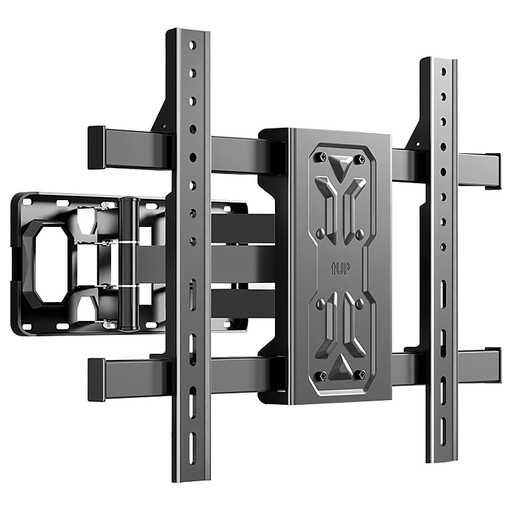
Why it stands out:
This model is designed for complete peace of mind. With a load capacity of 75 kg and a 5.5 mm thick steel frame, it's a true heavyweight in its class, built for the largest TVs on the market, up to 100 inches. Its dual articulating arm offers a maximum extension of 67 cm, allowing for a very wide range of motion and easy access to connections. Its large wall plate (250 x 250 mm) ensures ideal load distribution on the wall.
Advantages:
Who is it for?
This mount is the ideal solution for owners of very large-format TVs (65 inches and up) who prioritise safety above all else. It will delight home cinema enthusiasts looking for the best viewing flexibility, provided they have a load-bearing wall capable of handling the weight.
The model we've selected is a safe bet for XXL screens. Of course, every setup has its own constraints. If your TV is smaller, lighter, or if you're looking for different features, other solutions are available.
To explore a wider range of mounts suitable for all configurations, feel free to browse our complete selection.
Explore our collection of swivel arm TV wall mounts
Knock on the wall: a dull, solid sound is a good sign. Conversely, a drywall or plasterboard partition will sound hollow. To be absolutely sure, drill a small test hole: concrete dust is grey and fine, brick dust is red, while drywall produces a white, powdery dust. If in any doubt, call a building professional. This is non-negotiable.
The VESA standard is simply the horizontal and vertical distance (in millimetres) between the four screw holes on the back of your TV. For example, VESA 400x400 means the holes form a 40 cm x 40 cm square. This information can be found in your TV's manual, but you can also measure it yourself with a tape measure.
If you are a skilled DIYer, comfortable with a drill and a spirit level, the installation is within your reach. However, help from a second person is essential, especially for lifting and hanging the TV. Read the instructions very carefully, use the right tools, and most importantly, verify your wall type before drilling the first hole. The safety of your installation depends on it.