Households replacing a hob
You already have frying pans and saucepans and need to decide whether sorting or selectively replacing your cookware will allow you to switch to induction, or whether another technology would avoid the expense.


Choose induction if your most-used cookware has a ferromagnetic base, or if you can replace only the pieces that are incompatible. A ceramic hob may be a better choice when keeping all your pans immediately is the priority; a mixed induction-gas hob is mainly worthwhile if you genuinely use both cooking methods and the connections and cut-out suit the model you choose.
You already have frying pans and saucepans and need to decide whether sorting or selectively replacing your cookware will allow you to switch to induction, or whether another technology would avoid the expense.
You prioritise rapid boiling, power adjustment and zones suited to different diameters or large cookware; compare the zones and their functions based on how you cook.
You want to retain gas burners for certain cookware or cooking styles while adding induction; check the connections and dimensions of the mixed model you choose.
Start with your cookware and the existing cut-out, then compare the cooking functions and installation requirements of the specific model.
| Priority | What to check | Your needs |
|---|---|---|
| Cookware compatibility | Check the ferromagnetic base of every pan intended for use on induction. Also check the minimum diameter accepted by each zone and whether a flexible zone would be useful for large dishes. | I want to keep my most-used pans without discovering after installation that they are not detected. |
| Cooking and energy consumption | Compare how well the zones suit your cookware, low-power cooking and consumption when a comparable test is available. A booster provides temporary additional power depending on the model, but it does not define the hob’s overall performance on its own. | I’m looking for heat that suits my cooking habits, not just a large number of power levels or a booster function. |
| Fitting and connections | Measure the worktop cut-out, not just the visible width. Compare it with the manual, then check the power supply, specified ventilation and, for a mixed hob, the gas connection requirements. | My hob must be able to fit into and connect to the existing kitchen without assuming that two models of the same width have the same requirements. |
| Safety and cleaning | Look at the features of the exact model, such as pan detection, the lock and safety protections. For a mixed hob, take into account the grates and burners that need cleaning. | I prefer a solution whose everyday care requirements and safety features suit my household. |
An induction hob will not heat cookware whose base is not ferromagnetic; changing the power setting will not resolve this incompatibility.
Make an inventory of the saucepans, frying pans and cookware you use every day, then check their bases and the minimum diameter specified for the zones you plan to use.
A mixed hob combines electrical, gas and fitting requirements. It is suitable for genuinely hybrid cooking, but it is not automatically simpler than induction with selective cookware replacement.
Compare how much you really use gas with the number of pans that would need replacing, then ask a professional to confirm the technical requirements.
The gas connection and safety checks, along with cleaning the gas components, add practical considerations.
A booster can speed up certain cooking tasks, but it does not by itself tell you about low-power cooking, even heat distribution, energy consumption, cleaning or how easy the controls are to read.
To choose between two induction hobs, look at the zones that suit your cookware and, where available, prioritise a test covering several uses. UFC-Que Choisir states that its tests assess performance, ease of use, electricity consumption and safety, among other factors.
A documented French range of 60 cm induction hobs, including the four-zone EIV64453 with a flexible zone, as well as large-format mixed induction-gas hobs such as the KDI951723K.
Offers 60 cm mixed hobs combining two induction zones and two gas burners, including the HDB64623NB.
A range of built-in induction hobs including 60 cm models such as the PIJ631HB1E, with a 28 cm zone and DirectSelect controls.
Offers mixed gas-induction hobs in 65, 70/75 and 90 cm formats, with different burner configurations depending on the width.
Joybuy options covering the switch to an induction hob, the ceramic alternative and the selective replacement of cookware compatible with induction.
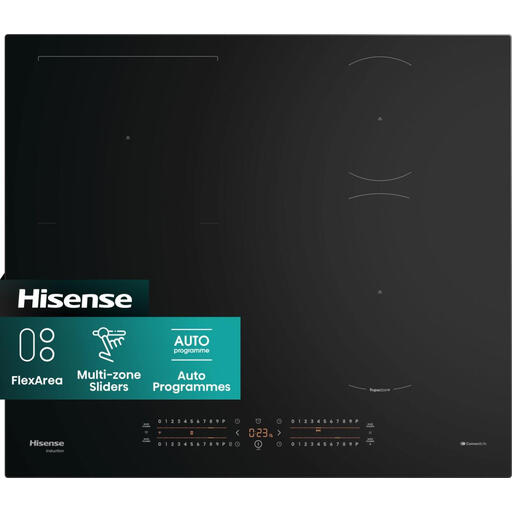 Image unavailable
A built-in option for households that use large saucepans or a griddle and want a Bridge zone.
Four zones, touch controls, booster, pan detection, residual heat indicator and child lock are listed.
Check that your cookware has a ferromagnetic base, along with the 56–56.2 × 49 cm cut-out, minimum height and power supply and ventilation requirements.
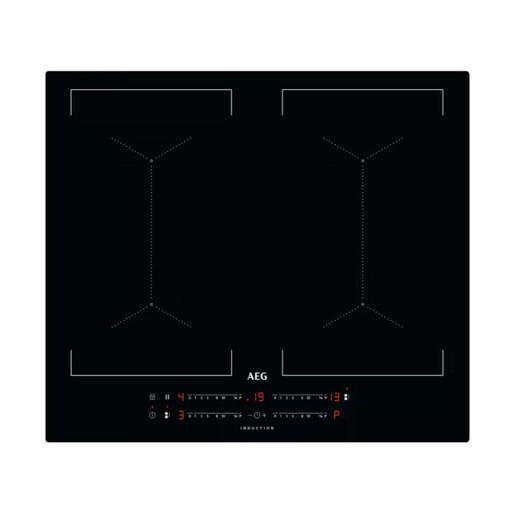 Image unavailable
This hob is suitable for cooks who want to combine zones for long dishes or large frying pans.
Four zones, two combinable FlexiBridge zones, TFT display, timer for each zone, Stop&Go and residual heat indicator are listed.
Cookware must have a ferromagnetic base; consult the manual for the exact cut-out and ventilation requirements before buying.
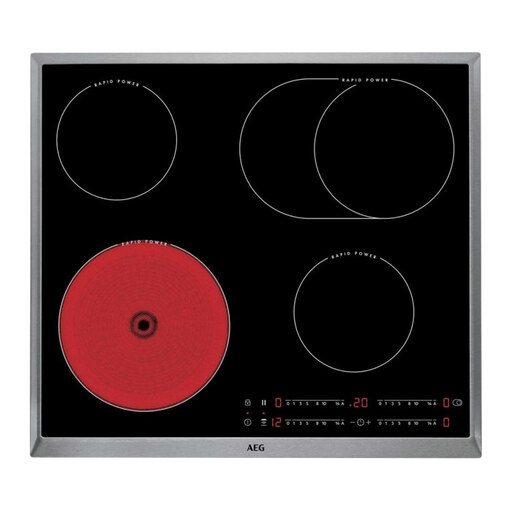 Image unavailable
An alternative when keeping non-ferromagnetic cookware without immediately sorting through it is the priority.
Four zones, one extendable zone up to 17 × 26.5 cm, four timers, Stop&Go, child lock and OptiHeat indicators are listed.
Check the 56 × 49 cm cut-out, 220–240 V / 400 V 2N power supply and the installation requirements for the exact model.
 Image unavailable
A four-zone hob for replacing an existing hob if the cut-out and power supply are suitable.
The product sheet lists a Boost function, nine power levels, a timer, pan detection, child lock and residual heat indicator.
The connection is wired without a plug: have the power supply, ventilation, 56.5 × 49.5 cm cut-out and cookware base diameters checked.
 Image unavailable
A large pan for selectively replacing one item of cookware when switching to induction.
The product sheet states a capacity of 6.5 L, a diameter of 30 cm, a glass lid, silicone handles and a composite base compatible with induction.
Check the diameter of the base in contact with the zone on your future hob; the product sheet recommends hand washing.
The base must be ferromagnetic. Electrolux guidance and UFC-Que Choisir advice mention cast iron, steel, enamelled steel and some stainless-steel or multi-layer cookware; also check the minimum diameter stated in the hob manual, as this varies by zone and model.
Yes, provided the cookware you actually use has a compatible base. Replacing only incompatible items may be sufficient, but a pan without a ferromagnetic base will not be detected by the hob.
Measure the worktop cut-out, not just the visible width of the old hob. UFC-Que Choisir states that 56 × 49 cm is a common built-in dimension, but some formats require a specific cut-out; the Electrolux EIV64453, for example, specifies a 560 × 490 mm cut-out.
Yes, have the fitting, specified ventilation and power supply confirmed using the manual for the exact model. With a mixed hob, gas connection requirements are added to these checks; using a qualified professional is therefore particularly important.
When buying an equivalent new appliance, the retailer must offer free take-back of the old appliance under the “1 for 1” principle, either at the point of sale or when the new appliance is delivered, depending on the sales arrangements. This requirement is highlighted by ecosystem.