Parents of a baby or toddler
You’re shopping for a child under 3 and need to distinguish an everyday plant-based drink from food suitable for their age. For babies, Anses warns against replacing breast milk or its substitutes with other drinks.


Before choosing between a ‘sweetened’ soya drink and a plain recipe, check the child’s age and what you intend to use the drink for. According to Anses, an everyday plant-based drink is not a substitute for breast milk or infant formula. For an older child, compare the ingredients and ‘sugars’ line on the products you’re considering; ‘sweetened’ does not mean ‘sugar-free’.
You’re shopping for a child under 3 and need to distinguish an everyday plant-based drink from food suitable for their age. For babies, Anses warns against replacing breast milk or its substitutes with other drinks.
You’re comparing recipes for an older child or a household that already drinks soya. The ingredients in the ‘sweetened’ products listed by Carrefour and Auchan show why it’s important to read the label before assuming this means they’re low in sugar.
You’re looking for a drink for breakfast or cooking and want to compare the ingredients, nutritional information, packaging and storage instructions after opening the carton you choose.
First, work out whether you’re shopping for a baby or an older child. Then compare the recipes on the same basis and choose a pack size you can use in line with its storage instructions.
| Consideration | What to check | Who this matters to |
|---|---|---|
| Age and purpose of the drink | Check the child’s age and distinguish an everyday soya drink from food designed for a baby. Anses warns against making this kind of substitution. | If I’m shopping for a baby, I need to know what food is right for their age before I look at the flavours of the drinks in the aisle. Around 31% of shoppers would put this need first. |
| Mild taste and sugars | Read the ingredients list and the ‘sugars’ line, then compare a ‘sweetened’ recipe with a plain product on the same nutritional basis. | I’m looking for a mild taste for an older child, but I don’t want to assume from the name on the carton that it’s sugar-free. This would be the main concern for around 25% of shoppers. |
| Plain recipe | Compare the ingredients and nutritional information for the exact product; don’t mistake a short ingredients list for infant formula. | For cereal or cooking, I prefer a plain recipe whose ingredients I can check easily. Around 25% of shoppers would prioritise this. |
| Pack size and storage | Check the carton size and the storage instructions for after opening on the product you choose. | If I’m not sure how quickly the drink will be used, I want to avoid opening more than I need. Around 19% of shoppers would make this their priority. |
When shopping for a baby, calling it ‘soya milk’ doesn’t make an everyday soya drink suitable for them. Anses says that replacing breast milk or substitutes designed for this purpose with another drink may pose risks.
Choose food that’s suitable for your baby’s age. If they have specific needs, ask a healthcare professional for advice rather than relying on labels such as ‘organic’ or ‘sweetened’.
The Carrefour Bio Soja Douceur and Bjorg Soja Douceur product listings on Auchan show cane sugar in these recipes. So the name alone doesn’t tell you how much sugar the product contains.
Compare the ‘sugars’ line and ingredients on each carton with those of a plain recipe, taking account of the nutritional basis shown on the label.
In 2025, Anses recommended that soya-based foods should not be served in collective catering, to limit excessive isoflavone consumption. This recommendation applies to collective catering; it doesn’t make a plain drink an automatic answer to the question of how often soya should be consumed at home.
If soya is a regular part of a child’s diet, or certain foods need to be avoided, ask for advice tailored to their circumstances.
A pack may not be practical if the drink is only used occasionally or if your household doesn’t like the taste.
If you’re trying it for the first time, check the carton size and the storage life after opening stated on the packaging.
An opened carton that isn’t used within the stated time may go to waste.
Carrefour offers a Soja Douceur Bio drink, among other products, as well as another soya drink under the Carrefour Sensation range.
Auchan Bio’s plain soya drink is worth considering if you’re looking for an unflavoured recipe.
The product listings on Auchan let you compare Bjorg Soja Douceur Bio and Bjorg Soja Nature Bio drinks.
The range of soya drinks listed by Carrefour includes Alpro plain, vanilla and banana varieties.
The range listed by Auchan includes Sojasun plain and vanilla drinks, as well as a product advertised as containing calcium and vitamin D.
This Vitasoy soya drink is labelled ‘Less Sugar’ and comes in small cartons. To compare it with sweetened or plain recipes, check its label against the products you’re considering and take the child’s age into account.
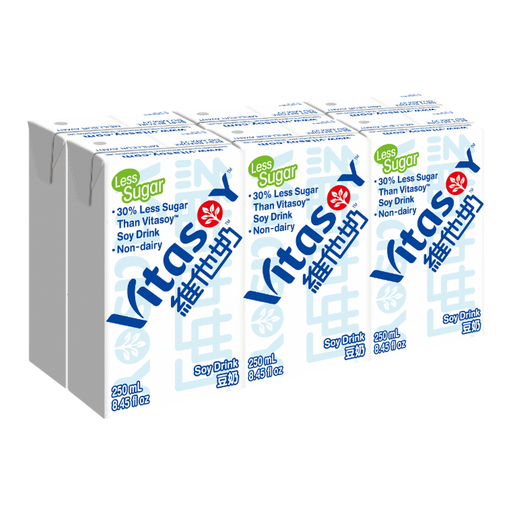 Image unavailable
This pack may suit you if you prefer to open one carton at a time: it contains six 250 ml cartons. The ‘Less Sugar’ claim doesn’t tell you the sugar content on its own, so check the nutritional information for this product to compare it with a plain recipe.
This is an everyday soya drink, not a substitute for breast milk or infant formula.
No. An everyday soya drink should not replace food designed for a baby. Anses warns against replacing breast milk or substitutes with other drinks during the first year, while Assurance Maladie advises continuing with infant formula until the age of one.
No. The Carrefour Bio Soja Douceur and Bjorg Soja Douceur product listings on Auchan include cane sugar in their ingredients. Check the ‘sugars’ line on the carton you choose before comparing it with a plain recipe.
Don’t treat a soya drink from the plant-based drinks aisle as an established nutritional replacement for this age group. If it’s going to become a regular part of the child’s diet, or you’re thinking of excluding other foods, ask a professional for advice tailored to their circumstances.
In 2025, Anses recommended that soya-based foods should not be served in collective catering to prevent excessive isoflavone consumption. This recommendation applies to that specific setting. For a child’s regular food choices at home, their individual circumstances should be considered.
Choose a pack size that matches how much your household expects to use, then follow the carton’s storage instructions after opening. Check the instructions on the exact product, as they can vary from one product to another.