Families making several portions
If your recipe uses sweetcorn kernels for several batches or a group, compare the quantity you need with the weight shown on each tin. Keeping some tins sealed also means you can use them later.


Check the recipe first: tinned sweetcorn is suitable if it calls for kernels, but it won’t replace the cornflour or corn starch needed for some biscuits. For a small group of children, smaller tins mean you only need to open what you’ll use. If you’re making several batches, compare the tin sizes with the quantity of kernels required and plan for any leftovers.
If your recipe uses sweetcorn kernels for several batches or a group, compare the quantity you need with the weight shown on each tin. Keeping some tins sealed also means you can use them later.
For a small activity, check that the recipe calls for drained kernels and choose an amount that’s easy to stir in. Bonduelle’s fritter recipe shows how tinned kernels can be used, but doesn’t establish that they’re suitable for a biscuit recipe.
Compare the ingredients and claims on the specific tin you’re considering. ‘No added sugar’, ‘no added salt’ and organic options don’t apply to every product from the same brand.
Start with the form of sweetcorn called for in the recipe, then choose the number and size of tins to suit the amount of kernels you’ll use.
| What to consider | What to check | Who is it for? |
|---|---|---|
| Quantity and leftovers | Compare the recipe quantity with the stated weight, and distinguish between net weight and drained net weight where given. | I’m planning several portions and want enough kernels without leaving tins open after the activity; around 33% of consumers prioritise getting the quantities right. |
| Recipe and preparation | Look for ‘sweetcorn kernels’ or ‘drained sweetcorn’ in the recipe. If it calls for cornflour or corn starch, choose that ingredient instead. | When cooking with children, I want to know whether drained kernels are actually used in the recipe; around 27% of consumers prioritise this over the pack size. |
| Ingredients and claims | Read the ingredients, nutritional information per 100 g and claims on the exact product. | I’m choosing an option for a specific claim, such as ‘no added salt’, and want to find it on the tin I buy; around 20% of consumers prioritise checking this. |
| Choosing a multipack | Compare the number of tins and their weight for an equivalent quantity, without assuming you’ll use an entire large multipack. | I’m making just one recipe and would rather not buy tins I won’t use; around 20% of consumers prioritise keeping their shopping in check. |
Tinned sweetcorn contains kernels, not the dry ingredient called for in a biscuit recipe that uses cornflour or corn starch. Bonduelle uses drained kernels in its fritter recipe, with the flour added separately.
Read the recipe ingredients before choosing a tin.
A multipack may contain more tins than you need for one recipe. Storage instructions apply as soon as a tin is opened.
Work out how many kernels you’ll need for all the recipes you have planned, then check the storage instructions after opening for the product you’ve chosen.
A claim such as ‘no pesticide residue’ applies to a specific product. Bonduelle states that its product has a quantification limit below 0.01 ppm for the molecules tested; this does not describe all its products.
Check the claim and its conditions on the packaging of the size you’re buying.
The DGCCRF lists dents, rust and bulging among the signs that may indicate a tin has been compromised.
If you’re unsure about the condition of the tin, don’t eat its contents. After opening, follow the manufacturer’s storage instructions.
The brand offers a 285 g tin of sweetcorn with ‘no added sugar’.
Carrefour offers sweetcorn in individual 285 g tins and multipacks of 3 × 140 g or 3 × 285 g.
E.Leclerc offers ECO+ sweetcorn in a multipack of 3 × 140 g and in a 285 g tin.
E.Leclerc offers NOTRE JARDIN sweetcorn with ‘no added sugar’ in a multipack of 3 × 140 g.
ALDI offers an organic BIO® sweetcorn product in a 285 g tin.
Consider these tins and multipacks of sweetcorn only if your recipe calls for kernels. Compare the pack size with the quantity you need, then check the drained weight on the packaging.
 Image unavailable
For a recipe that uses kernels, this multipack lets you open one tin at a time.
The stated pack size is 2 × 140 g. Check the drained weight and the claims for the Organic option on the packaging.
 Image unavailable
This individual tin is worth considering if your recipe calls for sweetcorn kernels.
The stated pack size is 400 g; check the drained weight to compare it with the quantity required.
 Image unavailable
Compare this individual tin with the quantity of kernels needed for your recipe.
The stated pack size is 285 g. Check the drained weight and what the claim in the name of this option covers.
 Image unavailable
If your recipe calls for more kernels in a single batch, compare this tin with the quantity you need.
The stated pack size is 570 g; check the drained weight and storage instructions after opening.
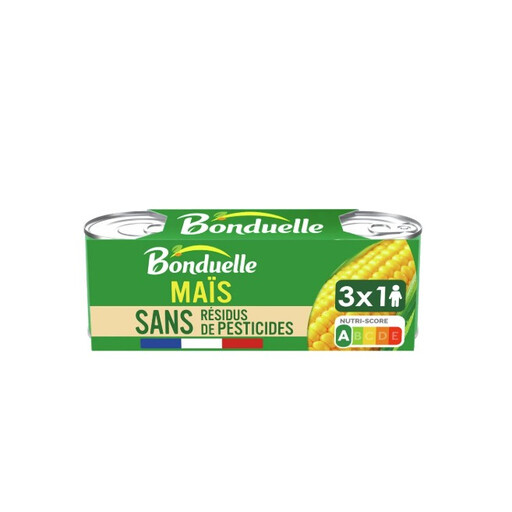 Image unavailable
This pack of three may suit you if several recipes call for kernels and you want to open the tins separately.
Check the weight of each tin, the drained weight and what the ‘No Residues’ claim on the packaging covers.
Yes, if the recipe calls for sweetcorn kernels, but not as a substitute for cornflour or corn starch. A fritter recipe published by Bonduelle uses drained kernels and adds the flour separately, so check which form of corn your own recipe calls for.
A multipack of small tins lets you open only the amount you need if the recipe calls for kernels. E.Leclerc offers, among others, ECO+ and NOTRE JARDIN multipacks of 3 × 140 g; always compare the recipe quantity with the stated weight of the product you choose.
Follow the temperature and time limit shown on the packaging of the tin you buy. For its ‘Maïs sans sucres ajoutés’ product, Bonduelle recommends storing it at a maximum of 4 °C and consuming it within 48 hours of opening; don’t assume these instructions apply to other products.
If you’re unsure about the condition of the tin, don’t eat its contents. The DGCCRF lists bulging, rust marks and dents among the signs that may indicate a tin has been compromised.