
Livraison le jour même ou le lendemain

Qualité garantie

Débloquez vos offres de bienvenue: Livraison GRATUITE | Jusqu'à -80 % | 30 jours d'essai gratuits à JoyPlus
Téléchargez l'application
Endless summer nights, an overheated bedroom even in winter… Sleep can quickly turn into a nightmare when the temperature rises. The solution? A summer duvet, of course. But be careful—the market is flooded with marketing promises, and it's easy to end up with buyer's remorse. To guarantee you finally get cool, restful nights, it's crucial to know how to avoid the most common pitfalls.
As a Product Recommendation Manager at Joybuy, my mission is to help you make an informed decision. Here are the mistakes to avoid and the criteria that truly matter.
Buying a duvet for the warmer months seems simple, but many people are disappointed with their choice. Here are the two most frequent mistakes:
To make the right choice, forget the marketing slogans and focus on objective data. Here are the three points to examine closely.
The fill weight of a summer duvet is the number one criterion. Expressed in grams per square metre (g/m?), it measures the weight of the filling. The equation is simple: the higher it is, the warmer the duvet.
The type of filling has a direct impact on breathability, weight, and ease of care.
The cover, meaning the outer fabric, is your first point of contact with the duvet. For a breathable duvet, natural materials reign supreme.
To put theory into practice, here are a few models that meet our criteria, suited for different needs.
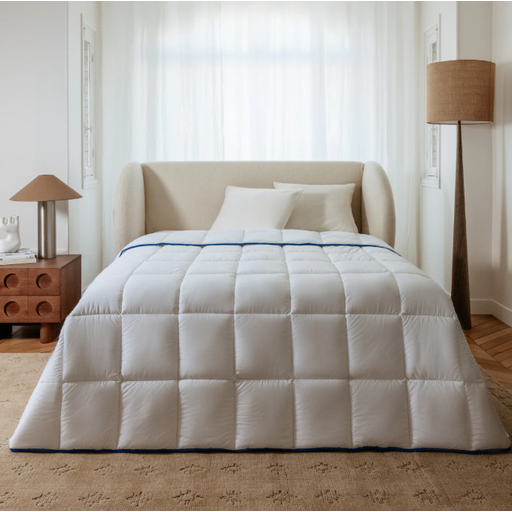
Why we recommend it: This model is a smart choice for anyone looking for a solution that is both practical and healthy. Its hollow, siliconised polyester fibre filling is designed to be hypoallergenic, and its certifications (Oeko-Tex, Sanitized) guarantee a healthy composition and an anti-dust mite and antibacterial treatment. A reassuring option for a duvet for two people.
With a fill weight of 250 g/m? and a 100% cotton percale cover, it ticks all the boxes to prevent overheating and the "greenhouse" effect of a low-quality cover.
The combination of an easy-care synthetic filling (washable at 40°C) and numerous health certifications makes it a very comprehensive product at an affordable price point.
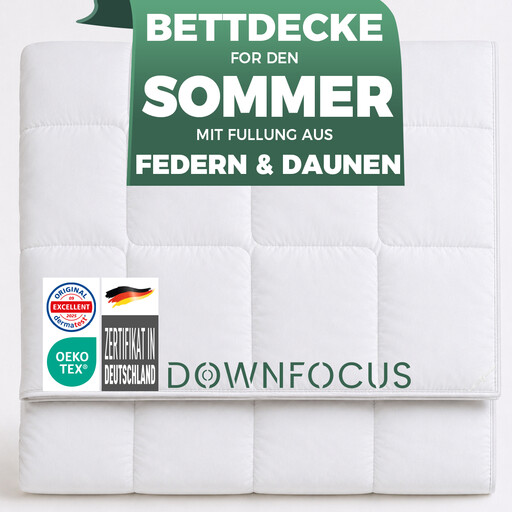
Why we recommend it: For purists who love premium materials, this natural duvet is a must-have. Its filling (90% feathers, 10% down) offers a level of breathability and lightness that synthetic materials can hardly match. It provides that airy comfort, perfect for summer nights.
Its fill weight of 200 g/m? is perfectly calibrated for summer, eliminating any risk of overheating. Its tightly woven cotton cover also acts as a natural anti-dust mite barrier.
The exceptional thermoregulation of down and feathers, combined with ethical (RDS, for animal welfare) and health (Oeko-Tex) certifications, makes this a product that is as high-performing as it is responsible.
Why we recommend it: Finding a good 140x200 cm summer duvet isn't always easy. This model offers the same excellent features as its larger counterpart (breathable synthetic filling, cotton percale cover) in a perfect size for single beds.
It provides a perfectly sized solution with clear specifications (250 g/m?, 100% cotton cover). No more settling for a model that's too large or compromising on quality.
Its numerous certifications (Oeko-Tex, Certipur, Sanitized) make it a safe and healthy choice for a single person, including for a teenager or to furnish a small bedroom.
Discover our full selection of duvets that meet our quality criteria and safety standards.
For a room where the temperature exceeds 20°C, a fill weight between 180 g/m? and 250 g/m? is ideal. If you get hot easily or if your bedroom turns into a real furnace in the summer, a fill weight around 200 g/m? will be perfect for a lightweight and airy feel.
Most synthetic duvets can be machine washed at 40°C. It's best to use a large-capacity washing machine (12 kg or more) to ensure proper agitation and rinsing. For natural duvets, read the label carefully: professional cleaning is sometimes required. In any case, thorough drying is essential to prevent mould growth, whether in a tumble dryer (on a low-temperature setting) or air-dried.
Yes, absolutely. Dust mites thrive in heat and humidity, which are typical conditions in our bedding during the summer. For people with allergies, an anti-dust mite duvet is therefore a real asset. This protection can come from a specific treatment (like the Sanitized label) or be natural, thanks to a tightly woven cover that forms a physical barrier against dust mites.