Sugar-free pellet chewing gum is not a substitute for a snack in a school lunchbox. You could consider a small pack for occasional use, provided the school allows chewing gum and your child is able to chew it. For an everyday snack, Manger Bouger’s advice is to choose minimally processed foods instead. Before buying chewing gum, also check the ingredients and warnings for the specific variety.
Which families is it for?
Here, ‘sugar-free pellets’ means pellet chewing gum, not sugared almonds or hard sweets. The distinction matters: chewing gum is not a snack.
Families comparing sugar content
You’re looking for an occasional treat and checking the ‘of which sugars’ line in the nutrition information. However, ‘sugar-free’ doesn’t automatically make a product something to include every day: Manger Bouger recommends limiting sugary products in children’s diets.
Families who need to consider school rules
Before putting a pack in your child’s bag, find out whether chewing gum is allowed at school and whether your child is able to chew it. A handy, easy-to-carry format doesn’t answer either question.
Families who pay close attention to ingredients
You want to check the ingredients and warnings for the exact product, particularly for polyols, aspartame and allergens. Freedent’s product information and that of several products featured by Carrefour show that recipes vary by brand and variety.
What should you check before buying?
First decide whether you’re looking for a snack or simply an occasional pellet to chew: these are not interchangeable uses.
A small pack of pellet chewing gum
Worth considering: for occasional use, once you’ve checked with the school and confirmed your child is able to chew it.
Limitation: ‘sugar-free’ doesn’t mean free from sweeteners or that it can replace a snack.
A lunchbox without chewing gum
Best choice: if your main need is an everyday snack made up of minimally processed foods, in line with Manger Bouger’s advice.
Limitation: this option won’t satisfy an occasional craving for something to chew.
| What to consider |
What to check |
Who this matters to |
| School and child |
Check the school’s rules and make sure your child is able to chew gum before choosing a pack to take with them. |
If the gum might end up unused in the bag because it isn’t allowed at school, permission matters more than the format. Around 38% of consumers prioritise whether it’s suitable for the school and child. |
| Sugars declared |
Read the ‘of which sugars’ line and remember that a piece of chewing gum is not a proper snack. |
Some consumers check the nutrition information first when looking for an occasional alternative to a sugary sweet, without expecting chewing gum to nourish their child. This is the priority for around 31% of them. |
| Ingredients and warnings |
Check the ingredients, allergens and any warnings about polyols or aspartame for the exact variety. |
If you need to check a recipe carefully, the wording on the front of the pack isn’t enough. Ingredients are the main consideration for around 31% of consumers. |
What mistakes should you avoid?
-
Assuming ‘sugar-free’ means it’s a balanced snack
A product may declare 0 g of sugars and still contain polyols or other sweeteners. The sugar content alone doesn’t tell you whether it belongs in a lunchbox. Manger Bouger recommends limiting sugary products for children and choosing minimally processed foods instead.
If you choose chewing gum, keep it for occasional use and read the nutrition information and ingredients list.
-
Choosing a large pack without thinking about how it will be used
A multipack or easy-to-reach pack doesn’t, by itself, help you keep track of how much is eaten. Some products containing polyols carry a warning that excessive consumption may have a laxative effect.
Decide what will be taken to school and check the warning on the variety you buy before putting a pack in the bag.
-
Assuming every product from a brand has the same recipe
Ingredients vary from one product to another. Product information published by Freedent and Carrefour lists aspartame, soya lecithin, gelatine and other ingredients to consider, depending on the variety.
Check the label on the exact product, even if you’re only switching flavour or pack size.
-
Confusing a pocket-sized pack with permission to take it to school
A compact pack is easy to carry, but its size says nothing about the school’s rules or whether your child is able to chew gum.
Check the school’s rules or ask before adding chewing gum to the lunchbox.
Brands to compare
These brands offer sugar-free chewing gum, but it’s the specific variety and its label you need to compare. A brand appearing here doesn’t mean all its products are suitable for a school lunchbox.
Freedent
The brand offers pellet chewing gum, including pocket-sized packs and multipacks.
- According to Freedent’s product information for its White fruit-flavour multipack of 5 × 10 pellets, this product contains 0 g of sugars and 67 g of polyols per 100 g.
- Check the packaging for the variety you choose for its warnings, including those about excessive consumption and phenylalanine. The brand’s whitening claims don’t tell you whether it’s suitable for use at school.
Hollywood
The brand offers sugar-free pellet chewing gum, including strong mint flavours.
- Carrefour’s product information for a strong fresh mint variety lists several sweeteners, including maltitol, sorbitol and aspartame, making it possible to compare this particular recipe.
- The same product information lists gelatine. Check the ingredients for each variety if this ingredient matters to you.
Airwaves
The products covered include sugar-free chewing gum with bold menthol flavours.
- For a strong menthol and eucalyptus variety, Carrefour lists several sweeteners, including sorbitol, isomalt and aspartame.
- A bold menthol flavour may not suit someone who prefers milder flavours. Check the ingredients of the product you buy, too.
CB12
This brand offers sugar-free chewing gum as part of a range focused on oral hygiene.
- Carrefour’s product information for a strong mint variety lists xylitol, sorbitol, aspartame, zinc and fluoride, among other ingredients.
- This positioning alone isn’t a reason to put it in a lunchbox. Check the ingredients, consider how it will be used and check the school’s rules.
Pellet chewing gum selected on Joybuy
This selection features a multipack of sugar-free pellet chewing gum, which you could consider for occasional use if the school’s rules and your child’s circumstances allow. It’s not a substitute for the food you pack for a snack.
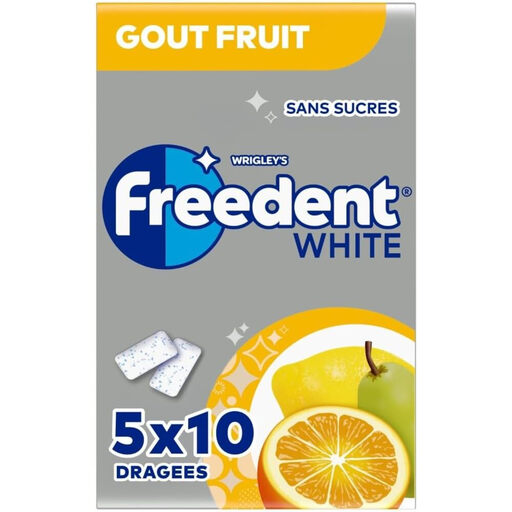 Image unavailable
FREEDENT Whitening fruit flavour, 5 × 10 pellets, 70 g
The five small packs make it easy to take one pack rather than the whole multipack, if occasional chewing gum is suitable for the intended use. This product is described as sugar-free. Read the ingredients and warnings on the packaging, particularly those about polyols and the presence of aspartame or soya lecithin. Separately, check that chewing gum is allowed at school and that your child is able to chew it.
View on Joybuy
Frequently asked questions
Does ‘sugar-free’ mean these pellets are suitable as a school snack?
No. The claim tells you about the product’s sugar content, not whether it can replace a snack. Manger Bouger recommends limiting sugary products for children and choosing minimally processed foods instead. Anses has not demonstrated any nutritional benefit of intense sweeteners for weight or blood sugar control.
Why do some pellets carry a warning about laxative effects?
Some contain polyols, and Freedent’s product information for the varieties concerned says that excessive consumption may have a laxative effect. Read the warning on the specific pack before deciding how much to take.
Should you check whether a product contains aspartame?
Yes, particularly if the warning ‘contains a source of phenylalanine’ is relevant to your child. Freedent includes this warning on some products. Carrefour’s product information for some Hollywood, Airwaves and CB12 varieties also lists aspartame. Always check the ingredients of the variety you buy.
How should you store a pack of pellets in a lunchbox?
Follow the storage instructions for the product you buy and keep its packaging so you can check the ingredients and warnings. Product information for some Freedent varieties says to store them in a dry place away from light.


