You’re looking for a “sugar-free” bar
The claim must match the amount stated per 100 g. EU rules set a maximum of 0.5 g of sugars per 100 g for this claim, so don’t rely on the look of the packaging alone.


If you’re looking for white chocolate that is “sugar-free”, check both this claim and the “of which sugars” line: EU rules reserve the claim for products containing no more than 0.5 g of sugars per 100 g. A bar labelled “no added sugars” or sweetened with sweeteners does not necessarily meet this criterion. To choose, also compare the ingredients, nutritional values and format that suit you.
The claim must match the amount stated per 100 g. EU rules set a maximum of 0.5 g of sugars per 100 g for this claim, so don’t rely on the look of the packaging alone.
Check the “of which sugars” line, even if the recipe uses sweeteners. Check the energy, fat and ingredients separately too: you can’t infer this information from the claim highlighted on the packaging.
Choose a format that suits how you’ll use it, and check the allergens and storage instructions. Don’t confuse a classic bar with a product carrying the “sugar-free” claim.
To compare “sugar-free” and “no added sugars” claims with a classic bar, start by checking the exact wording and the values given per 100 g. Then look at the ingredients and storage requirements for the product you’re considering.
| What matters to you | What to check | Who is it for? |
|---|---|---|
| Sugar content | Compare the exact claim with the “of which sugars” line per 100 g. For “sugar-free”, EU rules set a maximum of 0.5 g per 100 g. | If your priority is a bar that genuinely carries the “sugar-free” claim, a recipe that is simply sweetened with sweeteners isn’t enough to confirm this. Around 42% of consumers put this check first. |
| Nutritional information | Compare the energy, fat (including saturated fatty acids) and sugars on the same per-100 g basis. | When choosing between different recipes, you may want to look beyond a single claim about sugars. Around 33% of consumers make this overall comparison their priority. |
| Format and ingredients | Check the quantity, declared allergens and storage instructions for each product. | In a new home, how the bar will be stored and which ingredients matter to the people sharing it can help guide your choice. Around 25% of consumers prioritise these practical considerations. |
The product information for Torras White stevia published by Délices Low Carb lists 16 g of sugars per 100 g. This exceeds the EU maximum of 0.5 g per 100 g for the “sugar-free” claim.
Before choosing, compare the exact wording on the product with its “of which sugars” line.
You can’t compare a sweetened recipe with a classic bar simply by looking at whether it contains sweeteners. The product information from Délices Low Carb for Torras White stevia and from Carrefour France for Carrefour Classic’ lists 547 and 550 kcal per 100 g respectively; these values apply to those products only.
Compare the nutritional values per 100 g, then consider the portion you plan to use.
According to the French Ministry of the Economy, displaying the Nutri-Score is optional. Its absence alone doesn’t tell you whether a bar is a good choice.
Use the nutrition declaration and ingredients list to compare products.
The product information consulted for Milka Blanc, Carrefour Classic’ and Torras White stevia lists milk. Carrefour France also warns that its Classic’ product may contain traces of nuts and cereals containing gluten.
Check the allergens and sweeteners on the exact bar before sharing it or keeping several in the house.
Worth considering if you’re looking for a sweetened white chocolate recipe.
A useful point of comparison for a classic white chocolate bar.
Lindt France offers several white chocolate products to compare, depending on the recipe you’re looking for.
A supermarket own-brand option that lets you check the ingredients in a classic white chocolate bar.
This selection features a classic white chocolate block. If you’re looking for a claim about sugars, compare its label with your requirements.
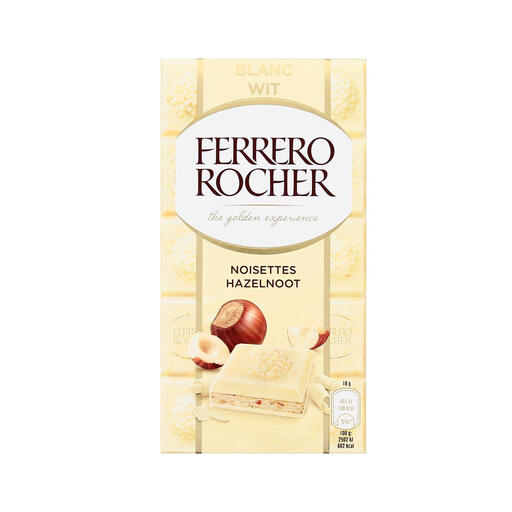 Image unavailable
A classic white chocolate format to consider if you’re not specifically looking for a bar carrying the “sugar-free” claim.
90 g block. Check the product label for its sugar content, allergens and storage instructions.
No. EU rules set a maximum of 0.5 g of sugars per 100 g of chocolate for the “sugar-free” claim. A different claim doesn’t mean you can skip checking the “of which sugars” line for the product you choose.
No. According to the French Ministry of the Economy, displaying the Nutri-Score is optional in France. To compare two bars, check their nutritional information per 100 g, even if one doesn’t display the logo.
No, it doesn’t apply to a white chocolate bar. The official French public finance bulletin describes a levy on non-alcoholic drinks; it isn’t a factor when choosing solid chocolate.
Follow the storage instructions for the product you’ve bought. The product information for Torras White stevia published by Délices Low Carb recommends storing it in a cool, dry place. Check the instructions for any other bar.
No. The product information for Torras White stevia published by Délices Low Carb lists milk. Check the allergens for the exact product, as the choice of sweeteners tells you nothing about its other ingredients.