For a strict gluten-free diet, choose a sugar-free mint only if you can verify that the specific product you’re buying is labelled ‘gluten-free’: ‘sugar-free’ does not meet this requirement. If the format is your main priority, compare boiled sweets, mints and chewing gum, then check the sweeteners, other ingredients and packaging warnings.
Who is this guide for?
People following a strict gluten-free diet
If you’re buying for someone with coeliac disease or another reason to avoid gluten strictly, an ingredients list that looks suitable is no substitute for a ‘gluten-free’ claim that applies to the product you’ve chosen.
People who prefer mint sweets
If you’d rather suck a mint than chew gum, compare the type of sweet, the sweeteners and the warnings for each specific product.
People who prefer chewing gum
If you’re looking for a piece of gum to chew, particularly after a meal, check the ingredients for the flavour and format you’ve chosen: these can vary within the same brand.
What should you check?
Start with the gluten-free requirement if it determines what you can buy. You can then compare the format and ingredients of products that meet this requirement.
| Criteria | What to check | Who it matters to |
|---|
| Strict gluten avoidance |
Look for a ‘gluten-free’ claim on the packaging or confirmation from the manufacturer for the product you’re buying. The ingredients list alone isn’t enough. |
If I need to avoid gluten strictly, I want to be able to confirm this before choosing a mint. Around 33% of consumers put this check first. |
| Boiled sweet |
Check the type of sweet, the ‘sugar-free’ claim and the sweeteners in the recipe. |
If I want a mint that dissolves in my mouth rather than one to chew, I first look for a format that suits me; around 27% of consumers prioritise this. |
| Mint chewing gum |
Compare the chewing-gum format, ingredients and details for the exact flavour. |
After a meal, I’d rather chew a piece of gum than suck a sweet. This is the main consideration for around 20% of consumers. |
| Polyols and other ingredients |
Read the sweetener list, the warning about excessive consumption and any details of other ingredients or traces. |
If I’m keeping an eye on polyols or another ingredient, I want to check the recipe before considering the format; around 20% of consumers make this their main criterion. |
Common misconceptions to avoid
-
Confusing ‘sugar-free’ with ‘gluten-free’
These claims refer to different things. So, just because a mint is labelled sugar-free doesn’t mean it’s suitable for someone who needs to avoid gluten strictly.
Before buying, check that the exact product is labelled ‘gluten-free’ on the pack, or confirm this with the manufacturer.
-
Overlooking polyols
Several sugar-free recipes from Mentos, Carrefour, Auchan and Hollywood use polyols. As the warning required under EU regulations explains, excessive consumption of products containing them may have a laxative effect.
Read the sweetener list and the warning on the pack, especially if you’re sensitive to these ingredients.
-
Assuming every recipe from a brand is the same
A Carrefour listing for Hollywood chewing gum mentions gelatine, while an Auchan listing for sugar-free Mentos sweets warns that they may contain traces of milk and soya. These details apply to different products.
Check the ingredients and trace warnings for the format and flavour you’re going to buy.
Brands to compare
These brands offer examples of different sugar-free formats and recipes. Their inclusion here doesn’t confirm that any specific product is labelled ‘gluten-free’.
Mentos
Depending on the product, the brand offers mint chewing gum and sugar-free menthol sweets.
- Mentos France states that Pure Fresh Spearmint chewing gum contains 0 g of sugars and 70 g of polyols per 100 g.
- An Auchan listing for sugar-free Mentos sweets warns that they may contain traces of milk and soya. Check separately for any gluten-free requirement.
Hollywood
Its sugar-free mint chewing gum comes in several recipes.
- An Auchan listing for a mint-flavoured product includes sorbitol, maltitols, xylitol and sucralose among its sweeteners.
- Another recipe described by Carrefour contains gelatine. Don’t assume the ingredients are the same across flavours, or that ‘sugar-free’ means gluten-free.
Carrefour
The brand offers sugar-free mint sweets in a 150 g bag.
- Carrefour’s product listing includes maltitols, steviol glycosides and natural mint flavourings.
- This ingredients list is not a substitute for a ‘gluten-free’ claim on the bag you choose.
Auchan
The brand offers sugar-free mint sweets in a 150 g pack.
- Auchan’s product listing includes maltitols, steviol glycosides, natural mint flavouring and menthol.
- It warns that the product may contain traces of milk. If you need to avoid gluten strictly, check for a claim that applies to this specific product.
Frisk
The Clean Breath product described by Auchan is a tin of sugar-free mint sweets.
- Auchan’s product listing states that it contains 0 g of sugars and 96 g of polyols per 100 g.
- These nutritional values don’t confirm whether the product is suitable for someone who needs to avoid gluten strictly.
A mint option on Joybuy
These sugar-free mints are worth considering if you prefer a sweet to suck. If you need to avoid gluten strictly, check that a ‘gluten-free’ claim applies to this specific product before choosing it: the listing says the production site may handle gluten.
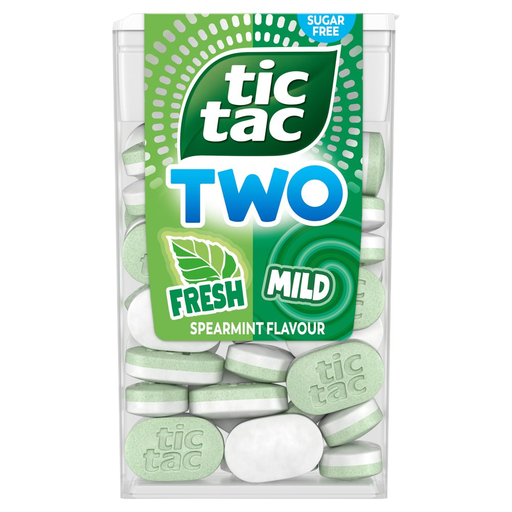 Image unavailable
TIC TAC Two Spearmint Fresh & Mild, sugar-free mints 38.5g
Worth considering if you prefer a mint to suck rather than chewing gum. The listing says the production site may handle gluten, so if you need to avoid gluten strictly, ask for confirmation that applies to this specific product before buying.
The listing also warns that excessive consumption may have a laxative effect and that small mints can pose a choking hazard, particularly for young children.
View on Joybuy
Frequently asked questions
Are sugar-free mints also gluten-free?
No: the two claims refer to different characteristics. If you need to avoid gluten strictly, look for a ‘gluten-free’ claim that applies to the product you’re buying, even if it contains no sugars.
What should you look for on a pack of mints when shopping gluten-free?
If you need to avoid gluten strictly, first check for a ‘gluten-free’ claim, then read the ingredients and allergen information for the exact product. The apparent absence of gluten-containing cereals from the ingredients list isn’t enough on its own to confirm this claim.
Why do some sugar-free products carry a warning about excessive consumption?
They may contain polyols, and the packaging may warn that excessive consumption can have a laxative effect. Check this warning and the sweetener list for the product you’ve chosen.


