What should you check?
When choosing a drink to make for Fête de la Musique, first decide whether you need a strict “sugar-free” option, want to control the recipe yourself or simply want something quick to prepare.
| What to consider |
What to check |
Who is it for? |
| “Sugar-free” threshold |
The “of which sugars” figure per 100 g for the product you’re buying; the threshold is 0.5 g per 100 g of powder. |
If I want to choose a powder that strictly meets the “sugar-free” claim, its name can’t replace its nutrition declaration. Around 42% of consumers rank this threshold as their top priority. |
| Control over the recipe |
The cocoa’s ingredients and preparation instructions, followed by anything added to the drink. |
If I want to make my own cocoa drink, I prefer to choose the liquid and adjust its sweetness, even if that means making the recipe rather than using an instant powder. Around 33% of consumers put this control first. |
| Quick preparation |
The preparation instructions and the powder’s sugar content, even when it carries a “less sugar” claim. |
When I need something simple to prepare, I may be happy with a powder that contains sugar, as long as I don’t confuse it with a “sugar-free” option. Convenience is the main priority for around 25% of consumers. |
Brands to compare by product
Recipes can vary within the same brand, so the figures below relate to the named products, not every powder sold under that brand.
Nestlé Dessert
Nestlé Dessert’s 250 g unsweetened cocoa powder is worth considering if you want to make a drink using cocoa.
- Auchan’s product page lists 0.4 g of sugars per 100 g, below the 0.5 g threshold for the “sugar-free” claim.
- The final sugar content of your drink depends on the milk and extras you choose; this figure applies only to the powder named here.
Nesquik
Moins de Sucres is an instant mix for making a cocoa drink.
- It suits shoppers looking for an instant mix, rather than pure cocoa powder to measure out as part of a recipe.
- Auchan’s product page lists 28.8 g of sugars per 100 g of powder, so this version does not meet the strict “sugar-free” criterion.
Poulain
Grand Arôme Moins de Sucres is a chocolate-flavoured powder whose name indicates a comparative reduction.
- The name helps you identify a recipe to compare with other chocolate-flavoured powders.
- Auchan’s product page lists sugar among the ingredients and 52 g of sugars per 100 g of powder. “Less sugar” does not mean “sugar-free”.
Équador (Marque Repère / E.Leclerc)
Équador’s 250 g unsweetened cocoa powder is designed for making your own cocoa drink.
- E.Leclerc’s product page lists cocoa powder and an acidity regulator, with no sugar in the ingredients list.
- It lists 0.9 g of sugars per 100 g, so this product exceeds the threshold for the “sugar-free” claim.
Carrefour
Carrefour’s range includes Carrefour Original and Carrefour Bio cocoa powders, as well as chocolate-flavoured powders from other brands.
- These categories let you compare cocoa powder with a chocolate-flavoured mix without treating them as the same thing.
- The supermarket or aisle name won’t tell you the sugar content: check the product page and packaging for each item.
A hot chocolate mix to consider on Joybuy
This selection features DAMTUH chocolate-flavoured drink sachets for making a drink at home. If “sugar-free” is essential, check the nutrition information and ingredients on the packaging of the variant you buy.
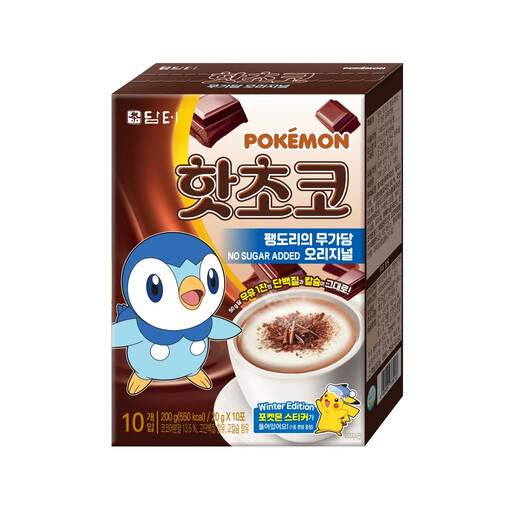 Image unavailable
DAMTUH Pokémon chocolate-flavoured drink, 10 sachets of 20 g
The sachets are handy if you want to make a drink without measuring powder out of a larger container. The product name specifies 10 sachets of 20 g. Before choosing it to meet a “sugar-free” requirement, check the “of which sugars” figure per 100 g on the packaging for this variant. If you need to avoid milk or soya, check the allergens listed on the packaging too.
View on Joybuy
Frequently asked questions
Do “sugar-free”, “unsweetened” and “less sugar” mean the same thing?
No. For a powder, the “sugar-free” claim means it meets the threshold of 0.5 g of sugars per 100 g set out in Regulation (EC) No 1924/2006. “Unsweetened” on its own does not prove that the threshold is met, while “less sugar” is a comparison: E.Leclerc and Auchan’s product pages list 0.9 g per 100 g for Équador unsweetened cocoa and 28.8 g per 100 g for Nesquik Moins de Sucres, respectively.
Does chocolate powder have to display Nutri-Score in France?
No. The French Ministry of Health explains that this front-of-pack label cannot be made compulsory under the European framework it refers to. To compare sugars in pre-packed foods, check the nutrition declaration instead. This is generally compulsory and, according to the Directorate-General for Competition Policy, Consumer Affairs and Fraud Control, is usually given per 100 g.
Does the soft drinks levy tell you which powder to choose?
No. It can’t help you assess the sugar content of a chocolate powder. The official French tax bulletin describes a levy on non-alcoholic drinks containing added sugars. To choose a dry powder, compare its ingredients and declared sugars per 100 g directly.
Will a “sugar-free” powder make a sugar-free drink?
Not necessarily. The “sugar-free” threshold for the powder alone doesn’t tell you the sugar content of the finished drink. Check the nutrition information for the milk or other drink you use, and take any extras into account too.


