For an after-school snack, pack food rather than sugar-free chewing gum. Manger Bouger recommends options such as bread, fruit, stewed fruit or a dairy product. Chewing gum should only be considered as an extra after eating, if your child can chew and spit it out and the after-school club allows it. The UFSBD mentions this use for children aged 7–11 when brushing is not possible, but does not present it as a substitute for brushing.
Who is this option for?
Parents of children who can chew and spit
You’re considering an occasional extra after a snack, not something to eat as a snack. The UFSBD mentions sugar-free chewing gum after eating for children aged 7–11 when brushing is not possible. You’ll also need to check that your child is able to use it safely and that the after-school club agrees.
Parents planning a food-based snack
You’re first looking for something for your child to eat during their break. Manger Bouger recommends varying snacks, with options such as bread, fruit, stewed fruit or a dairy product, rather than replacing food with something to chew.
Parents who check ingredients
You need to take any known allergy or dietary requirement into account. Ingredients and warnings vary between products, so check the sweeteners, polyols and allergens on the packaging of the product you choose.
What should you check before buying?
First, distinguish between food for a snack and chewing gum to use after eating. For the latter, the after-school club’s permission and your child’s ability to use it safely matter more than the flavour or pack size.
| What matters |
What to check |
Who should consider this? |
| Chewing and permission |
Ask whether the after-school club allows chewing gum, and make sure your child knows how to chew it and spit it out. The UFSBD advice is for children aged 7–11. |
If my child can’t yet spit it out reliably, or I don’t know the club’s rules, I need to clarify these points before buying. Around 42% of consumers put this first. |
| Use after a snack |
Choose a product labelled “sugar-free” only for use as an extra after eating, not as a replacement for a snack or brushing. |
If brushing isn’t possible after eating, I’m looking for something suitable as an extra for this purpose, not a snack. This is the top priority for around 25% of consumers. |
| Ingredients and warnings |
Read the ingredients list and warnings for the exact product variant, particularly if there’s a known allergy or dietary requirement. |
If a particular ingredient matters for my child, I want to check the formulation before choosing a flavour. Around 25% of consumers prioritise the ingredients. |
| Pack size and flavour |
Once you’ve checked that the product is suitable for your child, compare the number of pieces, net weight and flavour. |
For occasional use, I’d rather choose a pack size that lets me keep track of how much my child has than go straight for a large tub. Pack size or flavour is the top priority for around 8% of consumers. |
Common pitfalls to avoid
-
Thinking of chewing gum as a snack
Chewing gum doesn’t provide the nourishment of a snack. Manger Bouger recommends options such as bread, fruit, stewed fruit or a dairy product to add variety to this break.
Pack food first. Only consider chewing gum after your child has eaten, if it’s suitable for them and the after-school club allows it.
-
Choosing a large tub without reading the warnings
Hollywood and Stimorol products featured by Auchan warn that excessive consumption may have a laxative effect.
Check the warning on the product you buy, and make sure an adult supervises how much your child uses.
-
Assuming all sugar-free formulations are the same
Ingredients vary from one product to another. Products featured by Auchan and Carrefour show differences in sweeteners, and some formulations contain soya.
Check the label again if you switch brand, flavour or pack size, especially if your child has a dietary restriction.
-
Using chewing gum instead of brushing
The UFSBD describes sugar-free chewing gum as an extra after eating when brushing isn’t possible, and makes clear that it doesn’t replace brushing your teeth.
Keep up your child’s usual brushing routine, regardless of this occasional choice.
Brands to know
Hollywood
The range includes several sugar-free flavours and formulations. Check the ingredients for each individual product.
- In the “Blancheur 100% xylitol” product featured by Carrefour, xylitol accounts for 99.3% of the declared sweeteners.
- This product also lists other sweeteners. The fruit cocktail variant featured by Auchan carries a warning about excessive consumption and mentions a source of phenylalanine.
Freedent
The products reviewed include a 60-piece strawberry tub featured by Auchan and a Joybuy fruit multipack containing five packs of 10 pieces.
- These two pack formats make it easy to compare a tub with a multipack of smaller packs before choosing.
- The strawberry product featured by Auchan lists xylitol, sorbitol, mannitol, aspartame, acesulfame K and soya lecithin, among other ingredients. This list should not be attributed to the fruit multipack.
Stimorol
The sugar-free mint product featured by Auchan is sold as individual pieces.
- Its flavour and format make it easy to compare with other products.
- Its label mentions aspartame, a source of phenylalanine and a warning that excessive consumption may have a laxative effect.
A snack option on Joybuy
This selection is for a food-based snack to pack before considering any possible use of chewing gum; it does not include a product to chew.
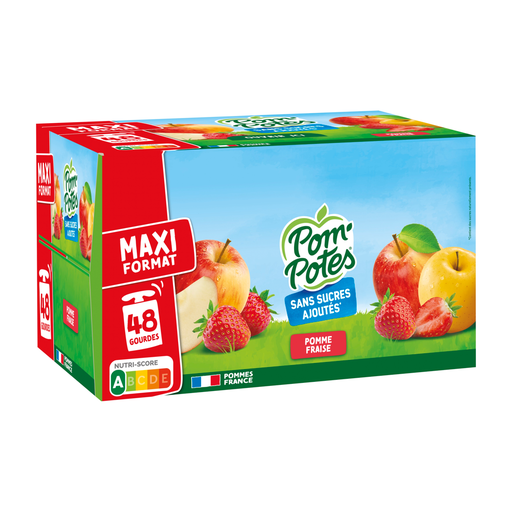 Image unavailable
POM’POTES Apple Strawberry No Added Sugar, 48 × 90 g
If you’re packing food for a snack rather than something to chew, this apple and strawberry product comes in a pack of 48, with each serving weighing 90 g. “No Added Sugar” in the product name doesn’t mean it contains no sugars.
View on Joybuy
Frequently asked questions
Can sugar-free chewing gum replace a snack at an after-school club?
No. For children, Manger Bouger recommends a varied snack that could include bread, fruit, stewed fruit or a dairy product. Chewing gum isn’t a substitute for food.
When should you consider sugar-free chewing gum after a snack?
In its advice for children aged 7–11, the UFSBD mentions chewing gum for 20 minutes after eating when brushing isn’t possible. At an after-school club, first make sure your child knows how to chew it and spit it out, and check that the club allows it. It doesn’t replace brushing.
What should you check if your child has an allergy or dietary restriction?
Read the ingredients list for the exact product and follow any dietary requirements that apply to your child. The Freedent strawberry product featured by Auchan lists soya lecithin; other products reviewed mention aspartame and a source of phenylalanine.
Does “sugar-free” mean you can have as much as you like?
No. Hollywood and Stimorol products featured by Auchan warn that excessive consumption may have a laxative effect. Check the information for the variant you choose, and supervise how much your child uses.


